Dogon — Creation Cycle
Dogon Creation Cycle: Amma, the Nommo and the Pale Fox
The Dogon of the Bandiagara Escarpment, Mali, West Africa
Dogon
The culture
The Dogon of the Bandiagara Escarpment, Mali, West Africa
Where
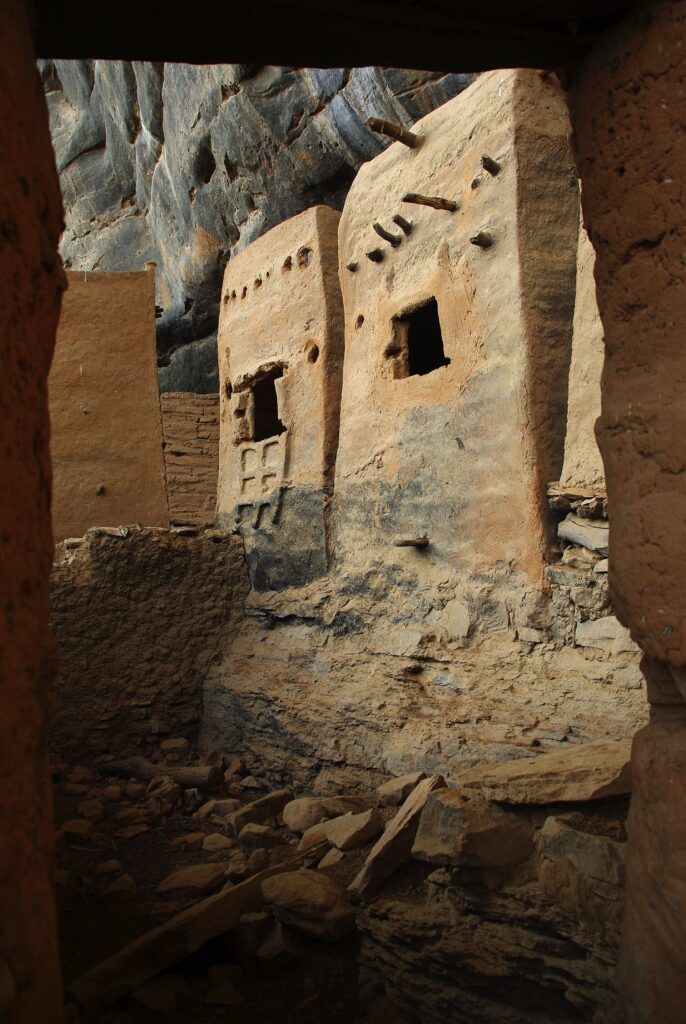
Bandiagara Cliffs, Sahel region, Mali, one of the most dramatic landscapes in Africa, cliff dwellings built into vertical sandstone escarpment
Time depth
A living tradition of the Bandiagara Escarpment, where the Dogon have lived for at least five centuries, after the Tellem before them.
Living tradition
Yes. Dogon priests (Hogon) continue to hold the sacred cosmological knowledge. The Sigui ceremony runs on a 60-year cycle and was last performed in 1967–1973.
Language
Dogon language (actually a family of closely related languages). Sacred cosmological knowledge held exclusively by Hogon priests and transmitted through initiation. The Sigui ceremony involves a special ritual language (sigi so) used only during that ceremony.
The world of its stories
Cosmological Structure
The universe was created by Amma (supreme deity) through a series of creative acts involving vibration, spinning, and cosmic egg. The Dogon cosmos also turns on the stars: sigi tolo, which they identified with Sirius, and po tolo, a small, heavy companion. The Nommo (primordial water beings) are the divine intermediaries who brought civilization, agriculture, and sacred knowledge to humanity. Time is organized in 60-year Sigui cycles, each cycle renewing the cosmic covenant between Dogon and the stars.
Creation
Amma took a lump of clay, squeezed it in his hand, and flung it, this became the Earth. His first attempt at union with the Earth was disrupted by the termite hill (the Earth's resistance). From this imperfect beginning came Yurugu (the Pale Fox), an incomplete being born of the failed creation, the force of disorder in the cosmos. Amma's second creation produced the Nommo, perfect water beings born as twins, embodying the ideal of paired complementarity. The Nommo descended to Earth on an ark, bringing with them the knowledge of agriculture, weaving, speech, and social organization.
Time
Cyclical, organized by astronomical observation. The 60-year Sigui cycle is the primary unit of sacred time. The Sigui ceremony renews the world, transfers sacred knowledge between generations, and honors the Nommo's covenant with the Dogon. Within the 60-year cycle are 8-year cycles and smaller divisions, tied to the star sigi tolo.
The Sacred
The stars are sacred. Initiates speak of po tolo, a small, very heavy star circling sigi tolo in about fifty years. Water is sacred as the medium of the Nommo. The number 8 (born of the 8 primordial ancestors) structures sacred knowledge.
Death / Afterlife
The dead become ancestors who continue to participate in the life of the community. The Dama ceremony (held 3-5 years after death) formally releases the deceased's spirit from the Earth and sends them to join the ancestors. Sigi masks perform at Dama ceremonies, representing the link between the living and the ancestral world.
Why Cyclical Architecture
The Dogon cosmological system is organized by astronomical cycles: the star cycles, the 60-year Sigui cycle, the 8-year agricultural cycles. Creation itself is cyclical: Amma's creative force vibrates and spins in circles and spirals. The Sigui ceremony renews the world by returning to the beginning of the cycle. Stories in this tradition track the movement through cosmic time toward the renewal point.
Structural Logic
Stories move through the phases of the cosmic cycle, from the initial creation/stirring through disruption (the Pale Fox), through the Nommo's intervention, through the work of restoration and organization, toward the renewal point where the cycle begins again richer. Resolution is renewal: the return to a beginning that now carries everything the cycle passed through.
Structural Movement
The cosmic beginning (Amma's first stirring) → the Pale Fox's disruption (incomplete creation generates disorder) → the Nommo's descent and sacrifice (divine intervention bringing order and knowledge) → the work of cosmic reorganization (establishing the patterns of agriculture, social life, astronomy) → the Sigui renewal (the cycle completes and begins again) → the eternal resonance (creation keeps vibrating)
Key figures
Supreme Being / Creator
Amma: the supreme deity who created the universe. Present everywhere, in everything. The source of the cosmic vibration (kize uzi) from which all things emerged.
Major Deities / Spirits
- Nommo: the primordial water beings, born as twin pairs. Embodiment of perfection, complementarity, and life force. They sacrificed themselves to give knowledge to humanity and were resurrected. Their ark brought civilization to Earth.
- Po Tolo: a sacred star, not a deity. In Dogon teaching it is the smallest and heaviest of the stars, of which it is said "it acts on all the other stars." They identified it with Sirius B; the identification is disputed.
- Yurugu (the Pale Fox): born incomplete from Amma's first failed creation. The principle of disorder. Runs through the cosmos leaving tracks that diviners read, the Pale Fox's footprints in the divination sand reveal what disorder is occurring and what must be done.
- Lebe: the first ancestor to die and be resurrected. His bones, swallowed by a Nommo and reconstituted, gave the Dogon their agricultural knowledge.
- The 8 Nommo Ancestors: the eight primordial ancestors (four male-female pairs) from whom all human social organization derives.
Trickster / Culture Hero
Yurugu (the Pale Fox), the cosmic disrupter. He is no Anansi-style trickster. Born incomplete, he generates disorder by his very existence. Paradoxically, his tracks in the divination sand are what allows diviners to read the state of the cosmos. Disorder makes knowledge possible.
Ancestor Figures
The 8 original Nommo ancestors are the foundation of all Dogon social structure. Lebe (the resurrected ancestor) governs agriculture. Dead community members are honored through the Dama ceremony and become part of the ancestral collective.
Who’s Who
Sacred elements
Sacred Objects
The Sigui mask (large wooden snake mask, passed between generations during the 60-year ceremony). Kanaga masks (cross-shaped, used in Dama ceremonies). Hogon's iron staff. Sacred granary architecture encoding cosmological knowledge in its proportions and divisions.
Sacred Places
The Bandiagara Escarpment, cliff dwellings and sacred caves. Specific sacred sites within the cliffs where cosmic events occurred in mythological time. The village granary as cosmological model. Divination fields where the Pale Fox's footprints are read.
Sacred Practices
Sigui ceremony: held every 60 years, renews the world, transfers sacred knowledge, honors the Nommo covenant. Dama ceremony, releases souls of the dead, involves masked performances. Fox divination (géru): diviners prepare a divination field, leave questions drawn in the sand overnight, and read the Pale Fox's footprints the next morning to understand what disorder is present and what is needed. The Hogon's role, chief spiritual authority, mediator between community and the ancestors.
Sacred Prohibitions
The Hogon must not touch the ground directly. He wears sandals and is always separated from the earth. Sacred cosmological knowledge is initiatory, not everyone is permitted to know everything. The Sigui ceremony and its language (sigi so) are accessible only to initiates. The granary's inner chambers are restricted.
How their stories are told
How Stories Are Told
Through the initiation system, deeper cosmological knowledge is transmitted at successive levels of initiation. The outer (giri so), inner (bolo so), and deep (so dayi) levels of knowledge are transmitted progressively. Public ceremonies (Sigui, Dama) transmit knowledge through performance, masked dance, and collective ritual. Diviners read the Pale Fox's tracks and narrate what they reveal.
Who Tells Them
Hogon priests for sacred cosmological knowledge. Diviners for fox divination readings. Initiated elders for ceremonial knowledge. Women participate in some ceremonies but the deepest astronomical knowledge is held by male initiates.
When They Are Told
During initiation ceremonies. During Sigui (60-year renewal). During Dama (death ceremony). During agricultural festivals tied to the star calendar.
The Purpose of Story
To maintain the Dogon's covenant with the Nommo and with Amma's ordering of the world. To organize human social life according to the cosmic pattern. To transmit astronomical knowledge that enables the community to understand their position in the universe and act accordingly.
Signature Story Types
Amma's creation (cosmic origin), the Nommo's descent and sacrifice (civilization origin), the Pale Fox's disruption (disorder cosmology), Lebe's resurrection (agricultural covenant), Sigui renewal narratives, fox divination readings.
How their stories are built, step by step
English translations of Dogon cosmological concepts, named in the StoryWorld with their cosmological significance
Amma's First Stirring (Stellar Genesis)
Cultural meaning
Before matter, before form. The first movement of the supreme creative force. Amma holds the universe in potential. The cosmic egg. The first vibration that will generate everything else.
Wisdom quote
"Amma made all things… he took a lump of clay, squeezed it in his hand and flung it from him.". Ogotemmêli, *Conversations with Ogotemmêli* (1948)
Cultural teaching
In Dogon cosmology, creation begins with a spinning movement. Amma rotates and the rotation generates the first forms. Sound (vibration, kize uzi) precedes matter. The Word is the creative force. Creation comes from potential, from the egg that holds everything.
Po Tolo Formation (Cosmic Structure)
Cultural meaning
Named for po tolo, in Dogon teaching the smallest, heaviest star, which organizes everything around it. The Po Tolo is the structural center of the Dogon cosmos, invisible to the naked eye, yet determining the movements of all other celestial bodies. In story terms: the hidden force that organizes everything.
In brief
In Dogon teaching, Po Tolo is the smallest and heaviest of the stars, the one on which all the others turn.
Cultural teaching
The Po Tolo's density (the smallest and heaviest) makes it the gravitational anchor of the system. This is the cosmological teaching: what is smallest and most invisible can be what organizes everything.
Nommo Descent (Divine Messengers)
Cultural meaning
The Nommo (primordial water beings born as perfect twin pairs) descend to bring civilization, agriculture, speech, and sacred knowledge to humanity. They sacrifice themselves (divided into parts, some eaten) to give their knowledge to humans. Through sacrifice, divine knowledge enters the human world.
Wisdom quote
"The Nommo divided his body among men to feed them…". Ogotemmêli, *Conversations with Ogotemmêli* (1948)
Cultural teaching
The Nommo are paired, male and female, always twins. This pairing (the principle of complementary pairs) is the foundation of all Dogon social organization, architecture, and cosmology. The granary has 8 chambers (for the 8 Nommo ancestors). The village is built in the shape of a human body (Nommo's body). The Nommo's sacrifice is total and generative, they give everything to give knowledge.
Cosmic Disruption (Disorder and Challenge)
Cultural meaning
Yurugu the Pale Fox (born from Amma's first incomplete creative act) runs through the cosmos introducing disorder. Yurugu is incomplete. He is not evil. His incompleteness generates disruption. Paradoxically, the tracks he leaves in his running are what diviners read, disorder makes knowledge visible.
In brief
But Amma's work was disrupted by Yurugu, the Pale Fox, who was born from Amma's failed attempt at creation.
Cultural teaching
Yurugu was born prematurely, he tore himself free from the cosmic egg before his creation was complete. He carries his placenta (the Earth) with him in his wandering, endlessly seeking what he was separated from at birth. His disruption is the disruption of incompleteness, of something that was never fully formed. This gives the disruption a pathos that pure evil could not have.
Cosmic Reorganization (New Order)
Cultural meaning
After Yurugu's disruption, Amma sends the Nommo to reorganize creation. They establish the proper patterns: agricultural calendars, social structures, the sacred geometry of the granary and village. The new order is richer than the original because it has incorporated the Pale Fox's disruption.
In brief
Amma then decided to create beings who would restore order to his creation, teaching them the proper way to organize the world.
Cultural teaching
The Dogon village, granary, and social organization are all understood as direct reflections of the cosmic pattern the Nommo established. The Hogon's role is to maintain this pattern, to keep the earthly reflection aligned with the cosmic original. When the pattern is violated, ceremony restores it.
Sigui Cycle (Renewal and Remembrance)
Cultural meaning
Every 60 years, the Sigui ceremony renews the world, restores the covenant between Dogon and Nommo, transfers sacred knowledge to the next generation, and returns the cycle to its beginning. The renewal is not repetition. It is the completion of one cycle and the initialization of the next, each one richer for what the previous cycle accumulated.
In brief
Every sixty years, the Sigui ceremony renews the world and passes the sacred knowledge to the next generation.
Cultural teaching
The Sigui ceremony uses a special language (sigi so) spoken only during the 60-year ceremony. The great Sigui mask (a large wooden snake mask) is passed from the previous generation and eventually buried with the last surviving initiate of the cycle. The ceremony physically enacts the transfer of cosmic knowledge between generations.
Eternal Resonance (Ongoing Creation)
Cultural meaning
Creation does not stop. Amma's vibration (kize uzi) continues through all things. Every being adds its voice to the cosmic conversation. The universe is alive, intelligent, and participatory. The Dogon community's ceremonies, knowledge, and way of life are their contribution to the ongoing creation.
In brief
The word of Amma continues to vibrate through all creation, each being adding their voice to the cosmic conversation.
Cultural teaching
For the Dogon the cosmos is still being made, and it needs human ceremony, knowledge and right relationship to keep going. Without the Sigui ceremony, the world does not renew properly. Human ritual participation is cosmologically necessary.
What makes this tradition distinct
What makes this tradition distinct from all others
The Dogon tradition is unique in its integration of precise astronomical observation with sacred cosmology. The house, the field, the granary, the village, the woven cloth and the spoken word are all organized as images of the cosmos, a world recorded in architecture and ritual. The Pale Fox divination system (reading footprints to understand cosmic disorder) is unique in world mythology. The concept of sacred twinning (everything comes in complementary pairs) as the structural principle of the cosmos (village, body, granary, social organization) is architecturally expressed in a way found nowhere else.
Cultural warnings — what NOT to do
Do not reduce Dogon cosmology to the Sirius controversy: the record holds far more: Amma, the Nommo, the Pale Fox, the Sigui, and a world built as an image of the cosmos. Do not separate Yurugu from sympathy. He is incomplete, not evil, and his disruption is a tragedy as much as a problem. Let the story cycle through its cosmic phases, as Dogon stories do. Do not treat the Sigui as exotic ritual. It is a knowledge transfer system of extraordinary sophistication.
The stories
Each story with its source, where to read it and why it fits.
The StoryWorld in Full
What makes this tradition distinct
The Dogon tradition is unique in its integration of precise astronomical observation with sacred cosmology. The knowledge of Sirius B (Po Tolo) — its density, its orbital period, its invisible presence organizing visible things — represents a knowledge system that Western science could not explain until the 20th century. The Pale Fox divination system (reading footprints to understand cosmic disorder) is unique in world mythology. The concept of sacred twinning (everything comes in complementary pairs) as the structural principle of the cosmos — village, body, granary, social organization — is architecturally expressed in a way found nowhere else.