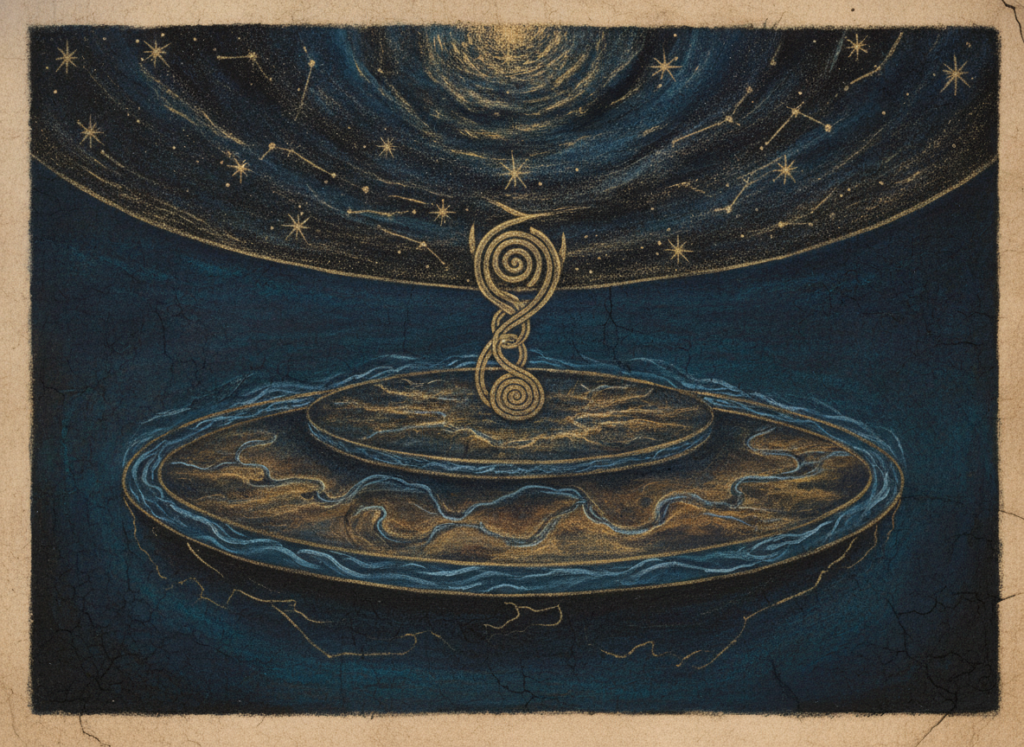
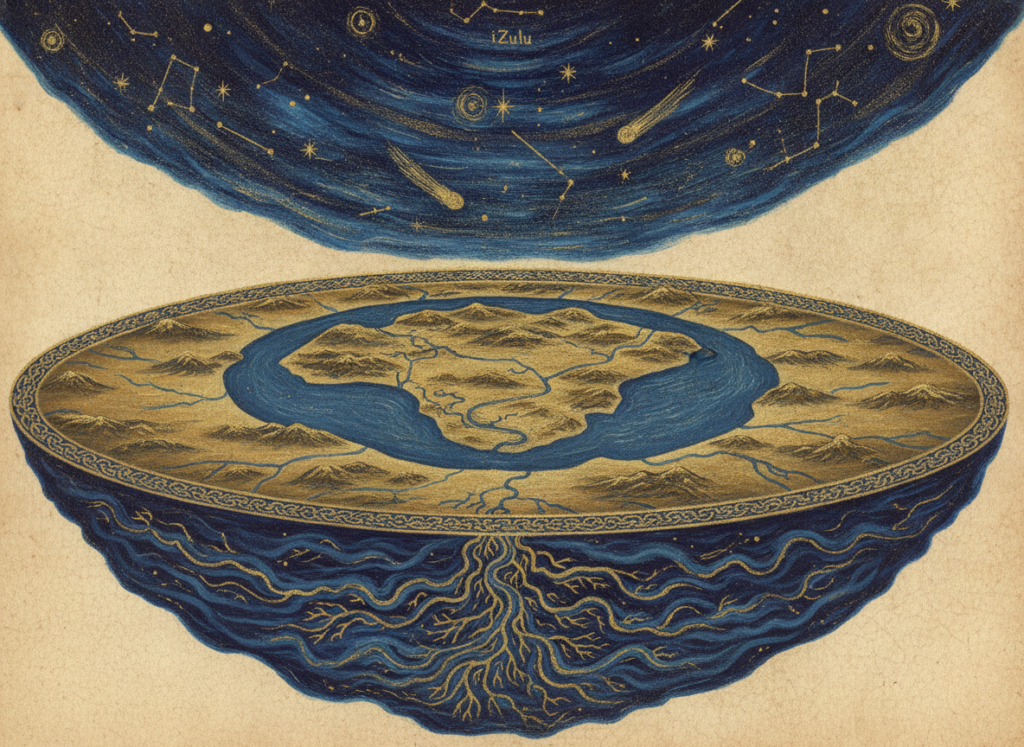
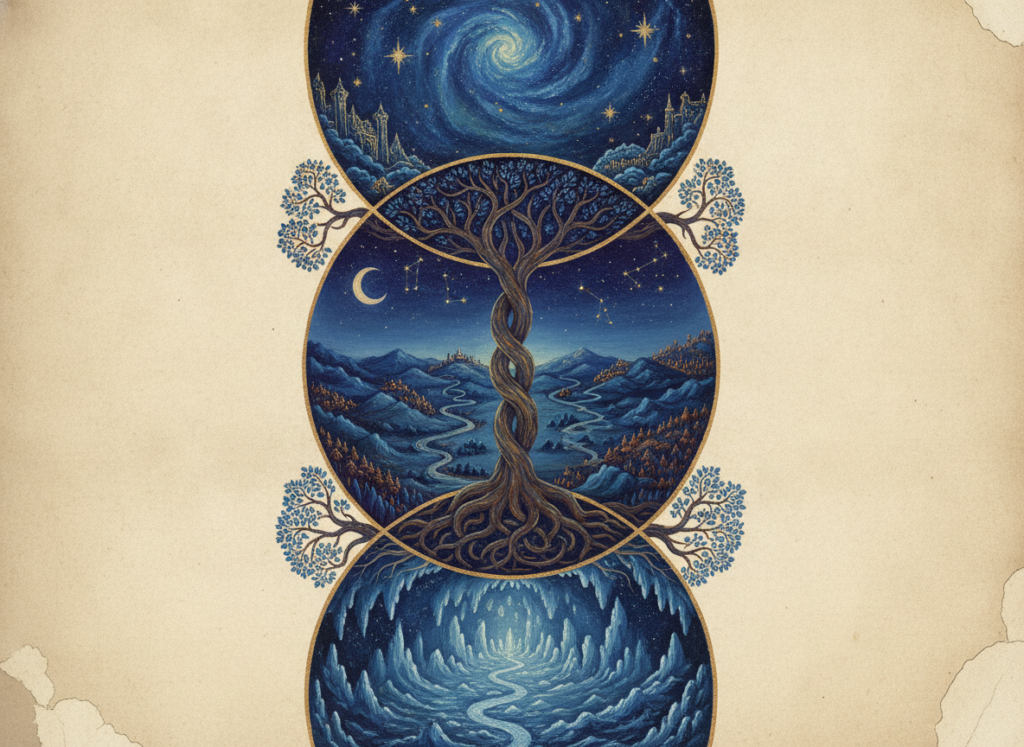
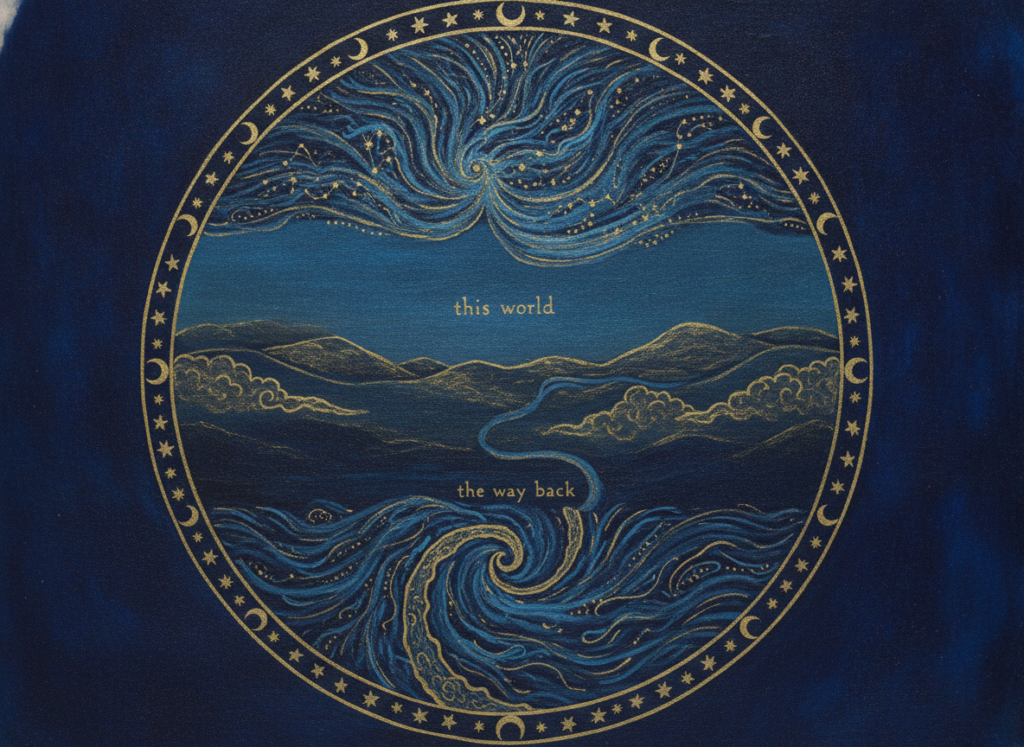
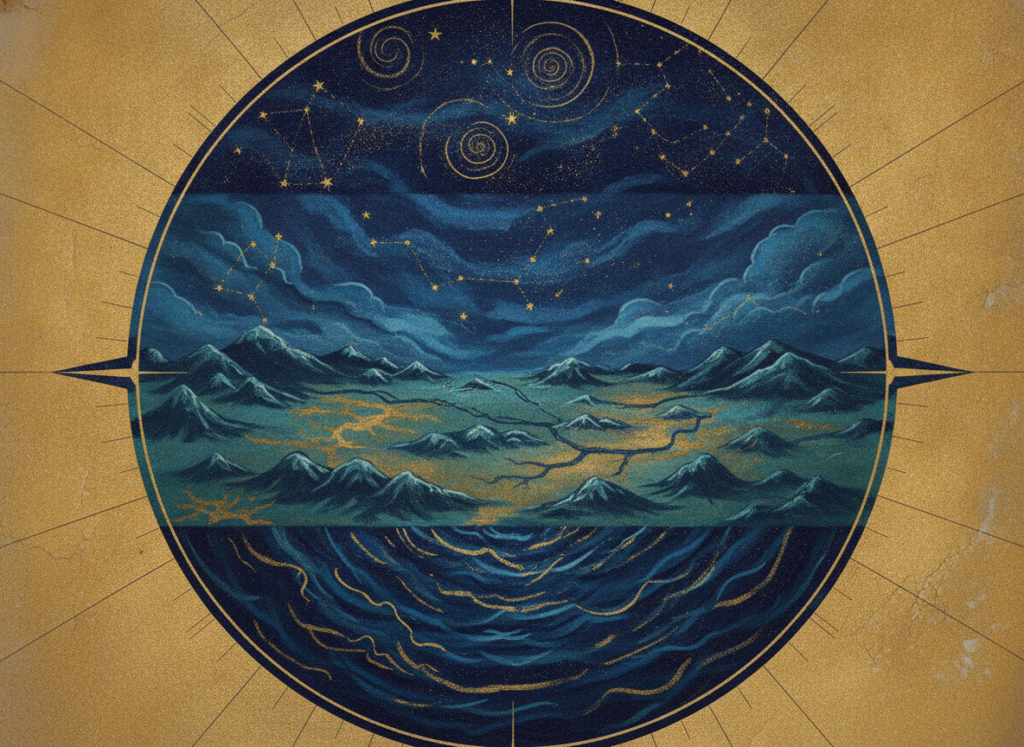
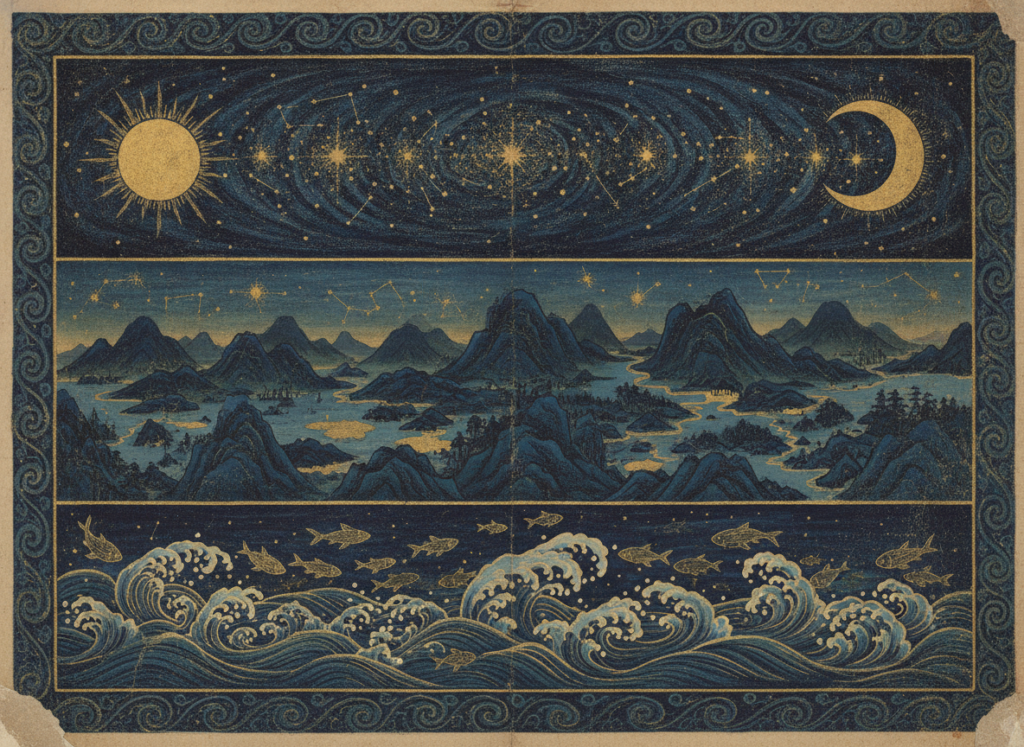
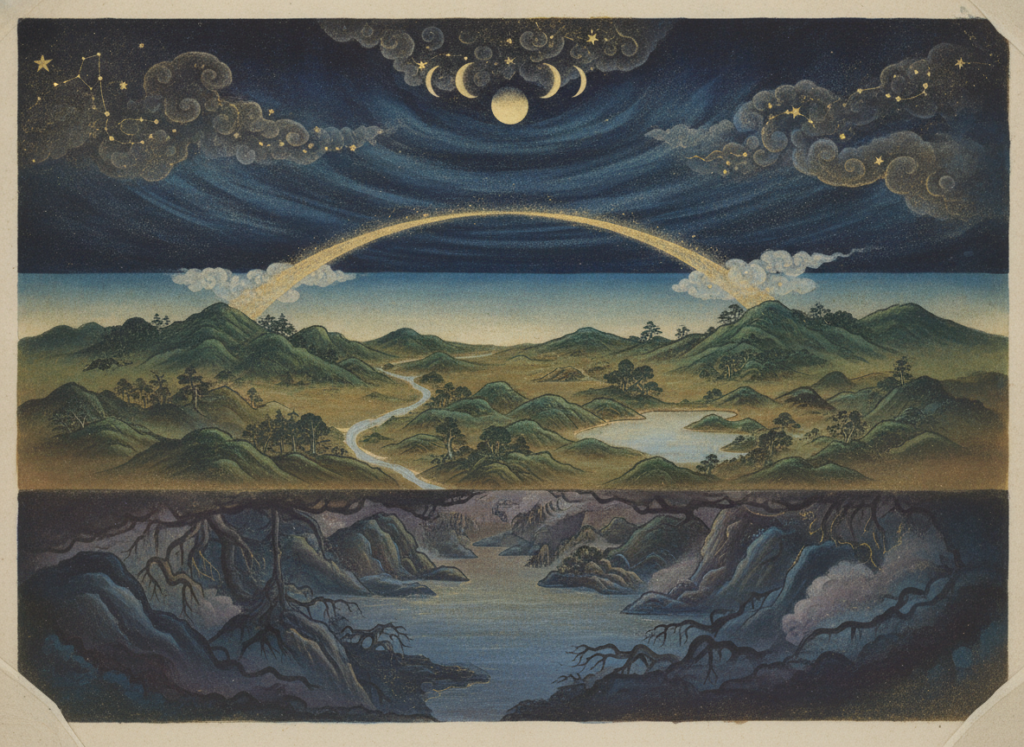
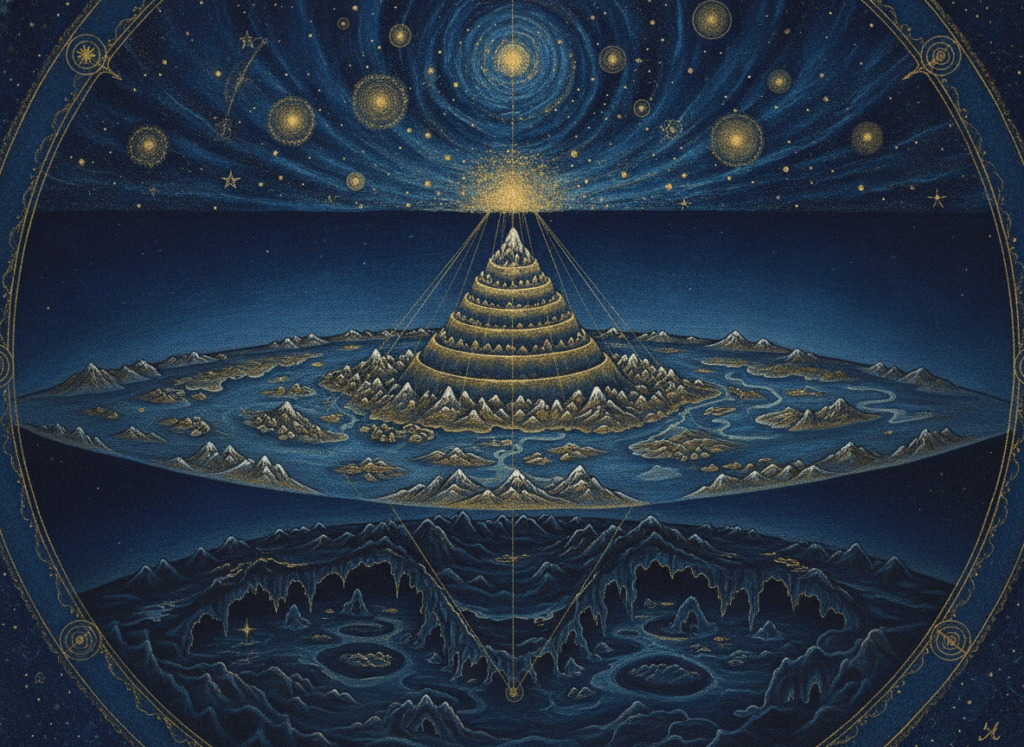
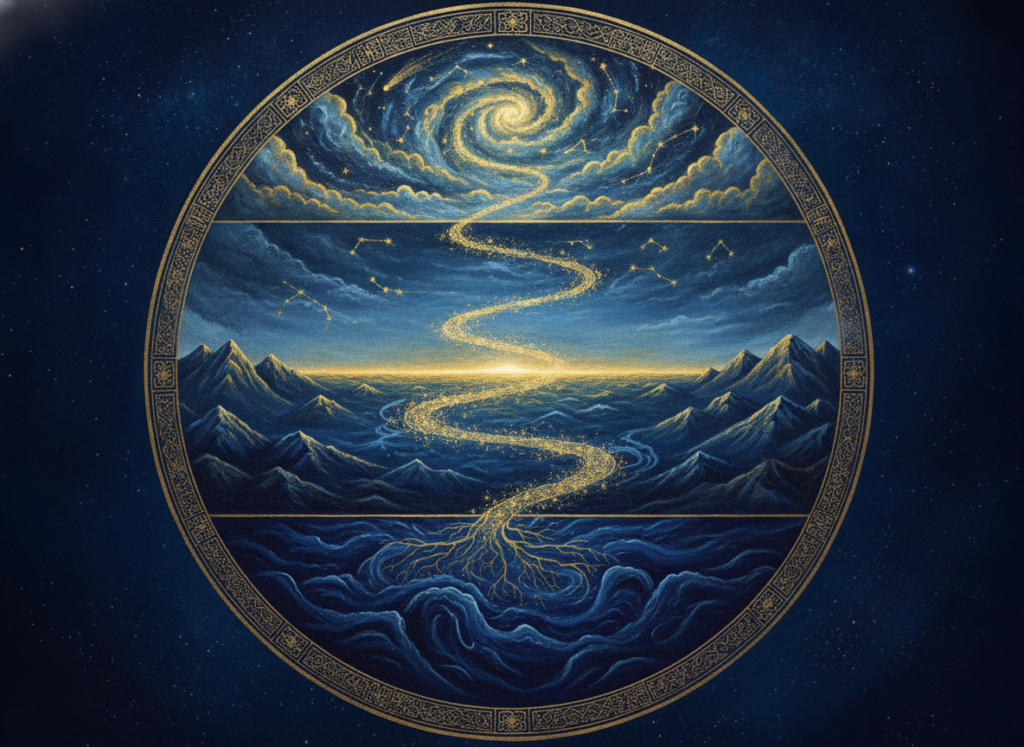
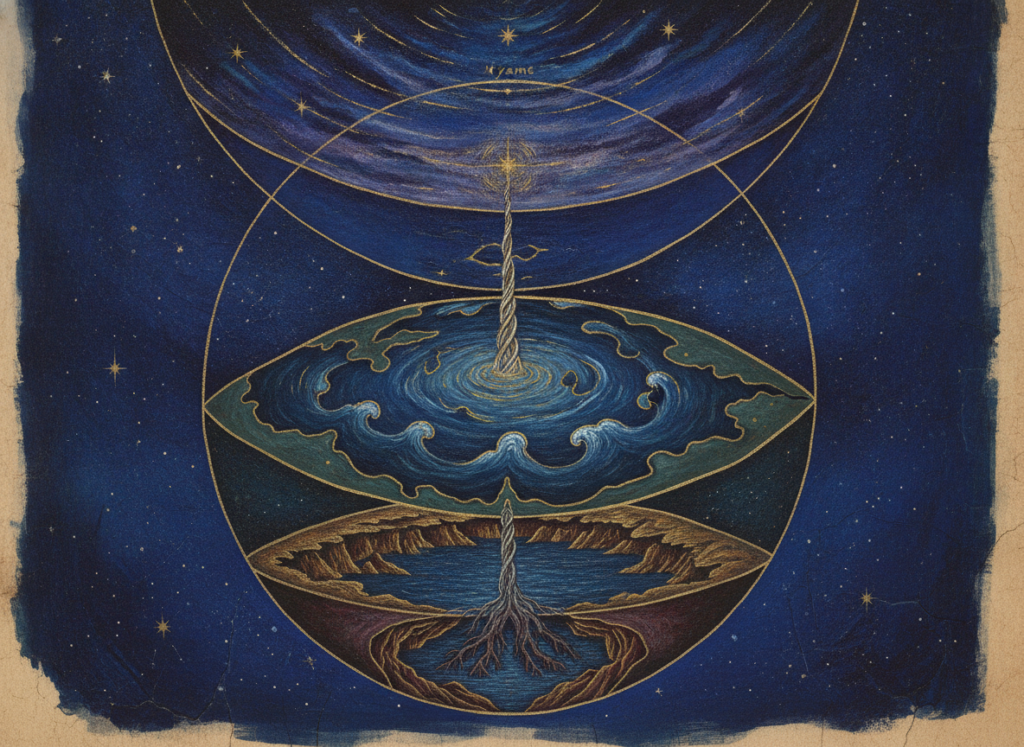
Every culture built its world in its own shape, and every WC StoryWorld carries that world: a sky above, an earth, a world below, waters, a tree or a mountain or a road that joins them, or a circle of four quarters. Each sky here is drawn from its StoryWorld’s own account of how its people see their world, with how that world keeps time.
Open a sky to enter its StoryWorld.
Africa
AI imageAfrica
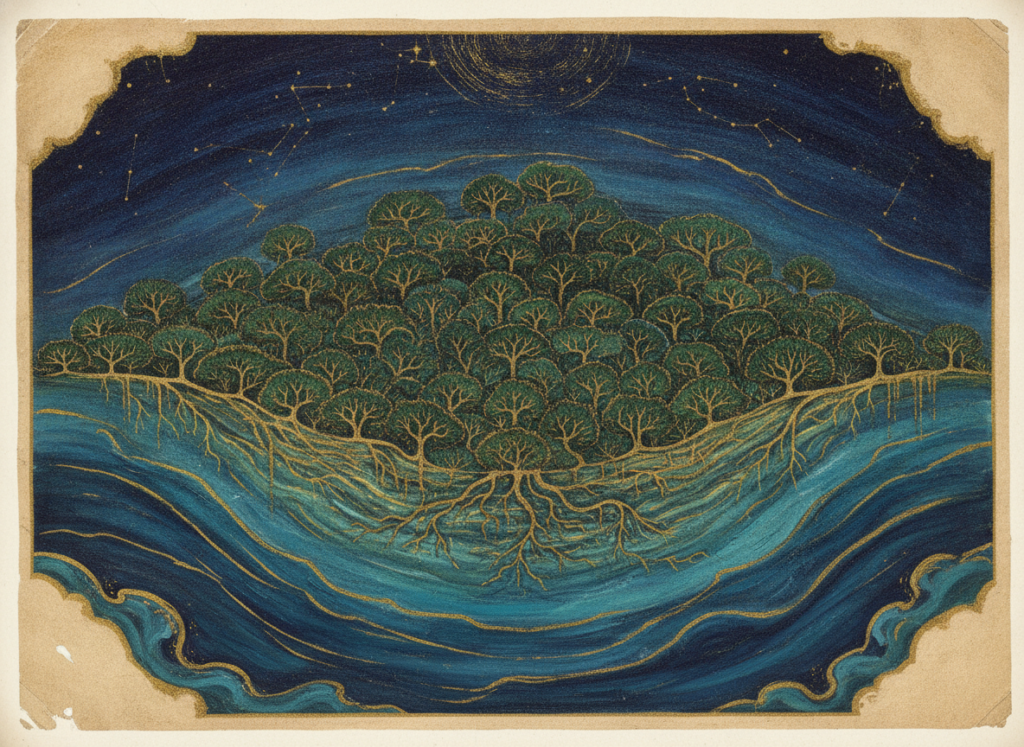
Akan — Anansi Web
Its cosmos. The Akan world holds together through the abusua, the mother's line: identity, inheritance and authority flow through it. The queen mother (Ohemmaa) holds equal or greater power than the chief in many contexts. Society is maintained through proper relationships between the Ohemmaa, the council of elders (Okyeame), and the community. The Akan universe has a sky deity above and an earth deity below, and Anansi, Kweku Anansi, son of both, mediating between them.
Its time. Cyclical: organized by the Akan calendar of festivals, planting and harvest cycles, and the rotation of political leadership. The abusua system means that power passes matrilineally through time, the community is always connected to its past through the maternal line.
Its cosmos. The forest itself is the living, conscious, benevolent whole: often addressed as father, mother, friend, and provider. The forest is a living being in relationship with the people. All life is held within it, and right relationship with the forest is the ground of everything. Harmony between the people and the forest is the natural state; when it is disturbed, it must be restored through negotiation and song.
Its time. Relational and restorative, time turns through the maintenance and restoration of right relationship with the forest. When things go wrong (sickness, death, poor hunting, discord), it is understood that the forest may be "sleeping" or that the relationship has been disturbed, and the work is to wake the forest and restore harmony through the molimo.
Its cosmos. The universe was created by Amma (supreme deity) through a series of creative acts involving vibration, spinning, and cosmic egg. The Dogon cosmos also turns on the stars: sigi tolo, which they identified with Sirius, and po tolo, a small, heavy companion. The Nommo (primordial water beings) are the divine intermediaries who brought civilization, agriculture, and sacred knowledge to humanity. Time is organized in 60-year Sigui cycles, each cycle renewing the cosmic covenant between Dogon and the stars.
Its time. Cyclical, organized by astronomical observation. The 60-year Sigui cycle is the primary unit of sacred time. The Sigui ceremony renews the world, transfers sacred knowledge between generations, and honors the Nommo's covenant with the Dogon. Within the 60-year cycle are 8-year cycles and smaller divisions, tied to the star sigi tolo.
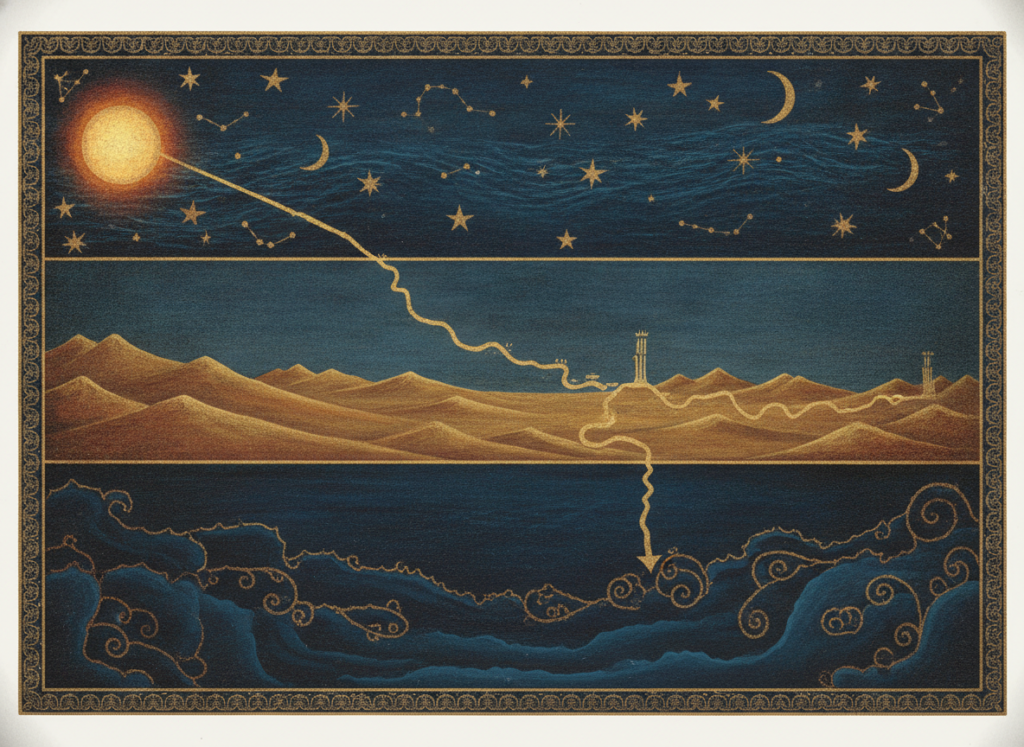
Its cosmos. The universe is maintained by Ma'at: the cosmic principle of truth, justice, order, harmony, balance, and morality. Ma'at is simultaneously a goddess (depicted with an ostrich feather on her head), a moral code (the 42 Negative Confessions), and the fundamental law of reality. The universe exists in a constant tension between Ma'at (order, right relationship) and Isfet (chaos, dissolution, entropy). Every human action either sustains Ma'at or feeds Isfet. The pharaoh's primary duty is to maintain Ma'at on Earth.
Its time. Cyclical, organized by Ra's daily crossing of the sky (day) and the underworld (night). The Nile's annual flood cycle. The agricultural calendar. The pharaoh's reign as a cyclical unit, each reign began with the restoration of Ma'at and was measured by how well Ma'at was maintained.
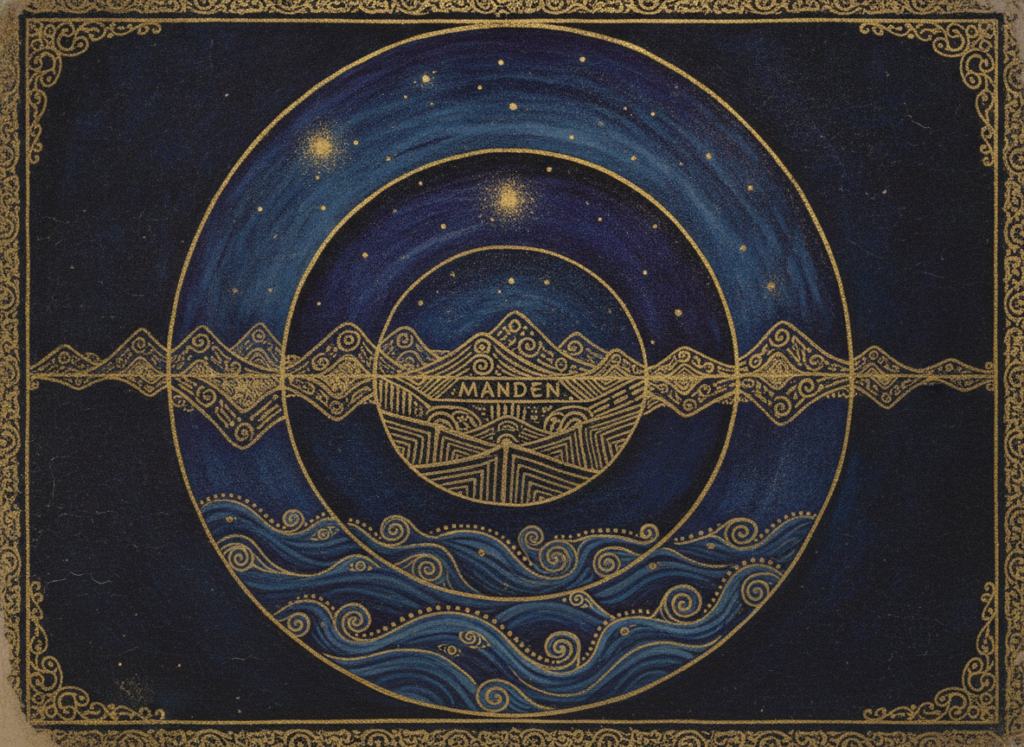
Its cosmos. The Mandé world is governed by nyama (sacred life force/energy) and organized by a social hierarchy in which the horon (freeborn nobles), nyamakala (specialist castes: griots, blacksmiths, leatherworkers), and jon (captives) each have their roles. Heroism in the Mandé tradition means fulfilling one's destiny in service to the community. The Manden Charter, proclaimed after Sundiata's victory, establishes the moral universe that the political victory made possible.
Its time. Historical-mythological time. The epic exists in a time that is both historical (specific dates, places, rulers) and mythological (the characters are larger than life, their mothers prophesied, their powers are supernatural). The griots hold this time: the epic lives again in each performance.
Its cosmos. Three worlds: Orun (spirit world/heaven above), Aiye (earth/living world), and the world of the Egungun ancestors. 401+ Orisha govern every aspect of existence. Each person carries Ori: their personal divine essence/chosen destiny. The universe is organized by Ashe: the divine power flowing through all things that makes ritual effective.
Its time. Cyclical. Each person's Ori (destiny) is chosen before birth and can be modified through ritual. Reincarnation within family lines. Ancestors return through new births. Ifá divination reveals what is written in destiny and what can be changed through right action.
Its cosmos. The universe is relational: everything exists in and through relationship. The individual person is not a pre-existing unit who then enters into relationships; the person is constituted by their relationships. "I am because we are" (the Nguni formulation of ubuntu). The community is the source and substance of the individual. This is not metaphorical: it is ontological.
Its time. Relational time: organized by the community's cycles of gathering, separation, grief, celebration, and renewal. The indaba (community council) is the primary time unit: when the community gathers, it occupies sacred time. The ancestor's relationship to the living community is ongoing: the dead do not leave the web, they occupy a different position within it.
Its cosmos. A cosmos of nine worlds held by the great ash Yggdrasil, presided over by the gods (the Æsir and Vanir) but governed, beneath even the gods, by wyrd, the fate that not even the gods escape. The world moves toward Ragnarök, the fated doom of the gods. Within this fated cosmos, human life is the working-out of deeds and their consequences toward a destiny already set, faced with courage and honour.
Its time. Linear and fated, the working-out of destiny toward its appointed end. Wyrd (fate) is set by the Norns; deeds unfold in sequence toward the consequences and the destiny already set. Time moves toward Ragnarök for the gods, and toward the fated end of each life for mortals. The saga follows the chain of deed and consequence to its set end.
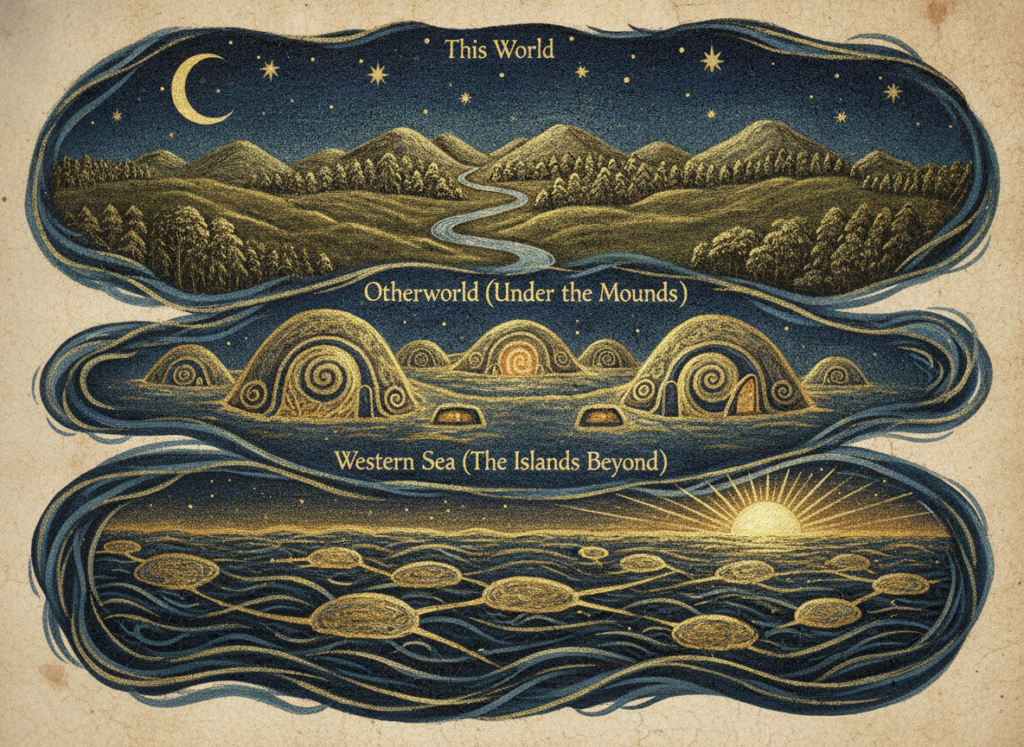
Its cosmos. A world the Otherworld runs through: the country of the sí (the fairy folk, the Tuatha Dé Danann), reached through mounds, mists and wells and at the turning of the seasons, and never far from the human world. The Celtic sense of time and story is spiral: motifs and voyages come back at deeper levels, and the Otherworld and the human world circle each other. The spiral (a pervasive Celtic art motif) expresses this deepening return.
Its time. Spiral: the seasons turn through their festivals (Samhain, Imbolc, Beltane, Lughnasadh), and each return comes round changed. Time spirals: the story returns to its motifs and places, each time deeper, the pattern recognized anew.
Its cosmos. A cosmos of divine unity (tawhid): all existence flows from and returns to the one God. The material world is a veil and a mirror; behind every form is the divine reality. The human soul is a spark separated from its divine source, yearning to return. The Sufi path (tariqa) is the journey of return, the ascent of the soul back toward union with the Beloved.
Its time. Spiral ascent: the seeker returns again and again to the same longing, the same turning toward God, each return at a higher station (maqam) of the soul. The whirling of the Sema embodies this: turning and turning, always around the same center, ascending. Time in the mystical sense is the soul's spiraling journey home.
Its cosmos. A three-tiered cosmos: the heavens (An), the earth and its cities, and the underworld (Kur / Irkalla), the "land of no return." The great gods, An (sky), Enlil (air, king of the gods), Enki/Ea (wisdom, fresh water), Inanna/Ishtar (love and war), govern the cosmos and the fates of cities and kings. Humanity was made to serve the gods; the boundary between mortal and divine is the tradition's central preoccupation.
Its time. Not cyclical in the seasonal sense so much as marked by the rise and fall of cities and kings, and by the absolute boundary of death. The great question is what endures: and the answer the tradition reaches, hard-won, is that walls, works, and stories endure while the individual does not. Time is the setting against which mortality is measured.
Its cosmos. The Dao (the Way): the ineffable source and pattern of all things, which cannot be named or grasped but only harmonized with. All things arise from the Dao and return to it. The cosmos is a spontaneous, self-generating flow; there is no cosmic conflict of good against evil, only the ceaseless transformation of things (wu hua) and the possibility of moving with or against the flow.
Its time. Cyclical transformation without fixed direction: things arise, change, and return; life becomes death becomes life in the great flux. Zhuangzi's serenity in the face of death comes from seeing it as one more transformation in an endless flow, no more to be feared than the turn of the seasons.
Its cosmos. A layered cosmos: Takamagahara (the High Plain of Heaven, home of the heavenly kami), the Nakatsukuni (the Central Land, the earthly world of Japan), and Yomi (the land of the dead) and Ne-no-kuni (the root-land). The kami (the sacred powers, gods, spirits, and forces present in nature, ancestors, and remarkable things) pervade all. The sacred is immanent, everywhere, in the mountain, the waterfall, the ancient tree, the emperor's line.
Its time. Cyclical and renewing, the seasons, the festivals, the perpetual renewal of purity through misogi (purification). The great shrine of Ise is ritually rebuilt every twenty years, an act of eternal renewal that embodies the Shinto sense of time: the sacred perpetually made new. The cave of Amaterasu, the sun withdrawing and being drawn back, is the mythic model of death-and-return that structures the cosmos.
Its cosmos. A cosmos ordered by dharma: cosmic and moral law, the right ordering of duty, righteousness, and the way things should be. Above and within the human drama move the gods (devas), avatars (especially Krishna, an incarnation of Vishnu), and the vast machinery of karma (action and its consequence) and rebirth (samsara). The four aims of life: dharma (duty), artha (prosperity), kama (desire), and moksha (liberation), frame human existence. The ultimate goal is moksha: release from the cycle of rebirth.
Its time. Cyclical across cosmic ages (yugas) and karmic across lifetimes, action in one life shapes the next; the wheel of samsara turns until liberation. Within the epic, time is the unfolding of consequence: choices made early return as fate, and the war is the harvest of long-sown karma.
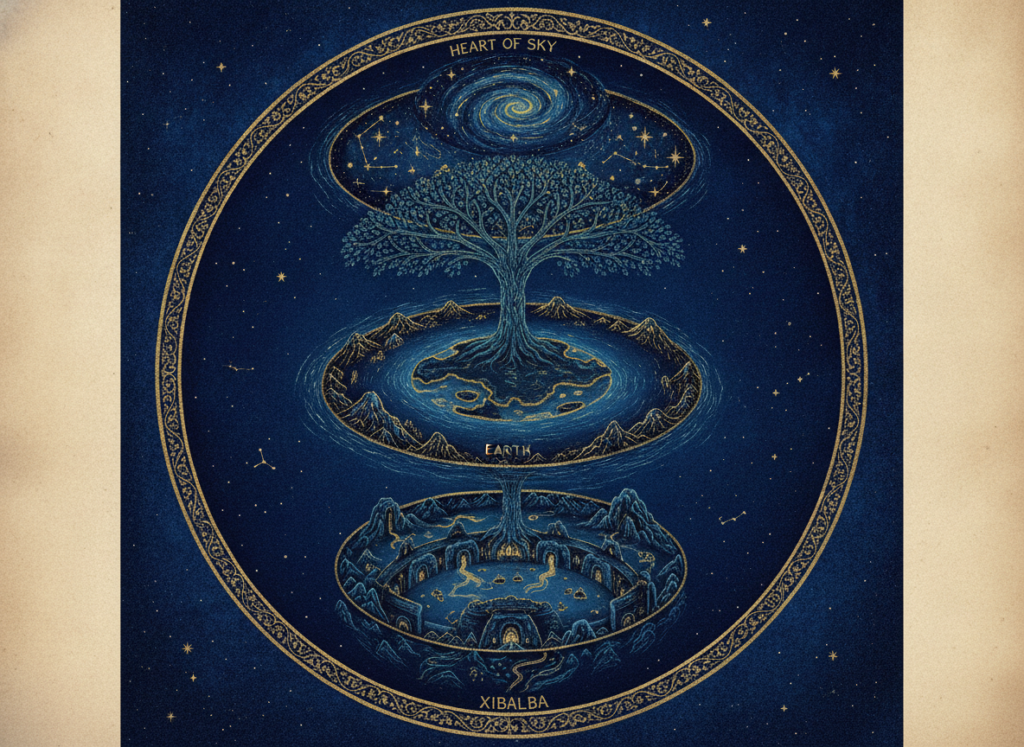
Its cosmos. A layered cosmos: the sky above, the earth, and Xibalba, the underworld (the "place of fright"), realm of the Lords of Death. These are connected; the boundary is permeable, crossed by the ballgame court, the ceiba tree, and the paths of the dead. The world has been made and unmade several times; the gods sought beings who could speak and honor them, trying mud, then wood, before succeeding with people of maize.
Its time. Cyclical across world-ages and structured by the sacred calendar; but the Hero Twins' narrative is a great linear-cyclical arc of descent, trial, death, and rebirth. Time turns through cycles of creation and destruction, and through the ballgame's ritual cycle of death and renewal. The defeat of death by the Twins establishes the pattern by which life renews.
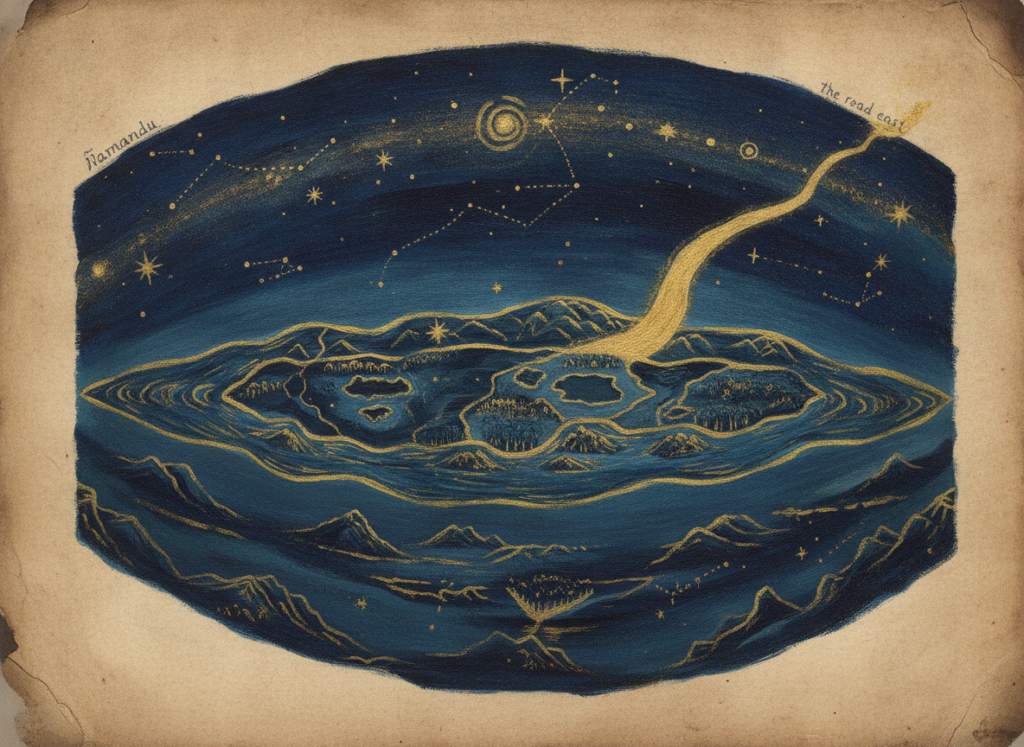
Its cosmos. A layered cosmos beneath the creator Ñamandu (Ñande Ru, "Our Father"), who arose from primordial darkness and created the world through sacred song and the beautiful words. The earth is imperfect, marked by evil (imperfection, violence, death), while Yvy Marã E'ỹ (the Land Without Evil, the Land Without Imperfection) exists as a real place, reachable, where death and suffering do not enter. The whole cosmos is oriented toward this perfect land, often placed to the east (toward the rising sun and the sea) or above.
Its time. Time points at the destination: it is the people's movement across the land toward Yvy Marã E'ỹ, the perfect place. There is an awareness of world-cycles and destructions (the world has been destroyed by flood and fire and may be again), but the deepest temporal orientation is the pilgrimage toward the Land Without Evil, a movement through geography toward a sacred goal.
Its cosmos. A world held together by balance and reciprocity. Social rank has to be balanced by reciprocity (ayni), and human society has to be balanced by its relationship with Pachamama, Mother Earth. The natural world and the social world are one: an earthquake and a revolution are both pachakuti, and environmental crisis and political upheaval come from the same imbalance.
Its time. Cyclical. Time turns over at intervals. Any order slowly builds up imbalance, the imbalance forces an overturning, and a new order emerges and starts building up its own imbalance. What was up goes down and what was hidden comes into view. The cycle repeats without end.
Its cosmos. A world within the four sacred mountains, established through the emergence: the ancestors climbed up through a series of lower worlds into this one, the Glittering World. The cosmos is held in balance between complementary forces, and the central organizing principle is Hózhó: a rich concept encompassing beauty, harmony, balance, order, health, and rightness, the state in which all things are in their proper relationship. Its complement is hóchxǫ' (disorder, ugliness, imbalance). Life is the continual restoration and maintenance of Hózhó.
Its time. Cyclical and balanced: the turning of the day and the seasons, the movement from Hózhó through disorder and back to restored Hózhó. Time is understood through the restoration of balance: things fall into disorder and are ceremonially restored to Hózhó, again and again. The Blessingway is often performed to keep Hózhó in good times as well as to restore it after trouble.
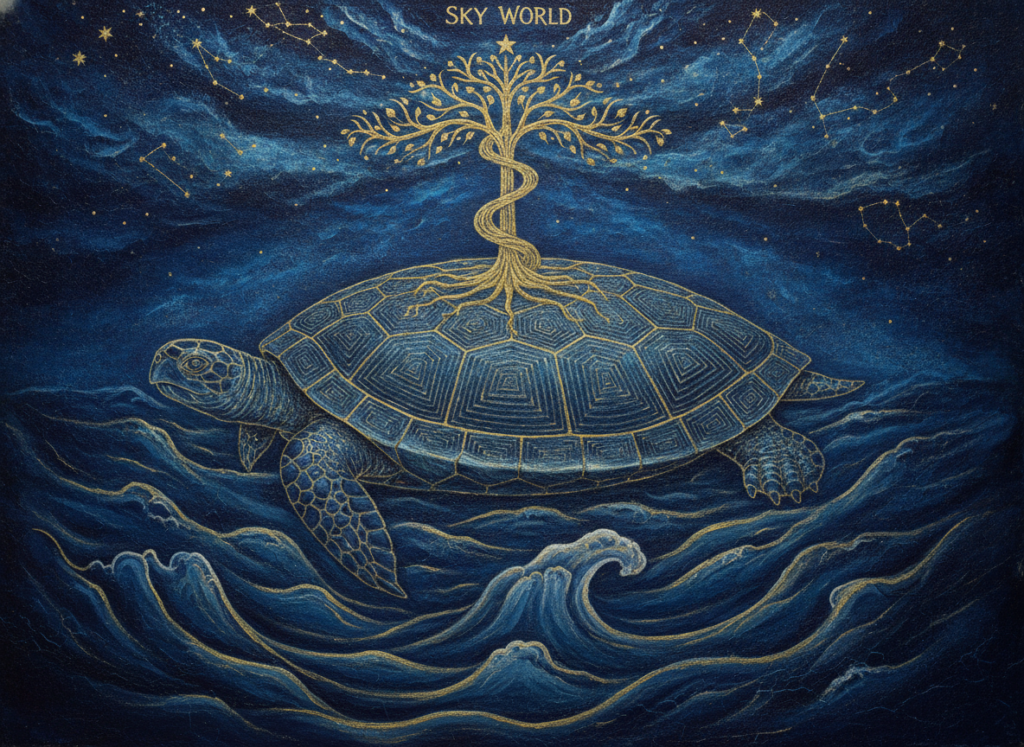
Its cosmos. A world understood as a web of relations: all beings (human, animal, plant, the elements, the spirit powers) bound in reciprocal relationship and mutual obligation. The earth itself rests on the back of a turtle (Turtle Island), formed on the turtle's back from a handful of earth. Above is the Sky World from which Sky Woman fell; the cosmos is layered but deeply interconnected, and the governing principle is right relationship among all the members of creation.
Its time. Cyclical through the seasons and the ceremonies of thanksgiving, and oriented by the principle of the seventh generation, decisions are to be made considering their impact seven generations into the future. Time runs through the relations and obligations between generations: the ancestors and the seventh generation to come are both present in each decision.
Its cosmos. A cosmos understood as a vast genealogical web, whakapapa, in which all things, from the primal void to the gods to the natural world to human beings, are connected through descent and relationship. Everything has whakapapa; everything is related. The cosmos unfolds from Te Kore (the void, the potential), through Te Pō (the long night, the darkness), to Te Ao Mārama (the world of light), through the separation of the primal parents Ranginui (Sky Father) and Papatūānuku (Earth Mother) by their children. The whole of existence is a web of genealogical relationship.
Its time. Genealogical and relational, time is understood through whakapapa, the succession of generations connecting the present to the ancestors and the origins. There is also the sense of walking backward into the future (facing the known past, the ancestors before us, while the unseen future comes behind). The web of relationship extends through time as through the cosmos.
 AI image