← The Cultures Behind the StoryWorlds
Northern Europe — Finland, Karelia
Finnish & Karelian — Kalevala
StoryWorld comingFinnish and Karelian
The World As They See It
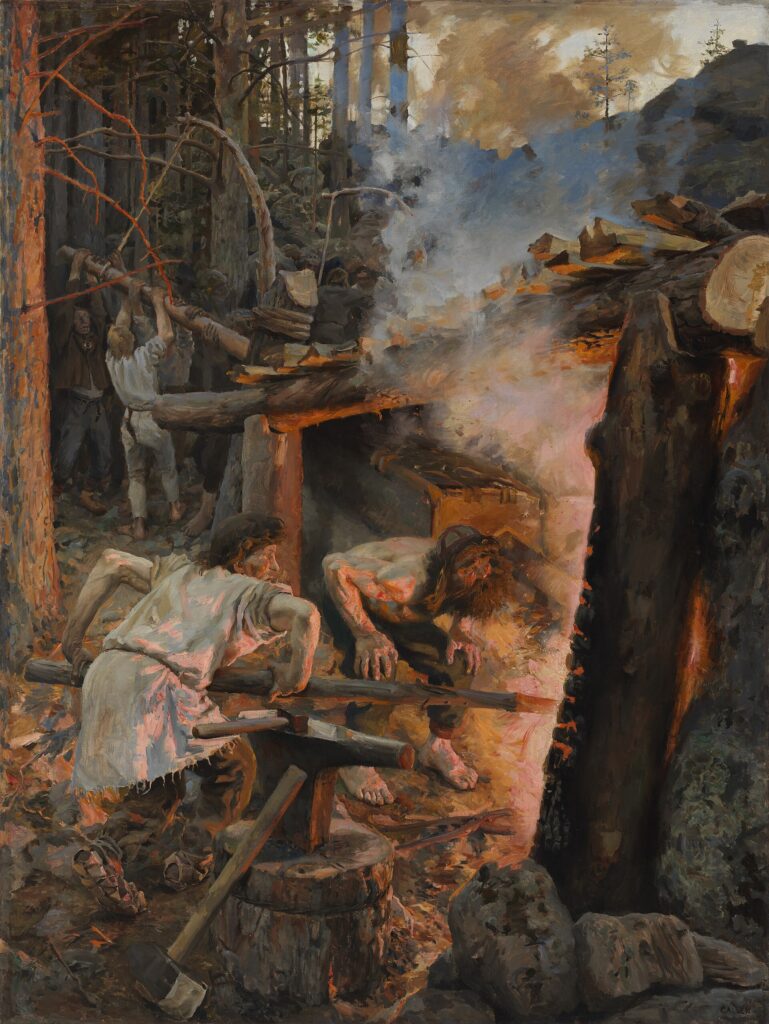
Cosmological Structure. A layered world of water, earth and sky. Above is the sky-dome, which in the songs the smith Ilmarinen forged, held up by a world-pillar and turning around the North Star. Below the living world lies Tuonela or Manala, the land of the dead, reached across a dark river. To the north, across the water, lies Pohjola, the cold North Farm. Forests, waters and homes each have their keepers (haltijat), and every being carries its own force (väki). The world-pillar and the turning sky appear in songs about the Sampo, which some scholars, following Uno Harva, read as the pillar itself; others disagree. Pohjola is both a real direction and a mythic otherworld, the place of cold, sickness and great wealth.
Creation. In Runo 1, Ilmatar, daughter of the air, drifts for seven hundred years on the primal sea. A bird, a teal in many versions, lays its eggs on her raised knee; when she moves, the eggs fall and break. From the lower shell comes the earth, from the upper shell the sky, from the yolk the sun, from the white the moon, and from the speckled parts the stars. In many folk versions the knee belongs to Väinämöinen himself; in others, to Ilmatar. Ilmatar then shapes the headlands, bays and sea-depths with her hands and feet. Creation here is gradual, watery and sung into completion rather than commanded: no one speaks the world into being in a single word.
Time. The world is not fixed at its first making. Things come into being one by one: iron, fire, barley, beer, the bear and the kantele each have an origin (synty) that can be sung. The epic moves through ages. At its close in Runo 50 a new age arrives with Marjatta's son, a king the old sage cannot rule, and Väinämöinen sails away, saying he will be needed again. Time also runs in the cycle of the year, marked in the old calendar by Kekri, the autumn feast at the turning of the agricultural year, and by the spring rites Agricola recorded. The right response to a new age is departure, leaving songs behind.
The Sacred. Power lies in knowledge spoken aloud. To know the origin-words of a thing and sing them rightly is to hold power over it: the tietäjä heals a wound by singing the birth of iron. The sacred is also in place and kin: the forest of Tapio and Mielikki, the waters of Ahti and Vellamo, the bear as relative, the sauna, the hearth, the grove and the graves of the family dead. Väki is the force that lives in places, beings and substances, in the forest, the water, iron, fire and the dead, and the tietäjä works by knowing and meeting it. Scholars such as Anna-Leena Siikala link the tietäjä's trance journeys to older shamanic practice.
Death / Afterlife. The dead go to Tuonela, ruled by Tuoni and Tuonetar, across a black river. It is hard to enter and harder to leave; Väinämöinen goes there in Runo 16 and only escapes by changing shape. The family dead remain close to the living. Karelians fed them at memorial meals, carved marks for them on karsikko trees, and still sing laments that guide the dead on their way and carry grief. In the songs, Tuonela's daughters guard the river and Tuoni's son waits with an iron net. Lemminkäinen dies there and is raked from the black water by his mother, who sews him back together: a mother's love reaching even into death.
The Figures
Sacred Elements
Sacred Objects. The Sampo, the bright-lid mill of limitless plenty, forged by Ilmarinen from a swan's feather, the milk of a barren cow, a grain of barley and the wool of a summer ewe. Scholars have read it as a world-pillar, a mill or a talisman and do not agree. The kantele, first made from a pike's jawbone and later from birch. Bear skulls hung in a sacred pine (kallohonka). Charm bags and tools of the tietäjä. Iron and steel themselves carry force and protect against harm.
Sacred Places. The sacred grove (hiisi) and offering stones (uhrikivet) where food and first fruits were left. The karsikko, a tree carved with marks for the dead. The sauna, where children were born, the sick were healed and the dead were washed. The hearth. The family graves (kalmisto). Lakes, rapids and islands linked to the water keepers. In the songs: Kalevala, Pohjola and Tuonela. Holy places were often on hills, islands or old burial grounds, and many Finnish place names still carry the word hiisi.
Sacred Practices. Incantation (loitsu) by the tietäjä, the seer-healer who heals and protects by singing a thing's origin. The bear feast (karhunpeijaiset), a wedding for the slain bear that returns its spirit home. Wedding songs and laments. Ukko's chest rites recorded by Agricola. Women's laments at funerals and memorial days carry the dead across; the lamenter (itkijä) is trusted with a specialist's art.
Sacred Prohibitions. The bear is not called by its name; speakers use words such as mesikämmen (honey-paw) or kontio. The forest is entered with respect and quiet, as the home of Tapio and Mielikki. The dead must be properly mourned and fed or they may trouble the living. A healer's words lose their force if spoken carelessly or to the wrong person, and are kept within the line that holds them. At the bear feast the bear is addressed with honour and told it was not killed by people but fell by accident.
The Shape This StoryWorld Shares
`multi-trial`
The Kalevala has no single quest. Its heroes go back again and again to the same great challenges: the wooing of the Maiden of Pohjola, the Sampo, the journey to Tuonela, the contest of songs. Väinämöinen woos and loses, builds his boat and wounds himself, goes to Tuonela and must flee, then seeks the missing words in the belly of Antero Vipunen. Lemminkäinen faces Louhi's three tasks and dies at the last. Each attempt reveals a deeper layer of the world's nature and the hero's own limits. The trials do not create the hero; they uncover what was always present, since Väinämöinen is born old and already wise.
The hero attempts the great challenges repeatedly. Each attempt reveals a deeper layer of the world's nature and his own limits. Success comes from knowing more, not from striking harder: the missing three words, the origin of iron, the right song. Trials do not create the hero; they uncover what was always present. The prize itself shatters, and its breaking seeds the world with plenty, so loss and gift are one event.
Attempt → partial outcome → deeper attempt → revelation through repetition → withdrawal, leaving the gift behind.
The Kalevala is the living inheritance of the Finnish and Karelian, carried by oral singers long before print. Lönnrot's epic stands on the voices of named singers such as Arhippa Perttunen and Ontrei Malinen in Viena Karelia, and on generations of women and men whose names were never written down. Many of those singers lived in Karelian lands now within Russia, and their descendants still keep the songs. Stories here follow the public-domain W. F. Kirby translation (1907) and the John Martin Crawford translation (1888). Structure is engaged; the singers' tradition itself belongs to its people.