← The Cultures Behind the StoryWorlds
East Asia — Japan
Japanese — Ma (間)
StoryWorld comingJapanese aesthetic and artistic tradition: developed across Noh theatre, ink painting (sumi-e), poetry, garden design, and music, and rooted in Zen and older Japanese sensibility.
The World As They See It
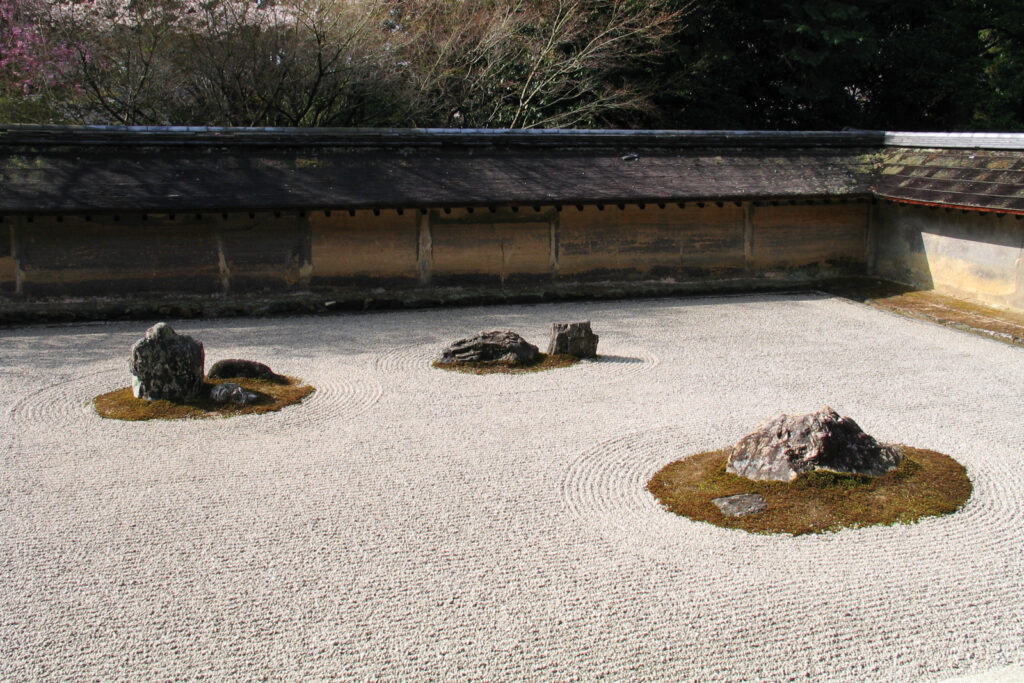
Cosmological Structure. In Japanese arts the gap counts. The rest in a shakuhachi line, the unpainted paper around a pine in sumi-e and the stillness before a Noh actor turns are all ma, and audiences learn to attend to them. Ma (間) is the pregnant interval, the meaningful space between: between sounds, between forms, between words, between moments. The world is read through the play of marked and unmarked, full and empty, and the empty carries meaning of its own.
Creation / Order. The order of ma is the order of interval and space: the meaningful arrangement of emptiness and fullness. Meaning comes from placing the pause and the gap well, so that what surrounds them can be heard.
Time. The time of ma is the time of the pause, the interval, the pregnant moment held. Ma is temporal as well as spatial: the meaningful silence in music, the held moment in Noh, the pause that carries more than speech. Time is shaped by the placement of intervals, not filled continuously.
The Sacred. The interval itself, ma, the meaningful space. Silence and emptiness as presence. Yohaku (the blank space of ink painting). The pause. Restraint. The afterglow (yoin) in the space around what is said.
Death / Afterlife. The tradition of ma is aesthetic, not doctrinal. Its teaching is the weight of the empty and the unspoken, a sensibility that runs through daily life and art and says nothing about an afterlife.
The Figures
Sacred Elements
Sacred Objects / Elements. The pause. The blank space (yohaku) of the ink painting. The silence of Noh and of music. The interval in architecture and garden. The afterglow (yoin) that lingers.
Sacred Practices. The disciplined use of restraint, silence and space in every art: where to leave the gap, and the nerve not to fill it. The cultivation of the sensibility that perceives the presence of the empty.
Sacred Prohibitions. Do not fill everything; do not over-explain; do not crowd out the space. The meaning of ma is destroyed by the compulsion to fill, to state, to complete. Restraint and trust in the empty are the discipline.
The Shape This StoryWorld Shares
`non-conflict`
Ma builds meaning by where it puts space, silence and the unspoken. There is no villain, no escalating struggle; instead, the story unfolds through restraint. What is not said, the power of the empty space, the small revelation and the afterglow. This is Non-Conflict in a spatial form: the story's depth comes from the interval. Meaning arises in the gaps.
Iwanai Koto (what is not said) → Kūhaku no Chikara (the power of the empty space) → Bimyō na Keiji (the small revelation) → Kyōmei to Yoin (resonance and echo) → Yoin no Musubi (the ending as afterglow).