GriotsWell Modern Synthesis (MS) StoryWorld
Four-Act Structure
Four-Act Structure: the Linear that divides the middle at the midpoint into two acts
Not one culture. A Modern Synthesis form: put together in the modern era from the stories of many places, and one of the four sorts of Linear that most popular stories are built on.
What this StoryWorld does. Bring any idea — a sentence, a premise or a whole story — and it is plotted here through 8 movements in order, in your own world and your own genre. You leave with the plot, and the story you write from it is yours.
The World As They See It
The Figures
- Articulators of the Tradition
- No one person defines it. It was put together over time from the stage, the novel and the screen, and it is taught wherever stories are written for the page and the screen. The tradition is analytical and craft-based rather than mythological.
Sacred Elements
The Narrative Tradition
Their Stories
The Shape This StoryWorld Shares
The Movements
- Setup: The World BeforeEstablish the protagonist, their world, their relationships, and their central flaw or limitation. Act One introduces everything the audience needs to understand before the conflict begins.
Cultural meaning: The setup, the world before the story's break. The protagonist's situation, world, and equilibrium are established, the stable "before" that the coming break will overturn. As in all linear architecture, the arc begins from a clear starting equilibrium, established so that the disruption and the escalating conflict have meaning.
In brief: First, the world before. The equilibrium that the story's break will overturn.
Cultural teaching: Begin with the setup. The world before, the starting equilibrium clearly established. In the four-act linear arc, the story starts from a stable situation about to be broken. Establish your protagonist's world and situation, the "before" that the inciting break will overturn, the clear starting point of the causal line.
Question prompt: What is the setup of your story (the world before, the protagonist's situation and equilibrium)? How do you establish the stable "before" clearly enough that the coming break has meaning? What is the starting point of the linear arc?- Protagonist
- The Ordinary World
- Key Relationships
- The World's Hidden Rules
- Story Elements Established
- Genre and tone established
- Protagonist's flaw demonstrated
- Stakes introduced or hinted
- Inciting Incident: The BreakThe event that ends Act One and launches Act Two. Something disrupts the ordinary world irreversibly. The protagonist must respond: the question is how.
Cultural meaning: The inciting incident. The break that disrupts the world before and begins the story. This event overturns the setup's equilibrium and starts the causal chain, raising the central question. As in the linear tradition, the break launches the forward drive of the arc; in the four-act frame, it opens the first of the middle's two escalating movements.
In brief: The break disrupts the world before. The event that overturns the equilibrium and starts the story moving.
Cultural teaching: Introduce the inciting incident. The break that disrupts the world before and starts the causal chain. In the four-act arc, this launches the story's forward drive and opens the complication act. Let your story's break overturn the setup's equilibrium, raising the central question and beginning the linear chain of consequence.
Question prompt: What is the inciting incident (the break that disrupts the world before and starts your story)? How does it overturn the setup's equilibrium and raise the central question? How does it launch the forward drive of the linear arc and open the complication act?- The Inciting Event
- Inciting Type
- The Protagonist's Commitment
- Stakes Established
- Act One's Final Image
- Complication: Things Get WorseThe protagonist enters the conflict and tries to solve it, but their approach is wrong, driven by their flaw. Things get progressively worse. The protagonist is REACTIVE: responding to problems rather than driving the story. This is the first half of the traditional Act Two.
Cultural meaning: The complication act. The first escalating movement of the middle, in which things get worse toward the midpoint. The protagonist reacts to the break, and the difficulties mount: obstacles multiply, the situation deteriorates, the pressure builds toward the midpoint pivot. This is the first half of the divided middle, escalating the conflict as complications accumulate.
In brief: In the first movement of the middle, things get worse. The complications mount, the difficulties accumulate toward the turn.
Cultural teaching: Build the complication act. The first escalating movement of the middle, things getting worse as complications mount toward the midpoint. In the four-act structure, this is the first half of the divided middle. Let your story's complications accumulate here, the situation deteriorating and the pressure building toward the pivotal midpoint, escalating the conflict along the linear line.
Question prompt: How does the complication act escalate in your story (things getting worse, complications mounting, the situation deteriorating toward the midpoint)? How does the protagonist react as the difficulties accumulate? How does this first half of the divided middle build pressure toward the pivotal midpoint?- The Protagonist's Wrong Approach
- Escalating Complications
- The Antagonist's Advantage
- Relationships Under Strain
- What the Protagonist Refuses to See
- Complication Pacing
- The Midpoint: The ShiftThis is the structural heart of Four-Act storytelling: the break between Complication and Escalation. Something happens that fundamentally changes the protagonist's approach. They shift from reactive to proactive, from wrong strategy to right strategy (though the right strategy will cost more than they imagined).
Cultural meaning: The midpoint, the pivotal act break at the center, dividing the middle into its two movements. Often a major revelation, reversal, or shift, the midpoint changes the protagonist's understanding or situation and turns them from reaction to action. In the four-act structure the midpoint is a true act break: the end of the complication act and the beginning of the escalation act, the pivot on which the whole story turns.
In brief: At the center, the shift. The pivot that turns the protagonist from reaction to action and divides the middle in two.
Cultural teaching: Make the midpoint a true act break. The pivotal shift at the center that ends the complication act and begins the escalation act, turning the protagonist from reaction to action. In the four-act structure, the midpoint is the pivot on which the story turns. Let your story's midpoint be a major revelation or reversal that shifts the protagonist and divides the middle into its two escalating movements.
Question prompt: What is the midpoint of your story (the pivotal shift at the center that divides the middle in two)? How does it turn the protagonist from reaction to action (a revelation, reversal, or major shift)? How does it function as a true act break, ending the complication act and beginning the escalation act?- The Midpoint Event
- Midpoint Type
- What Changes in the Protagonist
- New Strategy Emerging
- What the Reader Now Understands
- Escalation: The Protagonist Fights BackThe protagonist is now PROACTIVE: attacking the problem with their new strategy. But the opposition escalates to match. Act Three is a war of escalation: each side raises the stakes, each move provokes a counter-move, and the cost of victory climbs higher and higher.
Cultural meaning: The escalation act. The second escalating movement of the middle, in which the protagonist fights back with rising force. Turned to action by the midpoint, the protagonist now drives at the conflict actively; the stakes and intensity rise toward the crisis. This is the second half of the divided middle, its escalation distinct from the complication act's (active fightback rather than mounting difficulty) carrying the arc toward the climax.
In brief: In the second movement of the middle, the protagonist fights back, driving at the conflict with rising force toward the crisis.
Cultural teaching: Build the escalation act. The second escalating movement of the middle, the protagonist fighting back with rising force after the midpoint. In the four-act structure, this half is active drive, distinct from the earlier mounting difficulty. Let your protagonist take the offensive here, the intensity rising toward the crisis, the second escalation carrying the linear arc toward its climax.
Question prompt: How does the escalation act build in your story (the protagonist fighting back with rising force after the midpoint)? How is this second half of the middle active drive, distinct from the earlier mounting difficulty? How does the intensity rise toward the crisis, carrying the linear arc toward the climax?- The Protagonist's Offensive
- The Antagonist's Counter-Escalation
- Rising Cost
- Escalation Dynamics
- Allies fall or are compromised
- Moral cost: protagonist crosses ethical lines
- Scope expands: stakes grow beyond personal
- Time shrinks: deadline accelerates
- The Crisis: The Lowest PointThe escalation reaches its breaking point. The protagonist faces their darkest moment: everything they've built collapses, every ally is gone or compromised, every strategy has failed. The crisis is the structural hinge into Act Four.
Cultural meaning: The crisis, the lowest point, where despite the fightback all seems lost. The escalation brings the protagonist to their darkest moment, the greatest setback before the climax. Even the active fightback of the escalation act meets its trough here: the apparent defeat from which the protagonist must rise for the decisive confrontation. The linear arc reaches its low point before the climax.
In brief: Even the fightback meets its lowest point. The crisis where all seems lost before the final confrontation.
Cultural teaching: Bring your story to its crisis. The lowest point where, despite the fightback, all seems lost, the darkest hour before the climax. In the four-act arc, the escalation act's drive meets its trough here. Let your story reach its low point, the greatest setback or apparent defeat from which the protagonist must rise for the decisive climax.
Question prompt: What is the crisis in your story (the lowest point where, despite the fightback, all seems lost)? How does the escalation act's drive meet its trough here, the greatest setback before the climax? How does this low point set up the protagonist's rise for the decisive confrontation?- The Lowest Moment
- What Is Stripped Away
- The Flaw Fully Confronted
- The Seed of Resolution
- Crisis Type
- Climax: The Final ConfrontationThe protagonist rises from the crisis transformed by everything they've endured. Act Four is resolution: the final confrontation where the protagonist's transformation is tested and the central conflict is decided.
Cultural meaning: The climax, the decisive confrontation toward which the whole four-act arc has built. The central conflict comes to its head; the protagonist faces the final test, and the story's question is answered. This is the peak of the linear arc, the point of maximum tension and decisive action, where the two escalating movements of the middle culminate in the resolution of the conflict.
In brief: The climax is the decisive confrontation. The peak toward which both movements of the middle have built.
Cultural teaching: Build to the climax. The decisive confrontation toward which the whole four-act arc has driven, where the central conflict comes to its head and is resolved. In the four-act structure, both escalating movements of the middle culminate here. Let your story's climax be the peak of the entire linear arc: the final test, the decisive action, the answering of the story's central question.
Question prompt: What is the climax of your story (the decisive confrontation toward which the whole four-act arc has built)? How do both escalating movements of the middle culminate here? How is this the peak of maximum tension and decisive action, where the central conflict is resolved and the story's question answered?- The Final Confrontation
- Transformation Applied
- Resolution Type
- Central Question Answered
- The Moment of Choice
- The Antagonist's Final Move
- Denouement: The New WorldThe aftermath of the climax. Show the world that results from the protagonist's path, resolve remaining threads, and give the audience emotional closure.
Cultural meaning: The denouement, the resolution and new world after the climax. The conflict resolved, the story settles into its new equilibrium: the consequences play out, loose ends are tied, and the protagonist's changed world is established. This is the end of the four-act arc: the new world that answers the world before, showing how the protagonist and their situation have changed.
In brief: After the climax, the new world. The changed equilibrium that answers the world before, the arc complete.
Cultural teaching: End with the denouement. The resolution and new world after the climax, the changed equilibrium established and the arc completed. In the four-act structure, this answers the world before. Let your story close by settling into its new world: the consequences played out, the protagonist's changed situation shown, the linear arc brought to its complete and satisfying end.
Question prompt: What is the denouement of your story (the resolution and new world after the climax)? How does the story settle into its new equilibrium, the consequences played out and the changed world established? How does this new world answer the world before, completing the four-act linear arc?- The New Normal
- Character Final States
- Thematic Statement
- Final Image
- What the Protagonist Lost
- What the Reader Feels
- Series Potential
- Structure Integrity Check
The StoryWorld in Full
StoryWorld · GriotsWell StoryWorld
Four-Act Structure
The European/American dramatic and narrative tradition — a refinement of the classic linear arc that treats the midpoint as an act break, dividing the long middle into two escalating movements.
Linear architecture
The world as they see it
Structural / Aesthetic View. A view in which the long, difficult middle of a story is best handled by dividing it at the midpoint into two acts, each with its own escalation. Where the three-act model has one long confrontation act, the four-act model breaks it: an act of mounting complication before the midpoint, and an act of the protagonist's active fightback after it. The engine remains conflict, the movement linear and causal, but the structure gives the middle two distinct escalating movements around the pivotal midpoint.
Time. Linear and causal, in four movements — setup, complication (to the midpoint), escalation (from the midpoint), and resolution. The midpoint is a true act break, dividing the story's middle into two escalating halves. The causal through-line drives forward, but the four-act frame gives the middle its two-part shape.
The Valued. The pivotal midpoint as a structural act break. The two-part middle (complication, then fightback). Sustained escalation without a sagging middle. The decisive climax and resolution. Clarity of the four movements.
The powers and figures
Articulators of the Tradition
The Western dramatic tradition (from Aristotle onward) and the modern craft tradition that formalized the four-act model and the midpoint act break. The tradition is analytical and craft-based rather than mythological.
Sacred things and places
Valued Structural Elements. The four acts (setup, complication, escalation, resolution). The inciting incident. The pivotal midpoint as an act break. The two escalating halves of the middle. The crisis and climax. The denouement.
Craft Discipline. Divide the middle at the midpoint into two escalating movements. Keep the causal through-line. Avoid the sagging middle by giving each half its own escalation. Build to a decisive climax and resolve.
How the stories are told
How Stories Are Told. As a linear, conflict-driven arc through four acts. The setup establishes the world before; the inciting incident breaks it; the complication act mounts the difficulties toward the midpoint; the midpoint pivots; the escalation act has the protagonist fight back with rising force; the crisis brings the lowest point; the climax is the decisive confrontation; and the denouement establishes the new world. The distinctive feature is the two-part middle, split at the midpoint into complication (before) and escalation/fightback (after).
The Purpose of Story. To drive a protagonist through a well-shaped linear arc whose middle is divided into two escalating movements — solving the sagging middle by giving the story two distinct halves of rising conflict around a pivotal midpoint, toward a decisive climax and resolution.
Signature Story Types. The tightly-structured dramatic arc with a strong midpoint; the story whose middle escalates in two clear movements; the conflict-driven arc that avoids the sagging middle.
The stories
The Western Dramatic Tradition (from Aristotle)
Source The European/American dramatic tradition — the linear arc of beginning, middle, and end, and its refinements
Public domain access Aristotle's Poetics and classic Western dramatic theory are public domain via Internet Archive and Project Gutenberg
Why it fits The intellectual root of the linear, conflict-driven arc that the four-act model refines
Freytag's Analysis of Dramatic Structure
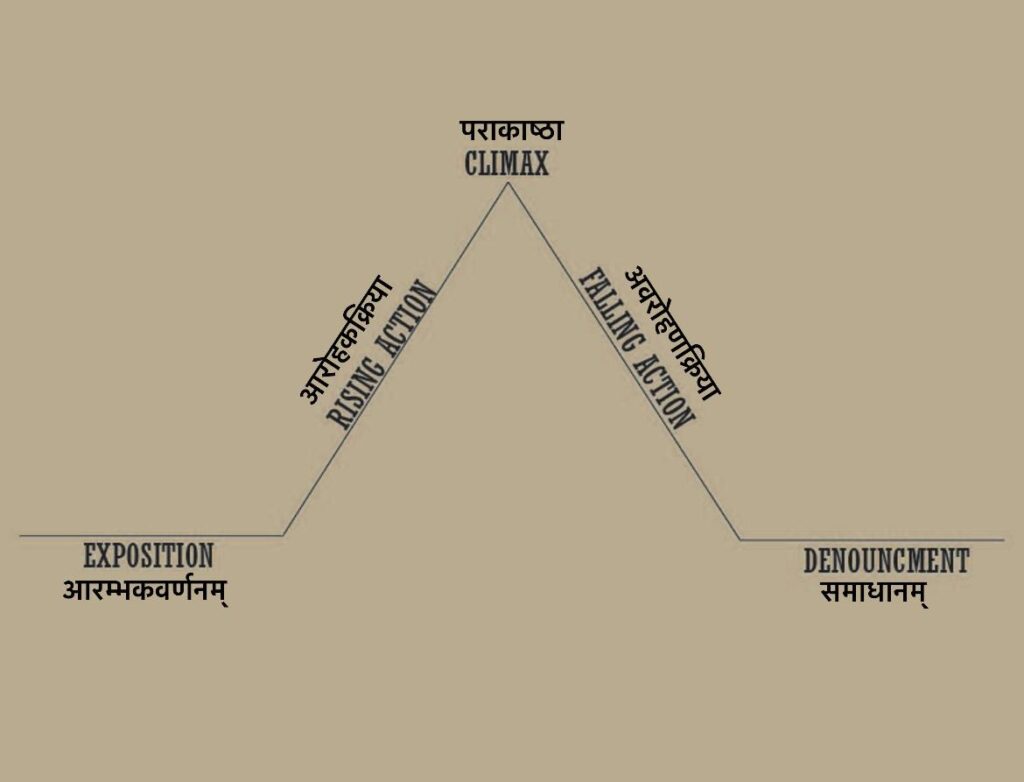
Source Gustav Freytag's 19th-century analysis of rising action, climax, and falling action
Public domain access Freytag's "Technique of the Drama" is public domain via Internet Archive
Why it fits A key articulation of the escalating dramatic arc that the four-act midpoint-division builds upon
The Two-Part Middle in Classic Drama
Source The European/American dramatic tradition — classic dramas whose middles escalate in two clear movements around a central turn
Public domain access Many classic Western dramas are public domain via Internet Archive and Project Gutenberg
Why it fits The four-act shape realized in drama — the divided, doubly-escalating middle around a pivotal midpoint
How their stories move
The four-act structure is linear architecture — a causal, conflict-driven through-line — refined so that the midpoint becomes a true act break, dividing the long middle into two escalating movements. The story still moves inexorably forward along its causal line from setup to resolution, but the four-act frame gives the middle a two-part shape: complication mounting toward the midpoint, then the protagonist's active fightback escalating from it. It is one of the nine equal architectures — a refinement of the linear form associated with the European/American dramatic tradition.
This culture
People · Not one culture: a Modern Synthesis form, put together in the modern era from the stories of many places.
Place · Not one place: put together in the modern era from the stories of many places
Depth · A modern refinement of the classical Western dramatic tradition (rooted in Aristotle and developed through Western theatre and screenwriting), formalizing the midpoint as a structural act break.
Living · Yes — the four-act structure is widely used in modern film, television, and fiction craft, valued for solving the "sagging middle" of the three-act model.
Linear worlds
The Hero's Journey
NORSE — Saga
Seven-Point Structure
Three-Act Structure
PLAINS INDIGENOUS — Vision Quest
What makes this tradition distinct
The four-act structure is a refinement of European/American linear architecture that treats the midpoint as a true act break, dividing the long middle into two distinct escalating movements — complication before, active fightback after. It solves the "sagging middle" of the three-act model by giving the story two clear halves of rising conflict around a pivotal midpoint. On this platform it is honored as one of nine equal architectures — a linear refinement, not a universal default.
Cultural warnings — what NOT to do
- Do honor its genuine craft value while keeping the platform's discovery framing: one architecture among nine.
Mythology Catalog
- Why it fits: The four-act shape realized in drama — the divided, doubly-escalating middle around a pivotal midpoint
GriotsWell · Simplified Lore Library · Four-Act Structure · July 2026
The Guide
GriotsWell StoryWorlds · Guide
Four-Act Structure — the European/American dramatic tradition dividing the middle at the midpoint into two acts
Linear architecture · 8 steps
How it moves
- Setup — The World Before
- Inciting Incident — The Break
- Complication — Things Get Worse
- The Midpoint — The Shift
- Escalation — The Protagonist Fights Back
- The Crisis — The Lowest Point
- Climax — The Final Confrontation
- Denouement — The New World
Setup (the world before) → the Inciting Incident (the break) → Complication (things get worse, toward the midpoint) → the Midpoint (the pivotal act break) → Escalation (the protagonist fights back, rising force) → the Crisis (the lowest point) → the Climax (the decisive confrontation) → Denouement (the new world). ---
Why it is told this way
The four-act structure is linear architecture — a causal, conflict-driven through-line — refined so that the midpoint becomes a true act break, dividing the long middle into two escalating movements. The story still moves inexorably forward along its causal line from setup to resolution, but the four-act frame gives the middle a two-part shape: complication mounting toward the midpoint, then the protagonist's active fightback escalating from it. It is one of the nine equal architectures — a refinement of the linear form associated with the European/American dramatic tradition.
To drive a protagonist through a well-shaped linear arc whose middle is divided into two escalating movements — solving the sagging middle by giving the story two distinct halves of rising conflict around a pivotal midpoint, toward a decisive climax and resolution.
What this StoryWorld asks
- Is your midpoint a true act break, dividing the middle into two escalating movements?
- Does the first half of the middle mount complications, and the second half drive an active fightback?
- Does the causal, conflict-driven line move forward through four clear movements?
- Does each half of the middle have its own distinct escalation, avoiding a sagging middle?
At a glance
People Not one culture: a Modern Synthesis form, put together in the modern era from the stories of many places.
Time depth A modern refinement of the classical Western dramatic tradition (rooted in Aristotle and developed through Western theatre and screenwriting), formalizing the midpoint as a structural act break.
Living tradition Yes — the four-act structure is widely used in modern film, television, and fiction craft, valued for solving the "sagging middle" of the three-act model.
How it is carried Global, developed across European languages and modern screen and prose craft; the tradition lives in drama, film, television, and the novel, and in the craft literature that teaches it. ---
“First, the world before — the equilibrium that the story's break will overturn.”— four-act dramatic tradition
Keep faith with it
- Do not treat the four-act structure as the "default" or "correct" way to tell a story — it is one of nine equal architectures. - Do not blur the midpoint into an ordinary beat — in the four-act model it is a true act break dividing the middle. - Do not make both halves of the middle the same — the first mounts complication, the second drives active fightback.
An example: The First Franchise, made in this StoryWorld
The idea as the writer gave it
Every year one figure brings a gift to every child in a single night, and no one has ever asked who owns the job. When the one who has always done it can no longer go on, the role is written down for the first time as a franchise: a name, a uniform, a route and a set of rules that can be handed on, bought or fought over. The first person to hold it under licence has one season to prove the franchise works, while the old giver's family, the makers who supply the gifts and a rival who wants the route all press in. Told by the clerk who wrote the first charter.
(Made in: Romance, present-day Leeds, England)
The First Franchise opens The Franchise Universe, a planned volume. Here the same idea is made in every StoryWorld open today, each in its own genre and its own place and time.
The Small Print of Christmas
Romance; present-day Leeds, England
A careful clerk at the Leeds Library is asked to write the first charter for the old giver's job, and the charter she writes cuts out the giver's granddaughter, the one person in Leeds she cannot stop thinking about. Over one season, as a market trader holds the licence and an events boss tries to buy the route out from under him, the clerk has to choose between the rules she hides behind and the woman she loves. She tells the story herself.
Who the plot needs
- Hannah Birch, the narrator, a clerk at the Leeds Library on Commercial Street who writes the first charter
- Bryony Garside, the old giver's granddaughter, a primary school teacher in Armley who expected to inherit the job
- Noel Garside, the old giver, who has done the job for longer than Leeds has had trams and has had a stroke
- Jonah Teale, who runs a toy stall in Kirkgate Market and wins the first licence
- Ted Clough, foreman of the makers at a disused mill in Armley
- Saskia Vane, managing director of a Leeds events company who wants the route for sponsors
Where it happens
- The Leeds Library, a subscription library on Commercial Street, where Hannah works
- Noel Garside's house in Headingley
- Jonah's toy stall in Kirkgate Market
- The makers' mill by the canal in Armley
- Saskia Vane's offices in a glass tower by Leeds Dock
- The rooftops of the Hyde Park terraces on Christmas Eve
Setup: The World Before
Hannah Birch has worked as a clerk at the Leeds Library on Commercial Street for nine years, keeping the membership rolls and the minutes of a board that meets twice a year. She likes rules because they let her say no without having to explain herself. Every Saturday Noel Garside, an old man in a red scarf, borrows the same atlas, and every Saturday his granddaughter Bryony comes with him and makes Hannah laugh. Hannah has never told Bryony anything about herself, and she tells herself that is the safe way. She goes home each evening to a flat in Chapel Allerton with a cat and a shelf of library rulebooks she has annotated by hand.
Inciting Incident: The Break
In November Noel has a stroke and cannot go on with the job he has done every Christmas Eve since before the trams. The library's board holds the oldest papers on the job, and they appoint Hannah to write a charter turning it into a franchise: a name, a red coat, a route and a set of rules. Hannah writes a fair open licence because the rules say she must, and that means Bryony has no special claim. Bryony arrives at the library the day the charter is published and asks Hannah how she could. Jonah Teale, who runs a toy stall in Kirkgate Market and knows every child in Leeds by their Christmas list, wins the licence that week.
Complication: Things Get Worse
Hannah tries to make it up to Bryony by writing better rules, and adds a clause giving the Garside family a formal advisory role, which Bryony reads as an insult. Saskia Vane of a Leeds Dock events company reads the same clause and uses it to argue that the route is now a commercial asset that can be leased. Ted Clough, foreman of the makers at the Armley mill, refuses to work with Jonah until the Garsides approve him, and Bryony will not. Each time Hannah answers with another amendment, and each amendment gives Saskia more to work with. By the end of the month Saskia has lodged a bid to lease the route for a sponsored parade.
The Midpoint: The Shift
Clearing Noel's books from the library's back room, Hannah finds the atlas he borrowed every Saturday, and folded inside it is an unposted letter he wrote to the board years ago. In it he asks that when he stops, the job go to whoever the children already trust, and he names no heir at all. Hannah realises she has been using rules to keep Bryony at arm's length, and that what she wants is Bryony. She takes the letter to Bryony's flat in Armley herself and tells her the truth about the letter and about her feelings in one long, frightened speech. Bryony goes quiet, then asks her to help her and Jonah win the season together.
Escalation: The Protagonist Fights Back
Hannah stops writing amendments and starts working alongside Bryony, who takes Jonah to the Armley mill and persuades Ted Clough to start the makers on the gifts. Jonah learns the route on night walks with Bryony and Hannah through Headingley and Hyde Park, while Noel watches from his window and corrects their turns by phone. Saskia answers by filing a complaint with the library's board that Hannah has a personal interest in the licence and cannot act as clerk. She also offers Ted's makers twice their wages to switch to her parade. Hannah and Bryony spend their first night together at Noel's house in Headingley, and the next morning the board summons Hannah.
The Crisis: The Lowest Point
The board removes Hannah as clerk to the charter and hands the file to Saskia's lawyers for review. They find that Hannah's advisory clause makes the Garsides responsible for the licensee, and they tell Bryony she will be liable if Jonah fails. Bryony believes Hannah wrote the clause to keep hold of her, and she tells Hannah to leave Noel's house. Ted's makers take Saskia's offer and the mill goes dark on the twentieth of December. Jonah closes his stall and says he will hand back the licence on Christmas Eve. Hannah sits in her flat in Chapel Allerton with Noel's letter on the table and no job, no Bryony and no right to touch the charter she wrote.
Climax: The Final Confrontation
On the twenty-third Hannah goes to the mill alone and finds Ted Clough there, the one maker who did not leave, and they work through the night on the gifts that remain. On Christmas Eve she walks into Saskia's office at Leeds Dock as the parade launches and reads Noel's letter aloud in front of the sponsors, declaring her own interest openly, which the rules she once hid behind say she must. The sponsors withdraw, unwilling to fight a dead man's wish on Christmas Eve, and Saskia's lease collapses. Hannah goes to Jonah's stall with the sack and finds Bryony there before her. They take the route over the Hyde Park rooftops together, Jonah in the coat and Bryony carrying the map, with Hannah reading out the turns.
Denouement: The New World
In January the library's board rewrites the charter on Noel's terms, naming Jonah and Bryony as joint holders. Ted Clough reopens the mill and the makers who left come back one at a time. Hannah does not return as clerk, and she takes a job teaching adult literacy in Armley, near Bryony's school. On Saturdays she and Bryony walk Noel to the library to borrow the atlas. Hannah has started telling Bryony everything, and on Saturdays she still laughs.
This is a plot, for you to take and make into your own original full story.
Bring your idea, answer the movements, and press Make. Your plot comes back.
Begin →