GriotsWell World Cultural (WC) StoryWorld · Africa
Akan — Anansi Web
Akan Anansi Web Pattern: Anansesem
Akan (Ashanti, Fante, Akyem, Akuapem, Kwahu), Ghana and Côte d'Ivoire
In the Anansesem the trickster is a member with a job: the one who can see the whole web when those inside the power structure cannot. That the stories travelled the Atlantic and were retold as Aunt Nancy and Compé Anansi is itself a demonstration of the web's resilience. No other trickster tradition has this specific relationship between individual cleverness and community wisdom, the trickster wins AND the winning creates the teaching.
What this StoryWorld does. Bring any idea — a sentence, a premise or a whole story — and it is made here as the Akan tell: their names, their places, their beings and their customs, through 9 movements in order. You leave with the plot, and the story you write from it is yours. It never retells this people’s own stories.
The World As They See It
 AI image
The Figures
- Supreme Being / Creator
- Nyame, the Sky God. Distant, powerful, the ultimate source. Asase Ya: the Earth Goddess, Nyame's wife, mother of Anansi. Both are above the human world but reached through Anansi's mediation.
- Major Deities / Spirits
- Kweku Anansi: the Spider. Son of Nyame and Asase Ya. Clever, not powerful. Won all stories from Nyame through wit. Born on Wednesday (Kweku = Wednesday-born). The trickster who owns all knowledge.
- Nyame: Sky God, supreme deity. Originally the sole owner of stories.
- Asase Ya: Earth Goddess. Mother of Anansi. Associated with fertility and truth.
- Ogun (shared with the Yoruba): iron deity, appears in some Akan contexts
- Sunsum: the personal spirit/soul that each person carries
- Trickster / Culture Hero
- Kweku Anansi, the definitive Akan trickster. Small, clever, apparently weak. Wins through intelligence and indirection, never through force. Obtains all stories and thus all knowledge from the Sky God himself. Carried across the Atlantic, Anansi became Aunt Nancy and Compé Anansi, the web holding its shape far from home.
- Ancestor Figures
- Nananom Mpanyimfo, the ancestral elders collectively. Each abusua (clan) has its own line of ancestors. Sacred stools of chiefs hold ancestral power after death.
Sacred Elements
The Narrative Tradition
Their Stories
The Shape This StoryWorld Shares
The Movements
- The Spider at the Center: AnansiEvery web has a spider at its center. In Anansi stories, the trickster is a weaver of connections. Your trickster character uses intelligence, cunning, and social manipulation rather than physical strength. They are often small, underestimated, and operating from a position of apparent weakness, which is itself their greatest weapon.
Cultural meaning: The trickster devises an approach based on intelligence rather than force. Anansi wins through understanding how people and creatures think. He exploits the predictability of the powerful.
In brief: The smallest spider can cross the biggest tree, and its web shows where it went and where it stopped.
Cultural teaching: Anansi's power comes from his marginality. He is small, underestimated, and operates outside the normal power hierarchy. This allows him to see the web's full pattern in a way that those embedded in the power structure cannot. The clever plan always exploits this visibility advantage.
Question prompt: Who is your Anansi figure (the clever, marginalized one who sees the full web when others see only their own thread)? What is ingenious about their plan? What does their position outside the power structure allow them to see? Why does the plan seem perfect to them?- Your Trickster Character
- Trickster's Position in the Power Structure
- Trickster's Intelligence Type
- Social reading: understands what people want and fear
- Pattern recognition: sees connections others miss
- Verbal cunning: uses language to reshape reality
- Strategic patience: waits for the perfect moment
- Improvisation: adapts instantly when plans fail
- The Web's Anchor Points: Characters as NodesA web needs anchor points, the fixed structures to which the threads attach. In Anansi stories, these are the other characters: the powerful figures the trickster must navigate, the allies who may help or betray, the community that watches. Each character is a node in the web, and the trickster's task is to create connections between them that serve the trickster's purpose. Remember what the elders know: the community, not the individual, is the protagonist of Anansesem. The web itself is the main character.
- The Power Figure: Who Holds What the Trickster Wants
- Power Figure's Vulnerability
- The Rival or Obstacle Figures
- The Community: Witnesses and Judges
- Hidden Connections Between Characters
- Information Asymmetry, Who Knows What?
- Trickster knows everyone's secrets
- Power figure is blind to the trickster's capabilities
- The Desire That Spins the Web: The PrizeAnansi's original quest was to buy all the stories in the world from Nyame the Sky God. The prize is always something that seems impossible for someone so small to obtain. The gap between the trickster's position and the prize is what generates the web, the trickster must spin connections because direct acquisition is impossible.
- The Prize: What Must Be Obtained
- Nature of the Prize
- The Impossible Price: What's Demanded
- Trickster Threads Needed
- Deception: making others see what isn't there
- Flattery: using ego as a lever
- Temporary alliances: enemies who become tools
- Disguise: appearing as something else entirely
- First Web Thread: The Initial StratagemAnansi captured Onini the Python first: by challenging his pride. He argued with his wife Aso about the python's length, knowing Onini would overhear and want to prove himself. The python stretched out to be measured, and was tied to a measuring pole. The first stratagem establishes the trickster's method: use the target's own nature as the trap.
- First Target, Who or What Must Be Overcome First?
- The Stratagem (How Does the Trickster Use Their Nature Against Them)?
- Trickster's Tool for This Stratagem
- The Partner: Who Plans Beside the Trickster
- What the First Success Costs
- How Does the Web Change After This Thread?
- Second Web Thread: Adapting the MethodAnansi captured Osebo the Leopard by digging a pit: using Osebo's habit of following the same path. Each stratagem must be different because each target has a different nature. The web pattern repeats in structure but varies in method. This is the architectural principle: same pattern, different content at every node.
- Second Target
- How Does This Stratagem Differ From the First?
- Web Connection (How Does the First Capture Enable the Second)?
- Second Stratagem's Tool
- The Partner's Role in This Stratagem
- Third Web Thread: The Web TightensAnansi captured the Mmoboro hornets by pretending it was raining and offering them shelter in a gourd: using their collective behavior against them. By the third stratagem, the web is tightening. The trickster has momentum, but the stakes are higher because failure now means losing everything already gained.
- Third Target: The Collective or Environmental Threat
- Third Stratagem
- The Cost So Far (What Has the Web Demanded)?
- Trickster Ethics at This Point
- Fourth Capture: The Invisible Challenge
- Fourth Stratagem
- The Turning Point: When the Web Almost Breaks
- How the Trickster Adapts
- The Web Completed: Presenting the PrizeAnansi brought all four captures to Nyame and said: "I have paid your price." The moment of completion is when all threads come together, the web is revealed in its full design. The power figure must acknowledge that the seemingly impossible has been achieved by someone they underestimated.
- The Moment of Presentation
- Power Transfer Mechanism
- The Power Figure's Recognition
- Community's Witness of the Transfer
- What the Web Reveals
- The Aftermath: Consequences and New WebsAnansi stories often don't end cleanly. The trickster succeeds, but at what cost? And what new webs does the victory create? In Akan tradition, many Anansi stories end with explanations of why things are the way they are: "And that is why spiders sit in the corners of houses" or "And that is why greed brings suffering." The aftermath connects the story to the real world. And the tradition teaches through laughter: the trickster's overreach is funny, which makes it safe to learn from. Anansi is never shamed: he is celebrated for revealing what the community needed to see. Individual cleverness, however brilliant, cannot substitute for the wisdom of the whole web.
Cultural meaning: The trickster's individual cleverness has created something the community must now deal with. Acting alone (without incorporating the full web's wisdom) always has unintended consequences.
Cultural teaching: This step is the moral center of Anansesem. Anansi wins but the winning creates new problems. Individual cleverness, however brilliant, cannot substitute for community wisdom. The spider's web holds best when every thread is tied in. A web one spider spins alone is weaker than it looks.
Question prompt: How does the success create new problems? What unintended threads does the trick pull? What negative side effects emerge from individual cleverness operating without the full community's participation? What does the web look like now (more tangled than before)?- Consequences (What Changed for Everyone)?
- How Each Node Was Changed
- New Webs Created
- Story Outcome Pattern
- The Trickster's Lesson (or Lack Thereof)
The StoryWorld in Full
StoryWorld · Ghana, Côte d'Ivoire, Togo — coastal and forest zones of West Africa
AKAN / ANANSI — Web Pattern
Akan — Ashanti, Fante, Akyem, Akuapem, Kwahu — Ghana and Côte d'Ivoire
Web architecture
The world as they see it
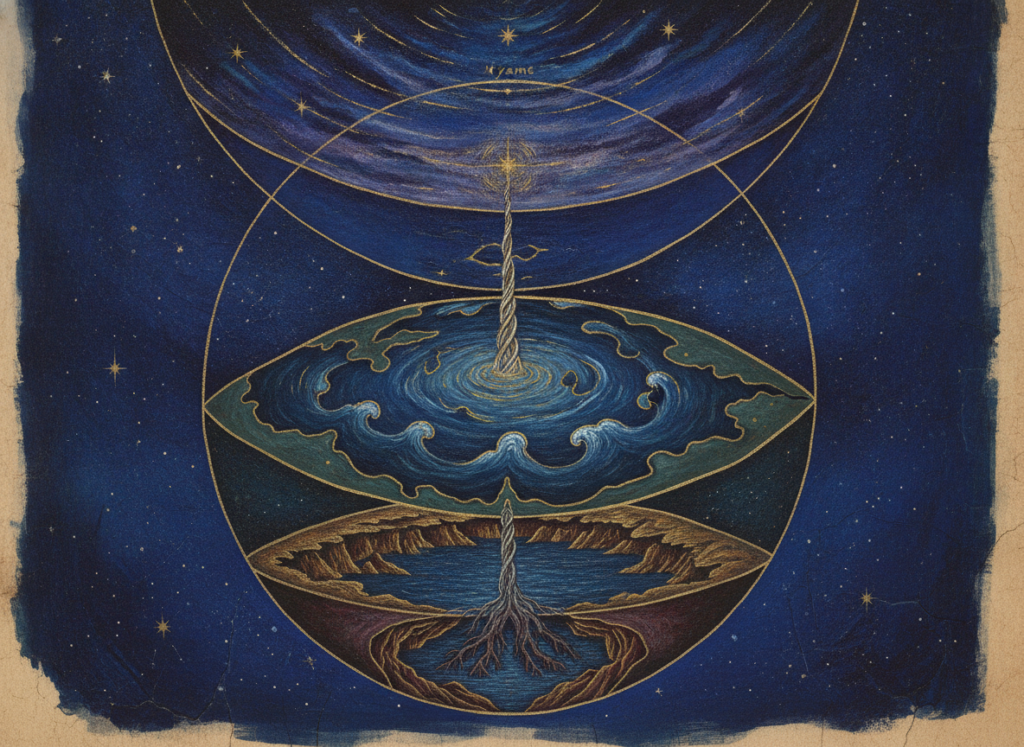
Cosmological Structure. The Akan world holds together through the abusua, the mother's line — identity, inheritance and authority flow through it. The queen mother (Ohemmaa) holds equal or greater power than the chief in many contexts. Society is maintained through proper relationships between the Ohemmaa, the council of elders (Okyeame), and the community. The Akan universe has a sky deity above and an earth deity below — and Anansi, Kweku Anansi, son of both, mediating between them.
Creation. Anansi did not create the world — but he obtained all the stories in the world. Nyame (the Sky God) originally held all stories. Anansi bought them by fulfilling four seemingly impossible tasks — capturing Onini the Python, Osebo the Leopard, the Mmoboro Hornets, and Mmoatia the Fairy. With stories came knowledge, and with knowledge came power. Anansi is the reason humans have stories to tell.
Time. Cyclical — organized by the Akan calendar of festivals, planting and harvest cycles, and the rotation of political leadership. The abusua system means that power passes matrilineally through time — the community is always connected to its past through the maternal line.
The Sacred. The community gathering itself is sacred. The act of storytelling at night (Anansesem sessions) is a sacred technology — a way of encoding and transmitting community wisdom. The abusua (matrilineal clan) is the sacred social unit. The Ohemmaa (queen mother) holds sacred authority. The kente cloth encodes cosmological knowledge in its patterns.
Death / Afterlife. The ancestors (Nananom Mpanyimfo) continue to participate in community life. They are honored through libations and festivals. The Odwira festival (annual purification) reconnects the living community to its ancestors. The stools of deceased chiefs are preserved as sacred objects through which ancestral power continues to work.
The powers and figures
Supreme Being / Creator
Major Deities / Spirits
Kweku Anansi — the Spider. Son of Nyame and Asase Ya. Clever, not powerful. Won all stories from Nyame through wit. Born on Wednesday (Kweku = Wednesday-born). The trickster who owns all knowledge.
Nyame — Sky God, supreme deity. Originally the sole owner of stories.
Asase Ya — Earth Goddess. Mother of Anansi. Associated with fertility and truth.
Ogun — (shared with Yoruba) — iron deity, appears in some Akan contexts
Sunsum — the personal spirit/soul that each person carries
Trickster / Culture Hero
Kweku Anansi — the definitive Akan trickster. Small, clever, apparently weak. Wins through intelligence and indirection, never through force. Obtains all stories and thus all knowledge from the Sky God himself. The diaspora transformation — Anansi becomes Brer Rabbit, Aunt Nancy — demonstrates the web pattern's resilience.
Ancestor Figures
Nananom Mpanyimfo — the ancestral elders collectively. Each abusua (clan) has its own line of ancestors. Sacred stools of chiefs hold ancestral power after death.
Sacred things and places
Sacred Objects. The Golden Stool (Sika dwa kofi) — the soul of the Ashanti nation, believed to have descended from heaven during the reign of Osei Tutu. Never sat upon. Adinkra symbols — visual proverbs encoding cosmological and philosophical knowledge. Kente cloth patterns encoding social and spiritual meaning.
Sacred Places. The stool house (where sacred stools are kept). Sacred groves. The Ohemmaa's court. Night gathering places for Anansesem performance.
Sacred Practices. Anansesem storytelling sessions — communal, nocturnal, participatory. The Odwira festival — annual purification and ancestor honoring. Libation pouring before ceremonies. Communal decision-making through the council of elders.
Sacred Prohibitions. The Golden Stool must never touch the ground and no one may sit upon it. Certain clan totems must not be eaten. Stories must not be told in the daytime (Anansesem are night stories only). Some proverbs may only be spoken by elders.
How the stories are told
How Stories Are Told. At night, in the communal space, under moonlight. The storyteller opens: "We do not really mean, we do not really mean, that what we are about to say is true." This signals the story operates in the space between truth and fiction — where dangerous truths can be spoken safely. Audience responds with "So!" throughout the performance. Multiple voices, gestures, sound effects.
Who Tells Them. Any community member with storytelling skill. The Okyeame (chief's spokesperson) is particularly skilled. Anansesem were traditionally women's stories and children's stories — accessible to all, not restricted by initiation.
The Purpose of Story. Community wisdom transmission. Social criticism — the trickster allows indirect criticism of power that direct speech cannot safely express. Moral instruction. Entertainment that encodes essential knowledge. The diaspora survival of Anansesem proved that story can survive the destruction of everything else.
Signature Story Types. Anansi acquisition stories (how Anansi got something through cleverness), community wisdom stories (the trickster reveals what the community needs to know), origin stories (how things came to be as they are), failure-as-teaching stories (the trickster's cleverness has unintended consequences).
The stories
Anansi and the Box of Stories
Source Akan oral tradition; Kwesi Yankah, The Akan Trickster Cycle: Myth or Folktale? (1983)
Why it fits The definitive web story — Anansi simultaneously pursuing four impossible tasks (four threads) that weave together into the single completion of buying all stories. The web pattern in its purest form.
Anansi and the Pot of Wisdom
How Wisdom Became Common Property
Source Akan oral tradition — multiple collections; available in African Myths and Tales ed. Susan Feldmann (1963)
"
Why it fits Anansi tries to keep all wisdom for himself (individual hoarding), climbs a tree with the pot, the pot falls and breaks, wisdom scatters everywhere. Individual cleverness creates community benefit through its failure — the web wins over the individual thread.
Anansi and the Turtle
Source Akan oral tradition — widely available in diaspora and West African collections
"Anansi turtle"
Why it fits The reciprocal web — Anansi tricks Turtle out of food, Turtle returns the trick later. The web always balances. What one thread does to another, the web will return. Community wisdom embodied in the reciprocity of the web pattern.
How their stories move
The Anansesem tradition is explicitly web-structured — Anansi the Spider weaves webs. Stories proceed through multiple simultaneous threads that weave together toward completion. No single linear path. Each character is a node in the web. The resolution comes when all threads have been properly connected — when the web is complete, the pattern emerges. The diaspora survival of the tradition demonstrates the web's resilience: individual threads can be cut but the pattern survives and regenerates.
A disruption to community harmony creates a need. Multiple threads activate — the trickster's plan, the community's response, the unintended consequences, the wisdom that emerges. These threads weave together. Resolution is achieved when all threads are in right relationship — when the web is complete, not when an enemy is defeated.
This culture
People · Akan — Ashanti, Fante, Akyem, Akuapem, Kwahu — Ghana and Côte d'Ivoire
Place · Ghana, Côte d'Ivoire, Togo — coastal and forest zones of West Africa
Depth · 2,000+ years. Pre-1471 CE (before European contact). Akan communities established sophisticated coastal societies with complex oral literature systems.
Living · Yes — and one of the most globally distributed African oral traditions, surviving the Middle Passage to become Brer Rabbit (American South), Aunt Nancy (Gullah/Geechee), Compé Anansi (Caribbean). The web proved resilient enough to travel.
Web worlds
MIDDLE EASTERN — The Thousand and One Nights (Nested Storytelling)
HAUDENOSAUNEE — Sky Woman / Great Law
ANDEAN / INCA — Quipu (Khipu) Knotted-Cord Narrative
MĀORI — Whakapapa
MELANESIA — Ancestor Presence
UBUNTU / BANTU — Story Circle
YORUBA / IFÁ — Orisha Realms
What makes this tradition distinct
The Anansesem tradition is unique in treating the trickster not as an outsider but as a necessary community function — the one who sees the full web when those embedded in the power structure cannot. The tradition's diaspora survival (becoming Brer Rabbit, Aunt Nancy) is itself a demonstration of the web architecture's resilience. No other trickster tradition has this specific relationship between individual cleverness and community wisdom — the trickster wins AND the winning creates the teaching.
The Guide
GriotsWell StoryWorlds · Guide
Akan Anansi Web Pattern — Anansesem
Web architecture · 9 steps
How it moves
- The Spider at the Center — Anansi
- The Web's Anchor Points — Characters as Nodes
- The Desire That Spins the Web — The Prize
- First Web Thread — The Initial Stratagem
- Second Web Thread — Adapting the Method
- Third Web Thread — The Web Tightens
- The Web Completed — Presenting the Prize
- The Aftermath — Consequences and New Webs
- Web Map — Architecture Review
Community harmony → community need → trickster's clever approach → multiple threads activate simultaneously → complications weave together → unintended consequences → wisdom through failure → new balance that reflects the web's full pattern
Why it is told this way
A disruption to community harmony creates a need. Multiple threads activate — the trickster's plan, the community's response, the unintended consequences, the wisdom that emerges. These threads weave together.
Community wisdom transmission. Social criticism — the trickster allows indirect criticism of power that direct speech cannot safely express. Moral instruction.
What this StoryWorld asks
- What is your community's web — the full pattern of relationships that must be honored for balance to be maintained?
- What position does your trickster occupy that allows them to see the full web when others cannot?
- How does your trickster's success create the very problem that teaches what success alone could not?
- Where is the laughter — the shared humor that makes the teaching safe to receive?
- How does the new balance incorporate the trickster's thread into the community web rather than expelling it?
At a glance
People Akan — Ashanti, Fante, Akyem, Akuapem, Kwahu — Ghana and Côte d'Ivoire
Region Ghana, Côte d'Ivoire, Togo — coastal and forest zones of West Africa
Time depth 2,000+ years. Pre-1471 CE (before European contact).
Living tradition Yes — and one of the most globally distributed African oral traditions, surviving the Middle Passage to become Brer Rabbit (American South), Aunt Nancy (Gullah/Geechee), Compé Anansi (Caribbean). The web proved resilient enough to travel.
How it is carried Twi (Akan language group). Anansesem ("spider stories" / "spider's words") — performed at night, under moonlight, in communal gatherings.
“Wisdom is like a baobab tree; no one individual can embrace it.”— Akan proverb
Keep faith with it
Do not make Anansi purely heroic — his overreach is as important as his cleverness. Do not make the unintended consequences purely bad — they reveal something the community needed to know. Do not tell Anansesem in the daytime — the storytelling space is nocturnal, communal, and requires the audience participation of "So!"
An example: The First Franchise, made in this StoryWorld
The idea as the writer gave it
Every year one figure brings a gift to every child in a single night, and no one has ever asked who owns the job. When the one who has always done it can no longer go on, the role is written down for the first time as a franchise: a name, a uniform, a route and a set of rules that can be handed on, bought or fought over. The first person to hold it under licence has one season to prove the franchise works, while the old giver's family, the makers who supply the gifts and a rival who wants the route all press in. Told by the clerk who wrote the first charter.
(Made in: Comedy, present-day Accra, around Makola Market)
The First Franchise opens The Franchise Universe, a planned volume. Here the same idea is made in every StoryWorld open today, each in its own genre and its own place and time.
The Makola Christmas Licence
Comedy; present-day Accra, in and around Makola Market, in the weeks before Christmas
For forty-one years Papa Kwesi Mensah has walked the lanes around Makola on Christmas Eve with a sack, leaving a gift for every child, and nobody has ever asked who owns the job. When his knees give out, his family pays a pavement typist to write the job down as a licence that can be sold, and a head porter nobody takes seriously talks her way into it with one season to prove it works. The typist who wrote the charter tells how she did it, and how her winning tore the charter up.
Who the plot needs
- Ebo Quansah, the narrator, a public typist and letter-writer who works from a kiosk on the pavement at Makola and writes the first charter
- Memuna Alhassan, nineteen, a kayayo (head porter) from Tamale who has carried Papa Kwesi's sacks for six Christmases and becomes the first licensee
- Papa Kwesi Mensah, eighty-one, the old giver, whose knees can no longer take the route
- Auntie Comfort Mensah, his eldest daughter, a wax-print cloth trader in Makola who controls the family's interest and sets the price of the licence
- Uncle Fiifi Ansah, the tailor near the market who has sewn the red suit every year and will sew it for no one else
- Nii Armah Lamptey, an events promoter who runs the Santa stage at a shopping mall for a telecom sponsor and wants the Makola route for his brand
- Madam Gifty Owusu, the biggest toy wholesaler in the Makola lanes and the leader of the toy sellers' WhatsApp group
- Rafia Issah, Memuna's friend and fellow porter, who speaks for the porters who sleep near the market
Where it happens
- Ebo's typing kiosk on the pavement at the edge of Makola Market
- Auntie Comfort's cloth stall inside Makola
- Uncle Fiifi's tailoring shop in a side street off the market
- The toy lanes of Makola, crowded with imported plastic toys in December
- The Mensah family house in Tudu, where Papa Kwesi sits with his legs up
- The forecourt of a shopping mall where Nii Armah films his Santa stage
- The Christmas Eve route through Makola, Tudu and down toward Jamestown
The Spider at the Center: Anansi
Ebo Quansah opens his account at his kiosk, where traders pay him to type letters, and where Memuna Alhassan sets her headpan down every afternoon to rest in his shade. Memuna is a porter, so the market looks straight through her, but because she carries for everybody she knows which seller owes which, who is quarrelling with whom, and what each of them boasts about. She is the one who carried Papa Kwesi's sacks for six Christmas Eves, so she knows the route by its gutters and its dogs, and which child has moved house. When word spreads that Papa Kwesi's knees are finished and his family wants the job written down, Memuna sits on Ebo's bench and works out, from everything she has carried, a plan for getting the job herself. Ebo laughs at her, and then he takes the commission to write the charter anyway.
The StoryWorld here The small one standing outside the circle of power sees the whole market better than the people who run it, and that seeing is where the story begins.
The Web's Anchor Points: Characters as Nodes
Auntie Comfort hires Ebo to write a charter naming the job: the name Papa Christmas of Makola, the red suit, the route on a hand-drawn map, and rules such as one gift per child and no child skipped. Around the charter Ebo lays out who presses on it. Uncle Fiifi thinks the suit is his. Madam Gifty and the toy sellers think the gifts make the job. Nii Armah wants the route for his sponsor's banners, and Papa Kwesi only wants the children looked after. Rafia and the porters, who have always carried the sacks for free on Christmas Eve, are left out of the charter entirely because nobody thinks to ask them. Ebo notes that each of these people talks to all the others in the same few lanes, so anything done to one of them will be all over the market by evening.
The StoryWorld here The market is set out as a web of people tied to one another, so that every pull on one thread will be felt along the rest.
The Desire That Spins the Web: The Prize
Memuna asks Auntie Comfort for the licence in front of the whole cloth row, and the row laughs, because a porter with a headpan is asking to wear the most famous suit in Makola. To be rid of her, Auntie Comfort names a price she thinks impossible: by Christmas Eve Memuna must bring the suit sewn by Uncle Fiifi, a written promise from Nii Armah that he will keep off the route, and a full sack with a gift for every child on the map from the toy sellers, who never give credit in December. Ebo types the price into the charter as Clause Nine, believing it closes the matter. Memuna has no money and no standing, so she cannot buy any of it or demand it. She will have to get each piece through the people who own it.
The StoryWorld here The gap between a porter and the prize is too wide to cross by force, so it can only be crossed through other people's natures.
First Web Thread: The Initial Stratagem
Uncle Fiifi's weakness is his pride in being the only tailor who can cut the suit properly. Memuna buys a cheap ready-made Santa costume from a stall in the lanes for twenty cedis and walks back and forth past his shop in it all one morning, letting the porters call out loudly that it looks just as good as his. By noon Fiifi cannot stand it, drags her inside and measures her, swearing he will show the market what a real suit looks like. He sews the suit to her measurements, which means it now fits nobody but Memuna, and he only realises this when it is finished. Ebo records the first piece of the price paid.
The StoryWorld here Like the old stories in which the spider ensnares the proud python, the first trap is built entirely from the target's own pride, and it shows the method.
Second Web Thread: Adapting the Method
Nii Armah has no pride in cloth; his habit is the livestream, and he cannot bear to look mean in front of his followers. Memuna gets Rafia to carry a load to the mall forecourt during his evening broadcast, then steps into the shot in Fiifi's suit and thanks him, for the camera, for agreeing to leave the old man's Makola children alone. With thousands of comments arriving, refusing would make him look like he is robbing an old man, so he signs the paper Ebo has typed and holds it up to the phone. His sponsor's social media team loves the clip and asks him to do it again. Memuna walks off with the second piece of the price and Nii Armah walks off with the best numbers of his year.
The StoryWorld here The second target has a different nature, so the trap changes shape while the plan holds, and the rival is caught by his own habit without being beaten.
Third Web Thread: The Web Tightens
The toy sellers are the hardest because they act as one group, and none of them will be the first to give credit. Memuna knows that Madam Gifty and Auntie Comfort have been rivals since their school days, so she lets slip at Gifty's stall that Auntie Comfort is sure Gifty is too tight to give. Gifty posts five cartons of toys in the group to prove her wrong, and then each seller in the WhatsApp group posts a bigger pledge than the last, because none of them will be shown up in front of the others. By Christmas Eve morning the pledges come to three times the children on the map, and every seller wants their own name written on the sack and their own grandchildren visited first. The gifts are now far too heavy for one person, Fiifi's suit is too tight for anyone else to wear, and the whole plan is about to sink under its own success. Memuna calls Rafia, and twenty porters who have never been in any charter lift the load onto their heads.
The StoryWorld here The group's habit of copying one another is turned against it, and the plan only holds because of the thread everyone had left out.
The Web Completed: Presenting the Prize
At dusk on Christmas Eve, Memuna leads a line of porters in through the cloth row to Auntie Comfort's stall, wearing the suit, carrying Nii Armah's signed promise, and followed by headpans piled with toys. The traders, Uncle Fiifi and Madam Gifty all crowd in to watch, and Papa Kwesi is brought from Tudu in a taxi. In front of the whole row, Auntie Comfort has to admit that Clause Nine has been met in full. Ebo types the licence in Memuna's name on his machine on the spot, and Papa Kwesi puts his old cap on her head. That night she walks the route with the porters behind her, and the children get their gifts.
The StoryWorld here The small one lays the whole price down in public, and the people who laughed at her have to say in front of everyone that the impossible has been done.
The Aftermath: Consequences and New Webs
In January the bill arrives, because every seller who pledged expects to be paid back, and every child got three gifts while some of their younger brothers and sisters, who were never on the map, got nothing. Nii Armah's clip has spread so far that a dozen young men in cheap red suits now claim neighbourhoods across Accra and quote the franchise at one another. The porters want their names on a licence they carried on their heads. When Auntie Comfort accuses Memuna of making a mess of the family name, Papa Kwesi laughs until he coughs and admits that he never did the route alone either, and that porters, sellers and his late wife's friends had carried it for him for forty years while the market called it his. Ebo tears up his charter and types a new one, in which the name belongs to the market, the licence is held by the porters with Memuna at their head, the sellers are listed as givers, Fiifi cuts the suit in several sizes, and Auntie Comfort's family keeps the first seat at the start of the route. That is why, at Makola to this day, the Christmas giver arrives with a line of porters behind her, and why every toy seller there keeps one carton under the table in December that she says is not for sale.
The StoryWorld here The clever win pulls on threads nobody counted, and the market laughs as it takes Memuna's thread back in, settling into a new balance that explains how something there came to be.
This is a plot, for you to take and make into your own original full story.
Bring your idea, answer the movements, and press Make. Your plot comes back.
Begin →