Japanese — Ma (間)
Japanese Ma (間): the aesthetic of negative space, silence, and the pregnant interval
Japanese aesthetic and artistic tradition: developed across Noh theatre, ink painting (sumi-e), poetry, garden design, and music, and rooted in Zen and older Japanese sensibility.
Japanese
The culture
Japanese aesthetic and artistic tradition: developed across Noh theatre, ink painting (sumi-e), poetry, garden design, and music, and rooted in Zen and older Japanese sensibility.
Where
East Asia — Japan
Time depth
The sensibility of ma is deeply old, articulated across centuries of Japanese art: in the Noh treatises of Zeami (14th–15th century), in ink painting and poetry, and in the broader aesthetic of yohaku (blank space).
Living tradition
Yes. Ma remains a living principle in Japanese art, design, architecture, music, and everyday aesthetic sensibility.
Language
Japanese. The tradition lives in the arts themselves (the pauses of Noh and music, the blank space of ink painting and poetry, the intervals of architecture and garden) as much as in words.
The world of its stories
Cosmological Structure
In Japanese arts the gap counts. The rest in a shakuhachi line, the unpainted paper around a pine in sumi-e and the stillness before a Noh actor turns are all ma, and audiences learn to attend to them. Ma (間) is the pregnant interval, the meaningful space between: between sounds, between forms, between words, between moments. The world is read through the play of marked and unmarked, full and empty, and the empty carries meaning of its own.
Creation / Order
The order of ma is the order of interval and space: the meaningful arrangement of emptiness and fullness. Meaning comes from placing the pause and the gap well, so that what surrounds them can be heard.
Time
The time of ma is the time of the pause, the interval, the pregnant moment held. Ma is temporal as well as spatial: the meaningful silence in music, the held moment in Noh, the pause that carries more than speech. Time is shaped by the placement of intervals, not filled continuously.
The Sacred
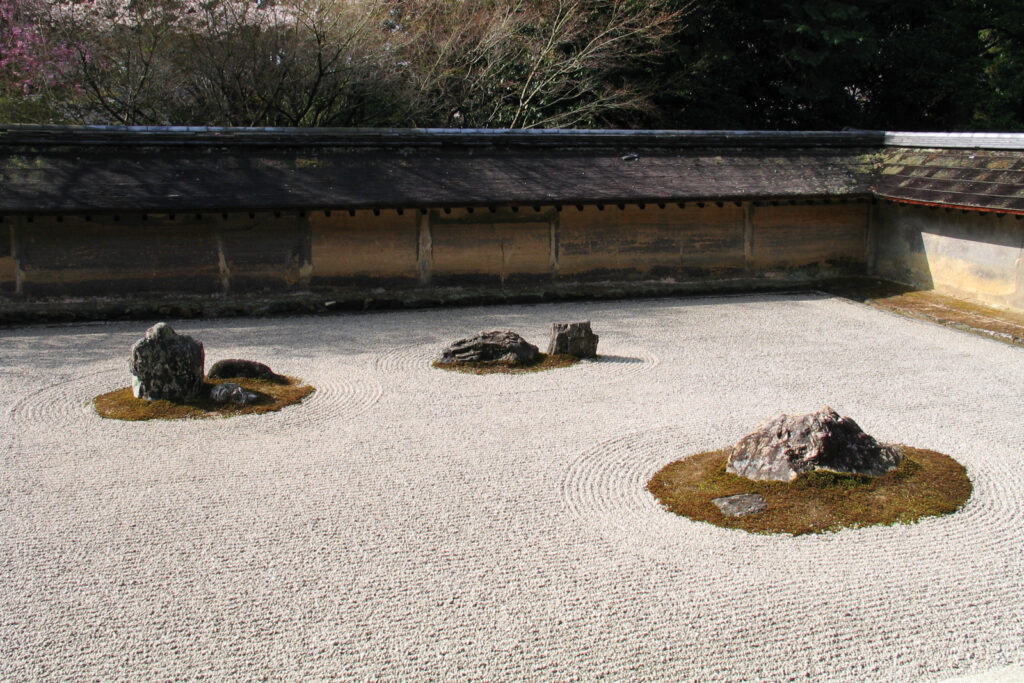
The interval itself, ma, the meaningful space. Silence and emptiness as presence. Yohaku (the blank space of ink painting). The pause. Restraint. The afterglow (yoin) in the space around what is said.
Death / Afterlife
The tradition of ma is aesthetic, not doctrinal. Its teaching is the weight of the empty and the unspoken, a sensibility that runs through daily life and art and says nothing about an afterlife.
Non-Conflict Architecture
An Architecture of Story
The Non-Conflict Architecture GuideWhy Non-Conflict Architecture
Ma builds meaning by where it puts space, silence and the unspoken. There is no villain, no escalating struggle; instead, the story unfolds through restraint. What is not said, the power of the empty space, the small revelation and the afterglow. This is Non-Conflict in a spatial form: the story's depth comes from the interval. Meaning arises in the gaps.
Structural Movement (matching the StoryWorld's cultural steps)
Iwanai Koto (what is not said) → Kūhaku no Chikara (the power of the empty space) → Bimyō na Keiji (the small revelation) → Kyōmei to Yoin (resonance and echo) → Yoin no Musubi (the ending as afterglow).
Key figures
Articulators of the Tradition
Zeami Motokiyo (the great theorist and playwright of Noh, who wrote of the pauses and the "flower" of performance); the masters of ink painting, poetry, and garden design who worked in and taught yohaku and ma. The tradition is carried by the arts and their masters rather than by named mythic figures.
Trickster / Culture Figure
Not applicable, ma is an aesthetic principle, not a mythology of figures. Its "protagonist" is the space itself.
Who’s Who
Sacred elements
Sacred Objects / Elements
The pause. The blank space (yohaku) of the ink painting. The silence of Noh and of music. The interval in architecture and garden. The afterglow (yoin) that lingers.
Sacred Practices
The disciplined use of restraint, silence and space in every art: where to leave the gap, and the nerve not to fill it. The cultivation of the sensibility that perceives the presence of the empty.
Sacred Prohibitions
Do not fill everything; do not over-explain; do not crowd out the space. The meaning of ma is destroyed by the compulsion to fill, to state, to complete. Restraint and trust in the empty are the discipline.
How their stories are told
How Stories Are Told
Through restraint and space, with the unspoken carrying as much as the spoken and the pause as much as the action. A story in the spirit of ma is built as much from what is not said and not shown as from what is; meaning arises in the intervals, the silences, the charged empty spaces, and lingers in the afterglow. This is Non-Conflict: the story unfolds through placed space and a small revelation.
The Purpose of Story
To say by not saying, and to leave an afterglow. Story in the spirit of ma trusts the empty to carry meaning, achieving depth through restraint rather than through conflict and resolution.
Signature Story Types
The spacious narrative and the story of the unspoken, built on pause and restraint.
How their stories are built, step by step
Japanese aesthetic terms (matching the StoryWorld's five cultural steps; the StoryWorld's opening "Ma Concept" is the framing, not a narrative step).
Iwanai Koto / 言わないこと (What Is Not Said)
Cultural meaning
The story is built as much from what is not said as from what is. Ma begins with restraint, the deliberate leaving-unspoken that lets meaning arise in the space. What is withheld, implied, left in silence carries as much as what is stated; the unspoken is a presence, not an absence.
In brief
What is left unsaid speaks most deeply; the space around the word carries the meaning the word cannot.
Cultural teaching
In non-conflict architecture of this spacious kind, begin with restraint, the deliberate leaving-unspoken that lets meaning arise in the space. Ma trusts the unspoken to carry meaning. Establish your story's power of the unsaid: what you deliberately withhold, imply, or leave in silence, so that meaning lives in the space rather than in explicit statement.
Kūhaku no Chikara / 空白の力 (The Power of Emptiness)
Cultural meaning
Kūhaku, the blank or the gap, is a presence in its own right; the empty space carries weight. In ink painting the blank space (yohaku) is as expressive as the ink; in a story, the empty space (the pause, the gap, the unfilled moment) carries its own charged meaning. This step establishes the power of the empty: the deliberate space that is full of meaning.
In brief
The blank space of the painting is not empty; it holds the mist, the distance, the breath. It is full of what is not drawn.
Cultural teaching
Establish the power of the empty, the charged space, the meaningful gap, the deliberate blank that is full rather than lacking. In ma, the blank space (yohaku) is as expressive as the mark. Let your story use the charged empty space (the pause, the gap, the unfilled moment) as a positive, meaningful presence, trusting the empty to carry weight.
Bimyō na Keiji / 微妙な啓示 (Subtle Revelation)
Cultural meaning
Revelation comes subtly, bimyō, the delicate, understated turn that the space allows. There is no confrontation or climax; the meaning arrives obliquely, in one small shift. The revelation is delicate, easy to miss, all the more powerful for its restraint. This is the non-conflict "turn": a quiet revelation, not a clash.
In brief
The deepest revelation arrives softly, in the smallest shift; what is delicate and understated moves the heart more than what is loud.
Cultural teaching
Let your story's turn be a subtle revelation rather than a dramatic confrontation, the delicate, understated shift that the charged space allows. In ma, the meaning shows itself obliquely, in a detail that is easy to miss. Let your story reveal its deepest meaning through restraint, a delicate shift perceived in the space, not a loud clash.
Kyōmei to Yoin / 共鳴と余韻 (Resonance and Echo)
Cultural meaning
Kyōmei (resonance) and yoin (the lingering echo): what was shown keeps sounding in the space after it. What has been revealed goes on sounding in the space around it. The story's meaning is left with the reader, in the space the story has opened. This step is the reverberation of meaning through the charged space.
In brief
The bell is struck once, and the sound lingers long after; the meaning resonates in the silence, echoing beyond the moment.
Cultural teaching
Let meaning resonate and echo in the space, the reverberation (yoin) that lingers after the subtle revelation. In ma, the meaning is left for the reader to finish. Let your story's meaning reverberate, deepening and spreading in the space you have opened, living on in the reader's feeling like the lingering sound of a struck bell.
Yoin no Musubi / 余韻の結び (Conclusion Through Afterglow)
Cultural meaning
Yoin no musubi, the ending as afterglow: the story stops while its feeling is still in the air. Rather than closing a conflict, the story ends by leaving its meaning reverberating in the charged space, the afterglow carrying on after the final note. The ending lingers and leaves the space open, which is ma at its fullest.
In brief
The truest ending does not close; it lingers, an afterglow in the space, resonating on after the last word is gone.
Cultural teaching
End on the afterglow. Stop a breath early, on an image, and let the feeling stay with the reader. In ma, the ending leaves a door open. Let your story close by leaving its meaning to linger, an afterglow that carries on after the final word, resonating in the space rather than resolving and closing.
What makes this tradition distinct
What makes this tradition distinct from all others
Ma builds meaning from the empty, the silent, and the interval, treating negative space, restraint, and the unspoken as positive, charged presences rather than absences. It is Non-Conflict built from space: there is no villain and no escalating struggle. Depth comes from where the gaps are placed, from a small revelation, and from yoin, the feeling that stays after the moment. Its ending is an afterglow, not a resolution.
Cultural warnings — what NOT to do
- Do not import conflict, villains, or escalating struggle, ma is non-conflict; its depth comes from space and restraint.
- Do not over-explain or fill every space, the meaning of ma is destroyed by the compulsion to state and complete.
- Do not treat emptiness as mere absence, in ma the empty is a charged, meaningful presence.
- Do not force a conclusive resolution; a ma ending lingers.
The stories
Each story with its source, where to read it and why it fits.
The StoryWorld in Full
StoryWorld · East Asia — Japan
JAPANESE — Ma (間)
Japanese aesthetic and artistic tradition — developed across Noh theatre, ink painting (sumi-e), poetry, garden design, and music, and rooted in Zen and older Japanese sensibility.
Non Conflict architecture
The world as they see it
Cosmological Structure. A world in which the empty, the silent, and the interval are not absence but presence — where what is not said, not shown, not filled carries meaning as fully as what is. Ma (間) is the pregnant interval, the meaningful space between: between sounds, between forms, between words, between moments. The world is understood through the interplay of the marked and the unmarked, the full and the empty, and the empty is not lack but a charged, meaningful presence.
Creation / Order. The order of ma is the order of interval and space — the meaningful arrangement of emptiness and fullness. Meaning arises not from filling but from the right placement of space, the pause, the gap, the silence that lets things resonate.
Time. The time of ma is the time of the pause, the interval, the pregnant moment held. Ma is temporal as well as spatial — the meaningful silence in music, the held moment in Noh, the pause that carries more than speech. Time is shaped by the placement of intervals, not filled continuously.
The Sacred. The interval itself — ma, the meaningful space. Silence and emptiness as presence. Yohaku (the blank space of ink painting). The pause. Restraint. The resonance and afterglow (yoin) that live in the space around what is expressed.
Death / Afterlife. The tradition of ma is aesthetic rather than doctrinal; its deep teaching is the presence of the empty, the meaning of the unspoken, the resonance that lives in space and silence — a sensibility that shapes the whole of life and art rather than a cosmology of afterlife.
The powers and figures
Articulators of the Tradition
Trickster / Culture Figure
Not applicable — ma is an aesthetic principle, not a mythology of figures. Its "protagonist" is the space itself.
Sacred things and places
Sacred Practices. The disciplined use of restraint, silence, and space in every art — the placement of the meaningful gap, the refusal to fill, the trust in resonance. The cultivation of the sensibility that perceives the presence of the empty.
Sacred Prohibitions. Do not fill everything; do not over-explain; do not crowd out the space. The meaning of ma is destroyed by the compulsion to fill, to state, to complete. Restraint and trust in the empty are the discipline.
How the stories are told
How Stories Are Told. Through restraint and space — the unspoken carrying as much as the spoken, the pause as much as the action, the resonance around the expressed. A story in the spirit of ma is built as much from what is not said and not shown as from what is; meaning arises in the intervals, the silences, the charged empty spaces, and lingers in the afterglow. This is non-conflict architecture: the story does not drive through escalating conflict but unfolds through the meaningful placement of space and the quiet revelation that resonance allows.
The Purpose of Story. To let meaning arise in the space — to say by not saying, to reveal through the interval, to leave resonance and afterglow. Story in the spirit of ma trusts the empty to carry meaning, achieving depth through restraint rather than through conflict and resolution.
Signature Story Types. The quiet, spacious narrative; the story of the unspoken; the account built on pause, restraint, and resonance rather than escalating conflict.
The stories
The Noh Pause
Source Japanese Noh theatre — the pregnant pauses and restraint articulated in the tradition and in Zeami's treatises on the art
Public domain access Zeami's Noh treatises and studies of Noh aesthetics are documented in the public and scholarly record; engage the tradition and its principles rather than reproducing protected translations
Why it fits The pause and restraint of Noh as the enactment of ma — meaning carried in the charged interval rather than in continuous action
Yohaku — the Blank Space of Ink Painting
Source Japanese ink painting (sumi-e) tradition — the expressive blank space (yohaku) as full presence
Public domain access Documented in the art-historical record; many classic ink paintings are public domain, and the principle of yohaku is widely described
Why it fits The power of emptiness made visible — the blank space as charged, meaningful presence, the visual heart of ma
Yoin — the Lingering Resonance
Source Japanese aesthetic tradition — the principle of yoin, the lingering echo and afterglow that carries meaning after the moment
Public domain access Documented in the scholarly record of Japanese aesthetics
Why it fits The resonance and afterglow that conclude a story in the spirit of ma — meaning lingering rather than resolving, the ending as afterglow
How their stories move
Ma builds meaning not through conflict and its resolution but through the meaningful placement of space, silence, and the unspoken. There is no villain, no escalating struggle; instead, the story unfolds through restraint — what is not said, the power of emptiness, the subtle revelation that space allows, the resonance and afterglow that linger. This is non-conflict architecture in a distinctively spatial, atmospheric form: the story achieves its depth through the charged interval rather than through struggle. Meaning arises in the gaps.
Iwanai Koto (what is not said — meaning through restraint) → Kūhaku no Chikara (the power of emptiness — the charged space) → Bimyō na Keiji (subtle revelation — the quiet turn that space allows) → Kyōmei to Yoin (resonance and echo — meaning reverberating in the space) → Yoin no Musubi (conclusion through afterglow — the ending that lingers in resonance rather than resolving a conflict).
This culture
People · Japanese aesthetic and artistic tradition — developed across Noh theatre, ink painting (sumi-e), poetry, garden design, and music, and rooted in Zen and older Japanese sensibility.
Place · East Asia — Japan
Depth · The sensibility of ma is deeply old, articulated across centuries of Japanese art — in the Noh treatises of Zeami (14th–15th century), in ink painting and poetry, and in the broader aesthetic of yohaku (blank space).
Living · Yes — ma remains a living principle in Japanese art, design, architecture, music, and everyday aesthetic sensibility.
Non Conflict worlds
JAPANESE — Kishōtenketsu (起承転結)
CHINESE — Tang Dynasty Qǐchéngzhuǎnhé (起承轉合)
TAOIST PARABLES — Zhuangzi
What makes this tradition distinct
Ma builds meaning from the empty, the silent, and the interval — treating negative space, restraint, and the unspoken as positive, charged presences rather than absences. It is non-conflict architecture in its most spatial and atmospheric form: no villain, no escalating struggle, but depth achieved through the meaningful placement of space, the subtle revelation, and the lingering resonance (yoin) that carries meaning after the moment. Its ending is an afterglow, not a resolution.
Mythology Catalog
- Why it fits: The pause and restraint of Noh as the enactment of ma — meaning carried in the charged interval rather than in continuous action
Story 2: Yohaku — the Blank Space of Ink Painting
- Why it fits: The resonance and afterglow that conclude a story in the spirit of ma — meaning lingering rather than resolving, the ending as afterglow
GriotsWell · Simplified Lore Library · Japanese Ma (間) · July 2026
The Guide
GriotsWell StoryWorlds · Guide
Japanese Ma (間) — the aesthetic of negative space, silence, and the pregnant interval
Non Conflict architecture · 6 steps
How it moves
- Ma Concept (間の概念)
- 言わないこと Iwanai Koto (What is Not Said)
- 空白の力 Kūhaku no Chikara (Power of Emptiness)
- 微妙な啓示 Bimyō na Keiji (Subtle Revelation)
- 共鳴と余韻 Kyōmei to Yoin (Resonance and Echo)
- 余韻の結び Yoin no Musubi (Conclusion Through Afterglow)
Iwanai Koto (what is not said — meaning through restraint) → Kūhaku no Chikara (the power of emptiness — the charged space) → Bimyō na Keiji (subtle revelation — the quiet turn that space allows) → Kyōmei to Yoin (resonance and echo — meaning reverberating in the space) → Yoin no Musubi (conclusion through afterglow — the ending that lingers in resonance rather than resolving a conflict). ---
Why it is told this way
Ma builds meaning not through conflict and its resolution but through the meaningful placement of space, silence, and the unspoken. There is no villain, no escalating struggle; instead, the story unfolds through restraint — what is not said, the power of emptiness, the subtle revelation that space allows, the resonance and afterglow that linger. This is non-conflict architecture in a distinctively spatial, atmospheric form: the story achieves its depth through the charged interval rather than through struggle.
To let meaning arise in the space — to say by not saying, to reveal through the interval, to leave resonance and afterglow. Story in the spirit of ma trusts the empty to carry meaning, achieving depth through restraint rather than through conflict and resolution.
What this StoryWorld asks
- Does your story build meaning from what is not said as much as what is?
- Is the empty space (the pause, the gap) a charged, positive presence rather than a lack?
- Is the "turn" a subtle, delicate revelation rather than a dramatic confrontation?
- Does the story end in lingering afterglow (yoin) rather than the resolution of a conflict?
At a glance
People Japanese aesthetic and artistic tradition — developed across Noh theatre, ink painting (sumi-e), poetry, garden design, and music, and rooted in Zen and older Japanese sensibility.
Region East Asia — Japan
Time depth The sensibility of ma is deeply old, articulated across centuries of Japanese art — in the Noh treatises of Zeami (14th–15th century), in ink painting and poetry, and in the broader aesthetic of yohaku (blank space).
Living tradition Yes — ma remains a living principle in Japanese art, design, architecture, music, and everyday aesthetic sensibility.
How it is carried Japanese. The tradition lives in the arts themselves — the pauses of Noh and music, the blank space of ink painting and poetry, the intervals of architecture and garden — as much as in words. ---
“What is left unsaid speaks most deeply; the space around the word carries the meaning the word cannot.”— Japanese Ma aesthetic tradition
Keep faith with it
- Do not import conflict, villains, or escalating struggle — ma is non-conflict; its depth comes from space and restraint. - Do not over-explain or fill every space — the meaning of ma is destroyed by the compulsion to state and complete. - Do not treat emptiness as mere absence — in ma the empty is a charged, meaningful presence. - Do not force a conclusive resolution — the ma ending lingers in afterglow rather than closing. ---