Babylonian — Enuma Elish
Babylonian: Enuma Elish
The Babylonians of central Mesopotamia, who wrote in Akkadian
A note of respect
The sevenfold cycle is taught as Babylon preserved it, in its own tablets and its own festival. Babylon’s heritage belongs first to the land where it was made, and to the cultures of Iraq today who hold it as their own. The tablets themselves are held in museums in Iraq, Britain, Germany and elsewhere, and new fragments still add lines to the text. The epic was the theology of a temple and a state, and it spoke for Babylon’s king and god; it should be read with that in mind, neither as a universal myth of all Mesopotamia nor as a curiosity, but as the sacred poem of a particular city and its people.
Babylonian
The culture
The Babylonians of central Mesopotamia, who wrote in Akkadian
Where
Middle East: Mesopotamia (modern Iraq)
Time depth
Composed in Akkadian from older Sumerian and Akkadian sources. It is dated to c. 1100 BCE (reign of Nebuchadnezzar I); others place it earlier in the second millennium BCE. Recited annually at the Akitu New Year festival in Babylon.
Living tradition
No: a historical tradition. The temple cult of Babylon ended in antiquity and the epic survives on cuneiform clay tablets, read today through Assyriology and claimed as heritage by the cultures of modern Iraq.
Language
Standard Babylonian, the literary dialect of Akkadian, written in cuneiform on clay. The epic takes its name from its opening words, *enūma eliš*, “when on high”. It runs to seven tablets and a little over a thousand lines of verse, and it was performed aloud: a priest recited the whole poem before Marduk’s statue during the New Year festival. Copies come from Babylon, Kish, Sippar, Ashur, Nineveh and Sultantepe; in Assyrian copies the god Ashur takes Marduk’s place.
The world of its stories
Cosmological Structure
Heaven (*šamû*) above, earth (*erṣetu*) in the middle, and below the earth the Apsû, the sweet-water deep where Ea dwells, with the land of the dead beneath. In the epic, Marduk makes the sky from one half of Tiamat’s body, fixes a bar and sets guards so her waters cannot escape, and assigns Anu, Enlil and Ea their stations in heaven, air and deep. Babylon stands at the centre as the house of the gods on earth, the place where heaven and earth meet.
Creation
Before heaven and earth were named, Apsû (fresh water) and Tiamat (salt water) mingled as one body. From them came Lahmu and Lahamu, then Anshar and Kishar, then Anu and Ea. The young gods’ noise disturbed Apsû; Ea killed him by spell, and Marduk was born in the deep. When Tiamat rose to avenge Apsû, Marduk defeated her, split her body to make sky and earth, set the stars and the calendar, opened the Tigris and Euphrates from her eyes, and had humankind made from the blood of her champion Kingu.
Time
Time is ordered by Marduk’s own hand: in Tablet V he fixes the year, divides it into twelve months with three stars for each, and sets the moon’s phases to mark the days. The Babylonian year began in spring with the month Nisannu, and the Akitu festival held then renewed the order the epic describes. Creation was not a finished event in a distant past; it was repeated and reaffirmed each New Year so that the year to come would stand.
The Sacred
The gods lived in their temples as in houses, present in cult statues brought to life by the mouth-washing ritual (*mīs pî*). People were made, in the epic’s own words, to bear the gods’ labour, so temple service was the purpose of human life: feeding, clothing and praising the gods. Names held power. To be named was to exist, and Marduk’s fifty names gather the powers of the other gods into one king. Destiny (*šīmtu*) was decreed by the gods in assembly.
Death / Afterlife
The dead went down to the netherworld, “the land of no return”, ruled by Ereshkigal and her consort Nergal, where in the poem of Ishtar’s descent dust is food and clay is bread. Each person continued as a ghost (*eṭemmu*) who depended on descendants for the *kispu*, regular offerings of food and water and the calling of the name. A ghost with no one to remember it could wander and trouble the living. The epic itself turns a death to life: Kingu’s blood becomes humankind.
Why Cyclical Architecture
The battle of order and chaos recurs annually; creation is performed, not remembered. Enuma Elish was not read as a record of something finished long ago. It was recited every New Year because the order it describes lapses without renewal: the king laid down his insignia and received them again, the destinies were fixed again, and Marduk was proclaimed king again. Chaos is held within the world, not erased from it: Tiamat’s body is the sky and the earth, bolted and guarded so her waters stay in place. The epic’s structure carries the cycle inside it as well: the young gods disturb Apsû, then Tiamat, so that disruption happens twice before order is won, and the poem closes by asking to be taught and told again.
Structural Logic
The ending (the fifty names) is a door back to the beginning: next year the epic is recited again, because order lapses without renewal. Each turn of the cycle passes through disruption, the mobilising of chaos, the failure of the capable, the transfer of authority to a champion, combat, and world-building out of what was defeated. Resolution is not permanent victory but order sealed for one more turn of the year. The cycle also runs at a human scale. The king who is humbled and restored at the festival, the statue that is carried off and brought home, the temple that falls and is rebuilt: each repeats the same turn, and each restoration is told as Marduk’s order returning to its place.
Structural Movement
Unnamed state → disruption → chaos mobilized → failures → champion’s bargain → combat and world-building from the defeated body → naming, and the wheel turns again.
Key figures
Supreme Being / Creator
Marduk, city god of Babylon, called Bēl, “Lord”. The epic tells how he became king of the gods: the assembly grants him supreme authority before his battle with Tiamat, and after his victory he builds the ordered world and receives fifty names. Apsû and Tiamat are the first begetters, and Anu and Enlil held the highest rank in older tradition; scholars read the epic partly as an account of Marduk’s rise alongside Babylon’s political rise from the time of Hammurabi onward.
Major Deities
- Ea (Sumerian Enki; also called Nudimmud): god of the sweet-water deep, wisdom, craft and incantation. He kills Apsû by a spell of sleep, builds his dwelling on him, fathers Marduk, and fashions humankind from Kingu’s blood.
- Tiamat: the primordial salt sea, mother of the gods. Grieving and provoked after Apsû’s death, she creates eleven monstrous beings, exalts Kingu and gives him the Tablet of Destinies.
- Apsû: the primordial fresh water, first father. His plan to silence the young gods brings the first irreversible deed. His vizier is Mummu.
- Anu: the sky god, son of Anshar. He makes the four winds and gives them to the young Marduk; sent against Tiamat, he turns back.
- Anshar and Kishar: the second divine pair, whose names refer to the whole of heaven and the whole of earth. Anshar presides over the assembly that chooses Marduk; in Assyrian copies he is identified with Ashur.
- Lahmu and Lahamu: the first pair born of Apsû and Tiamat, who later join in proclaiming Marduk king.
- Damkina: Ea’s wife and the mother of Marduk, who bears him in the Apsû.
- Kingu (Qingu): Tiamat’s champion and second husband, holder of the Tablet of Destinies. Judged guilty after the battle, he is executed and his blood becomes humankind.
- Nabû: Marduk’s son, god of writing and scribal learning, whose temple Ezida stood at Borsippa. His statue travelled to Babylon for the New Year festival.
- Zarpanitu (Ṣarpānītu): Marduk’s consort, worshipped with him in the Esagila temple.
Trickster / Culture Figure
Ea is the clever god of Mesopotamian myth, who works by spell, craft and counsel rather than force. He defeats Apsû with an incantation, not a weapon, and in the flood stories he warns the human Atrahasis while keeping the letter of the gods’ oath. In wider tradition Ea sends the seven sages (*apkallū*) to teach the arts of civilisation; Adapa of Eridu, his servant, is the best known.
Ancestor Figures
Within the epic, the successive divine generations: Lahmu and Lahamu, Anshar and Kishar, Anu, Ea. For humankind, the seven sages who lived before the flood, remembered as the first teachers, and the kings listed before and after the flood in king lists. In each family, the dead were honoured through *kispu* offerings, and the heir who poured water for the ghost of the father kept the line remembered. Babylonian scholars traced their learning back to the sages, and the scribes who copied the great texts sometimes named an ancestral family of scholars in their colophons.
Heroes
Marduk is the epic’s champion. Scholars note that his battle draws on older stories of Ninurta, who in the poem of Anzu wins back the Tablet of Destinies from the bird Anzu. In the wider Babylonian tradition the great human heroes are Gilgamesh, king of Uruk, and the flood survivors Atrahasis and Utnapishtim.
Who’s Who
Sacred elements
Sacred Objects
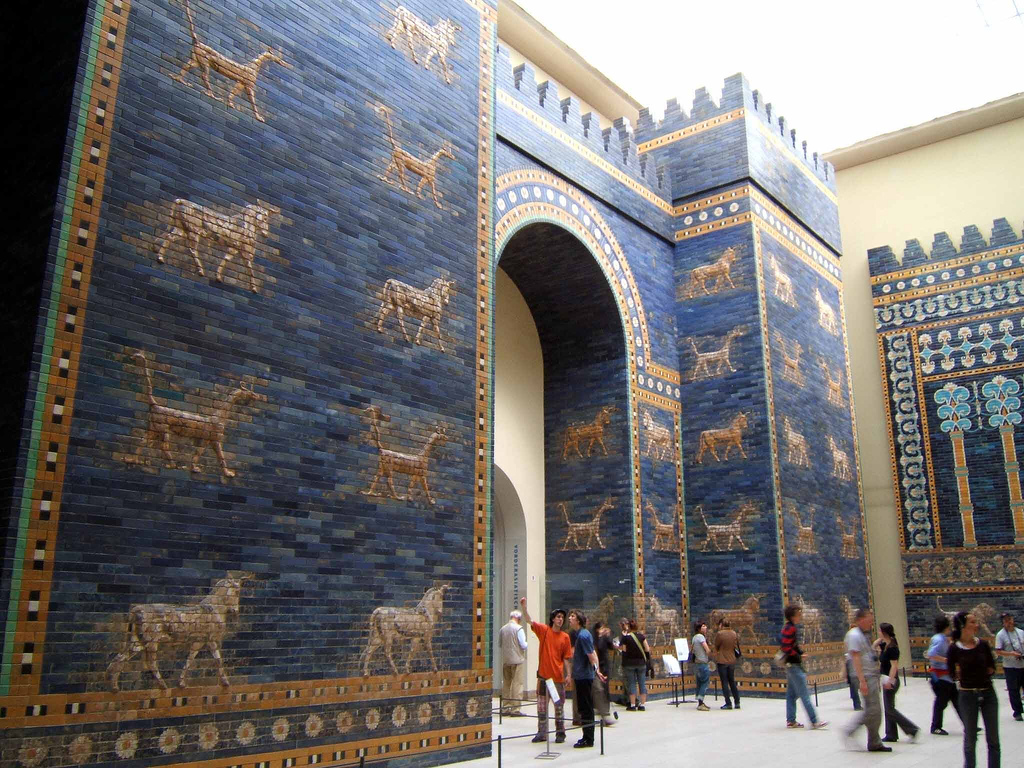
The cult statue of Marduk in Esagila, the god’s living presence. It was carried off more than once, including to Elam, and its return under Nebuchadnezzar I is one reason scholars connect the epic with his reign. The Tablet of Destinies, the mythic tablet that commands fate. Marduk’s emblems: the spade (*marru*) and the serpent-dragon *mušḫuššu*, shown on the Ishtar Gate. His weapons in the epic: bow, mace, net, the winds and the flood-weapon.
Sacred Places
Babylon (Bāb-ili, “gate of the god”), a UNESCO World Heritage Site since 2019. Esagila, Marduk’s temple, and Etemenanki, its ziggurat, “house of the foundation of heaven and earth”. The Akitu house outside the city walls, reached by the Processional Way through the Ishtar Gate. Ezida, Nabû’s temple at Borsippa. Eridu, Ea’s ancient city, where his temple stood over the Apsû.
Sacred Practices
The Akitu festival in the month Nisannu: on the fourth day the high priest recited Enuma Elish before Marduk; on the fifth the king was stripped of his insignia and struck by the priest, and his tears were a good sign; the gods’ statues gathered, destinies were fixed, and Marduk went in procession to the Akitu house. Daily meals for the gods, the mouth-washing ritual for statues, divination by extispicy and by the stars, and incantation rites.
Sacred Prohibitions
Hemerologies, lists of favourable and unfavourable days, forbade certain acts on certain days, and some texts restrict the king on particular days of the month. Oaths sworn by the gods bound absolutely.
How their stories are told
How Stories Are Told
In verse, in Akkadian, written in cuneiform on clay tablets and performed aloud. Enuma Elish opens, “When in the height heaven was not named, / And the earth beneath did not yet bear a name.” The poem was copied, studied and explained in commentaries; one learned text works through Marduk’s fifty names sign by sign. Lines move in pairs that echo each other, and long passages repeat word for word as messages are carried between gods.
Who Tells Them
Scribes (*ṭupšarru*) trained in the tablet-house copied and preserved the literature. Temple specialists performed it: the high priest of Esagila recited the epic at the New Year, lamentation priests sang to calm the gods, and incantation priests spoke the mythic passages within their rites. The epilogue of Enuma Elish asks that the names be pondered and that father teach son.
When They Are Told
Enuma Elish was recited at the Akitu New Year festival in Nisannu, and the ritual texts suggest it was also recited at another festival in the month Kislīmu. Myths were spoken inside incantations when healing or protection was sought, at temple foundations and rebuildings, and in the scribal schools where students copied them.
The Purpose of Story
To keep the world in order. Reciting how Marduk defeated chaos and built the world renewed his kingship and Babylon’s place at the centre. Stories also explained why humans serve the gods, why the dead need remembering, and how kingship came down from heaven. In incantations, telling how a thing first came to be gave power over it.
Signature Story Types
Creation and kingship epics (Enuma Elish), flood narratives (Atrahasis, Gilgamesh Tablet XI), descents to the netherworld (Ishtar’s descent, Nergal and Ereshkigal), hero epics (Gilgamesh, Anzu), stories of sages and lost immortality (Adapa), poems of divine wrath (Erra and Ishum), and short mythic passages inside incantations.
How their stories are built, step by step
Seven steps, one for each of the epic’s seven tablets. Each step title gives the epic’s own moment followed by its meaning in English.
Enuma Elish, When On High
Cultural meaning
The primordial state before names. Fresh and salt water mingle; nothing is yet distinguished. Apsû and Tiamat lie together as one body, with no pasture formed and no reed-bed seen, and no gods yet named. Naming will be creation’s first act: in Babylonian thought, to be unnamed is not yet to exist.
In brief
Before the order of the world comes, there is only what has not yet been told apart.
Apsu’s Slaying, The First Disruption
Cultural meaning
New vitality disturbs old stillness; wisdom strikes first. The young gods’ clamor provokes Apsu, who plans with his vizier Mummu to silence them; Ea’s quiet incantation is the first irreversible deed. Ea pours sleep over Apsû, kills him, and builds his dwelling on the deep, and there Marduk is born.
In brief
The first deed that cannot be undone is often done quietly.
Tiamat Rises. Chaos Mobilizes
Cultural meaning
Chaos returns as organized counter-creation. Provoked by the gods who cannot rest, Tiamat makes eleven monstrous beings, exalts Kingu as her champion, and gives him the Tablet of Destinies. Eleven monsters, a champion exalted, the Tablet of Destinies seized: chaos builds its own legitimacy, with its own army, its own leader and its own claim to fate.
In brief
Chaos does not come back as noise. It comes back with an army and a title.
The Gods’ Fear. None Can Stand
Cultural meaning
The capable ones fail first. Anshar hears of Tiamat’s army and sends his strongest. Ea turns back; Anu cannot face her. The assembly sits in silence and fear. The failures teach what the true answer must be: not cunning alone, not rank alone.
In brief
Each one who turns back shows what the one who goes forward will need.
Marduk’s Bargain, The Champion Chosen
Cultural meaning
Authority consciously transferred, tested, sealed. Marduk agrees to fight, but only if the assembly makes his word supreme. The gods gather at a banquet and grant it. “My word, like yours, shall fix fate”. The garment destroyed and restored by speech alone: to prove the power, the gods set an object before him (a garment in some readings, a constellation in others), and Marduk’s word destroys it and makes it whole. Then he is armed: bow, mace, net, the winds, the storm-chariot.
In brief
The champion does not take power. The champion asks for it, and it is given in the open.
The Combat. Order Against Chaos
Cultural meaning
The world built from the defeated body. Marduk drives the wind into Tiamat’s open mouth, shoots an arrow that splits her heart, nets her helpers and takes the Tablet of Destinies from Kingu. He splits her in two like a fish for drying; sky and earth raised from her halves; the stars set, the months fixed, the rivers opened from her eyes; humankind made from Kingu’s blood.
In brief
What opposed the new order becomes the material it is built from.
The Fifty Names, The Cycle Renewed
Cultural meaning
Order sealed by naming, and the wheel turns. The grateful gods build Babylon and Esagila as Marduk’s house, and in assembly they proclaim his fifty names, each a power or office, among them names once held by other gods. The names are proclaimed; next New Year the epic is recited again. The ending is a door.
In brief
The story ends by being told again.
What makes this tradition distinct
What makes this tradition distinct from all others
Enuma Elish is a creation story that was also a working ritual: it was recited each year so that the order it describes would hold for another year. Creation, kingship, the calendar and the city of Babylon are made in one movement, and the world is built out of the defeated power itself. Authority is not seized but granted by an assembly, tested, and sealed by speech, and the whole poem ends in naming. It is one of the oldest surviving written creation narratives. It is also a text about writing and naming: the fate of the world is held on a tablet, power passes with that tablet, and the closing names are meant to be studied, explained and handed down by the learned, father to son.
What NOT to do in this StoryWorld
- Do not make Tiamat a simple evil monster: she is the mother of the gods, provoked by grief and by the gods around her, and her body becomes the world
- Do not end with chaos destroyed forever: it is bounded, guarded and built into the world, and must be faced again
- Do not let the champion take power by force alone: in this tradition authority is asked for, granted and proven
- Do not treat the ending as final: the fifty names lead back to the next telling
- Do not borrow Greek or later European dragon-slaying patterns as if they were the source: this story is older and has its own logic
Genre affinities
Mythic fantasy, political epics, founding-of-order narratives, stories where institutions must be maintained or decay. Also stories of succession between generations, of a younger power proving itself before its elders, and of cities and states that tell their founding story each year to keep it true.
Craft note
The masterstroke is transformation, not destruction: build the new world visibly out of the antagonist’s substance. Let the reader see the old power in the finished world: the sky that was Tiamat, the rivers that were her eyes, the people made from Kingu’s blood. Give the champion a price to ask and a test to pass, and close with a ceremony of naming that clearly points to the next telling.
The stories
Each story with its source, where to read it and why it fits.
The StoryWorld in Full
StoryWorld · Middle East — Mesopotamia (modern Iraq)
BABYLONIAN — Enuma Elish
Babylonian civilization — Akkadian-speaking, central Mesopotamia
Cyclical architecture
The world as they see it
Core cosmology. Before names, the fresh water (Apsu) and the salt sea (Tiamat) mingle as one body. Naming is creation’s first act; to be unnamed is not yet to exist.
Order and chaos. Order is not chaos destroyed but chaos transformed — the world is built from Tiamat’s divided body. Chaos is held, not erased, and must be re-defeated annually.
The annual renewal. The world is recreated each New Year through the full recitation of the epic — story as the engine of cosmic maintenance.
The powers and figures
Marduk
Champion of the gods — bargains supremacy for battle, divides Tiamat, builds the ordered world from her body, receives fifty names.
Tiamat
Primordial saltwater, chaos-mother — rises with an army of eleven monsters when Apsu is slain.
Apsu
Primordial freshwater, first father — his plan to silence the young gods brings the first irreversible act.
Ea / Enki
God of wisdom — slays Apsu by incantation; father of Marduk.
Kingu
Tiamat’s champion, holder of the Tablet of Destinies — from his blood humankind is made to carry the gods’ labor.
Sacred things and places
The Akitu Festival. The Babylonian New Year; on Day 4 the epic was recited entire before Marduk’s statue.
The Tablet of Destinies. Whoever holds it commands fate — seized by Kingu, won by Marduk.
The Fifty Names. Order sealed by speech — each proclaimed name a power.
The Seven Tablets. The epic’s own sevenfold body, the structure of the cycle.
How the stories are told
Form. Akkadian epic verse on seven cuneiform tablets; ceremonial recitation as ritual performance.
How their stories move
The battle of order and chaos recurs annually; creation is performed, not remembered. The ending — the fifty names — is a door back to the beginning: next year the epic is recited again, because order lapses without renewal.
The sevenfold cycle is taught as Babylon preserved it — in its own tablets and its own festival.
This culture
People · Babylonian civilization — Akkadian-speaking, central Mesopotamia
Place · Middle East — Mesopotamia (modern Iraq)
Living · Historical civilization; textual tradition preserved on cuneiform tablets
Cyclical worlds
NATIVE AMERICAN — Animal Guide Journey (Structural Tradition)
NAHUA / MEXICA — Aztec Codex (Amoxtli)
BAKONGO — Congo Cosmogram
DOGON — Creation Cycle
KOJIKI / SHINTO — Amaterasu
K'ICHE' MAYA — Creation Cycle (Popol Vuh)
LAKOTA — Medicine Wheel / Sacred Hoop (Structural Tradition)
NATIVE AMERICAN — Medicine Wheel Story (Circular Narrative, Structural Tradition)
PHILIPPINE — Bathala / Diwata
The World As They See It
Core cosmology
Before names, the fresh water (Apsu) and the salt sea (Tiamat) mingle as one body. Naming is creation’s first act; to be unnamed is not yet to exist.
Key Figures
Kingu
Tiamat’s champion, holder of the Tablet of Destinies — from his blood humankind is made to carry the gods’ labor.
Sacred Elements
The Seven Tablets
The epic’s own sevenfold body, the structure of the cycle.
The Architecture
Signature movement
Unnamed state → disruption → chaos mobilized → failures → champion’s bargain → combat and world-building from the defeated body → naming, and the wheel turns again.
The Guide
GriotsWell StoryWorlds · Guide
Babylonian — Enuma Elish
Cyclical architecture · 7 steps
How it moves
- Enuma Elish — When On High
- Apsu’s Slaying — The First Disruption
- Tiamat Rises — Chaos Mobilizes
- The Gods’ Fear — None Can Stand
- Marduk’s Bargain — The Champion Chosen
- The Combat — Order Against Chaos
- The Fifty Names — The Cycle Renewed
Unnamed state → disruption → chaos mobilized → failures → champion’s bargain → combat and world-building from the defeated body → naming, and the wheel turns again.
Why it is told this way
The battle of order and chaos recurs annually; creation is performed, not remembered. The ending — the fifty names — is a door back to the beginning: next year the epic is recited again, because order lapses without renewal.
Akkadian epic verse on seven cuneiform tablets; ceremonial recitation as ritual performance.
Where writers take it
Mythic fantasy, political epics, founding-of-order narratives, stories where institutions must be maintained or decay.
At a glance
People Babylonian civilization — Akkadian-speaking, central Mesopotamia
Region Middle East — Mesopotamia (modern Iraq)
Time depth Compiled c. 1100 BCE from older Sumerian-Akkadian sources; recited annually at the Akitu New Year festival
Living tradition Historical civilization; textual tradition preserved on cuneiform tablets
How it is carried Akkadian epic verse on seven cuneiform tablets; ceremonial recitation as ritual performance.
“When in the height heaven was not named, / And the earth beneath did not yet bear a name.”— Enuma Elish, Tablet I
Keep faith with it
The masterstroke is transformation, not destruction: build the new world visibly out of the antagonist’s substance.
Engaged through the public-domain scholarly translation (L. W.