← The Cultures Behind the StoryWorlds
Oceania — the Trobriand Islands and Milne Bay, Papua New Guinea
Trobriand & Melanesian Cultures — Ancestor Presence
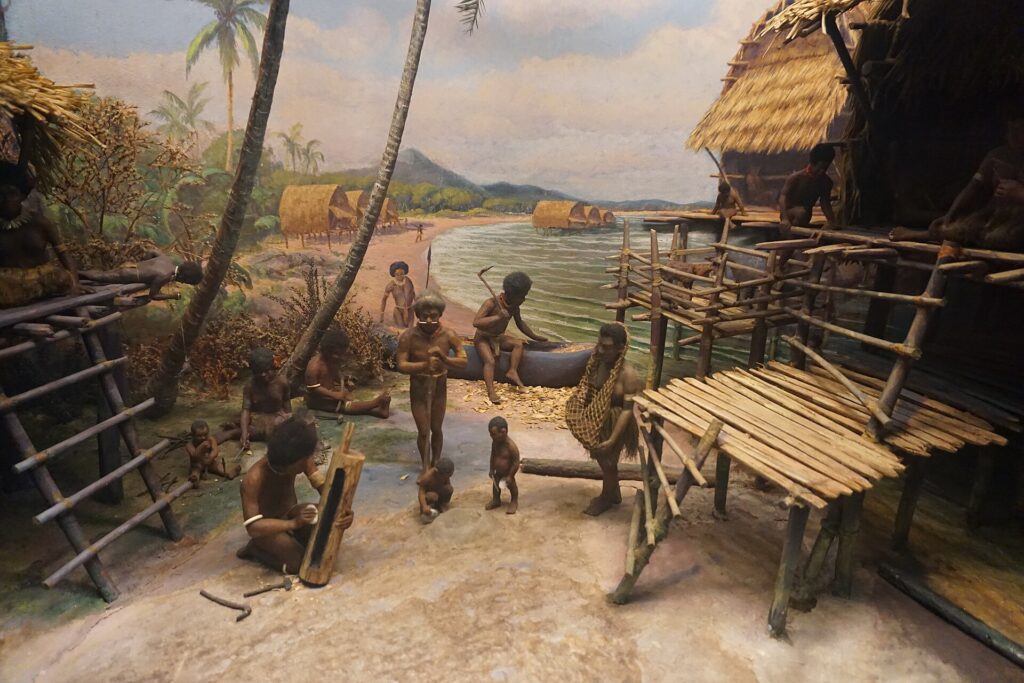
StoryWorld comingThe Trobriand Islanders of Kiriwina and the other Massim island cultures of Milne Bay, Papua New Guinea, whose Kula exchange ties island to island; with the feast-giving and the earned leadership of the 'big man' that cultures of the Papua New Guinea Highlands and the Solomon Islands also know. Melanesia's are many, more than 800 languages are spoken in Papua New Guinea alone, and each holds its own traditions.
The World As They See It
Cosmological Structure. The world is a field of relationships more than a stack of heavens. The living occupy villages, gardens, reefs and sea lanes; the dead (baloma) live on Tuma, an island to the northwest; spirits of other kinds dwell in trees, rocks and the sea. People belong to one of four matrilineal clans (kumila): Malasi, Lukuba, Lukwasisiga and Lukulabuta, each divided into subclans (dala) that hold land, rank, magic and myth. Beyond the Trobriands, the Kula ring links islands in a great circle of named partners and travelling valuables.
Creation. Trobriand tradition, as recorded, tells of no single act of world-making. Instead each dala traces its origin to a particular spot, a hole in the ground, a grotto or a stone, where its first ancestors, a woman and sometimes her brother, came up from beneath the earth, already holding their magic, their rank and their right to the land around that spot. The best known account, at Obukula near the village of Laba'i, explains why the Malasi clan holds the highest rank. Gardening and order were later brought by the culture hero Tudava.
Time. Time turns with the garden year. Clearing, planting, weeding and the great yam harvest set the calendar, and the season of milamala, after the harvest, is when the spirits of the dead return to their villages. Lives also turn in a circle: the baloma age on Tuma, slough their skins to become young again, and at last become spirit children (waiwaia) who return to enter a woman of their own dala. The Kula adds a second clock, the slow years it takes a valuable to travel the ring.
The Sacred. Power is held in words and in relationships. Magic (megwa) is spoken, inherited and owned; a garden, a canoe, a Kula voyage or a courtship succeeds when the right spell is spoken by the right person. Land, rank and spells come from the first ancestors of the dala and are held in trust for them. Exchange is itself weighty: every gift calls for a return, and a person's name and renown (in Gawa the word is butu, fame) grow as valuables and food move through their hands.
Death / Afterlife. At death the person divides. A kosi, a lingering ghost, stays briefly near the village; the baloma travels to Tuma, where Topileta, the keeper of the entrance, receives it. Life on Tuma resembles life in the villages, though gentler. The living answer a death with long mourning and with the women's great distribution of banana-leaf bundles and fibre skirts (sagali), which, as Annette Weiner showed, restores the dala's identity and settles the debts of the dead person's life.
The Figures
Sacred Elements
Sacred Objects. Kula valuables (vaygu'a): red shell-disc necklaces (soulava, also bagi) that travel the ring clockwise, and white armshells (mwali) that travel anticlockwise. Each famous piece has a name and a remembered line of holders. Polished stone axe blades (beku) are also valuables. Yams, above all the taytu stored in decorated yam houses (bwayma), are wealth and honour. Women's banana-leaf bundles and fibre skirts carry the dala's worth at mortuary distributions. Carved canoe prowboards (lagim and tabuyo) belong with Kula magic.
Sacred Places. Tuma, the island of the dead to the northwest. The emergence spots of the dala, including Obukula near Laba'i. The central plaza (baku) of each village, where dances, distributions and gatherings happen, and the yam houses that face it. The gardens, where garden magic is spoken. On the Kula route, Sarubwoyna beach near Dobu, where Trobriand crews make themselves beautiful with magic before meeting their partners.
Sacred Practices. Garden magic, led by the garden magician (towosi) at each stage of the year and recorded at length in Coral Gardens and Their Magic (1935). The harvest gifts of yams from a man to his sister's household (urigubu), and competitive displays of produce (kayasa). The Kula voyage, prepared with canoe-building rites and Kula magic (mwasila). The season of milamala, with dancing and food set out for the returning baloma. The women's sagali distributions after a death.
Sacred Prohibitions. Taboos (bomala) bind persons, subclans and seasons: certain foods are forbidden to particular subclans and to people of rank, and gardens and canoes are placed under restriction while magic is at work. Marriage within one's own clan is forbidden, and a breach (suvasova) is a grave matter. Brother and sister keep strict avoidance in all matters of courtship. The words of spells belong to their owners and are passed only to the rightful heirs.
The Shape This StoryWorld Shares
`web`
Web / Network. The story’s true protagonist is the network: meaning lives in the connections, a gift traveling, an obligation ripening, an ancestral presence felt at many points at once. The full pattern is visible only from the whole network. In the Kula, a necklace moves one way and an armshell the other, and each exchange binds two named partners for life; no single partner ever sees the whole ring. In the village, every yam given at harvest and every bundle given at a death answers an older gift and calls for a new one. A Trobriand story is therefore a story of threads: who gave to whom, who owes, whose ancestor stands behind which claim.
Stories move toward reciprocity made visible. A valuable or a gift enters the network and changes standing; an obligation ripens; an ancestral claim is felt along the lines of kin; a failure to answer a gift sends damage outward from strand to strand; and a great gathering, a distribution, a harvest display or a Kula meeting, brings every thread into the open at once. Resolution is not victory over an enemy but a network re-tied in a new pattern, with names and renown redistributed, and the gift moving on.
Map the network → a gift moves → the ancestral thread → a thread breaks and the damage spreads → the great gathering makes it all visible → the web remade, and the gift moves on.
Melanesia’s hundreds of distinct cultures each hold their own traditions. The words of Trobriand spells are owned property, handed down within the dala, and the entry names them without giving them.