← The Cultures Behind the StoryWorlds
Middle East: Mesopotamia (modern Iraq)
Babylonian — Enuma Elish
StoryWorld comingThe Babylonians of central Mesopotamia, who wrote in Akkadian
The World As They See It
Cosmological Structure. Heaven (*šamû*) above, earth (*erṣetu*) in the middle, and below the earth the Apsû, the sweet-water deep where Ea dwells, with the land of the dead beneath. In the epic, Marduk makes the sky from one half of Tiamat’s body, fixes a bar and sets guards so her waters cannot escape, and assigns Anu, Enlil and Ea their stations in heaven, air and deep. Babylon stands at the centre as the house of the gods on earth, the place where heaven and earth meet.
Creation. Before heaven and earth were named, Apsû (fresh water) and Tiamat (salt water) mingled as one body. From them came Lahmu and Lahamu, then Anshar and Kishar, then Anu and Ea. The young gods’ noise disturbed Apsû; Ea killed him by spell, and Marduk was born in the deep. When Tiamat rose to avenge Apsû, Marduk defeated her, split her body to make sky and earth, set the stars and the calendar, opened the Tigris and Euphrates from her eyes, and had humankind made from the blood of her champion Kingu.
Time. Time is ordered by Marduk’s own hand: in Tablet V he fixes the year, divides it into twelve months with three stars for each, and sets the moon’s phases to mark the days. The Babylonian year began in spring with the month Nisannu, and the Akitu festival held then renewed the order the epic describes. Creation was not a finished event in a distant past; it was repeated and reaffirmed each New Year so that the year to come would stand.
The Sacred. The gods lived in their temples as in houses, present in cult statues brought to life by the mouth-washing ritual (*mīs pî*). People were made, in the epic’s own words, to bear the gods’ labour, so temple service was the purpose of human life: feeding, clothing and praising the gods. Names held power. To be named was to exist, and Marduk’s fifty names gather the powers of the other gods into one king. Destiny (*šīmtu*) was decreed by the gods in assembly.
Death / Afterlife. The dead went down to the netherworld, “the land of no return”, ruled by Ereshkigal and her consort Nergal, where in the poem of Ishtar’s descent dust is food and clay is bread. Each person continued as a ghost (*eṭemmu*) who depended on descendants for the *kispu*, regular offerings of food and water and the calling of the name. A ghost with no one to remember it could wander and trouble the living. The epic itself turns a death to life: Kingu’s blood becomes humankind.
The Figures
Sacred Elements
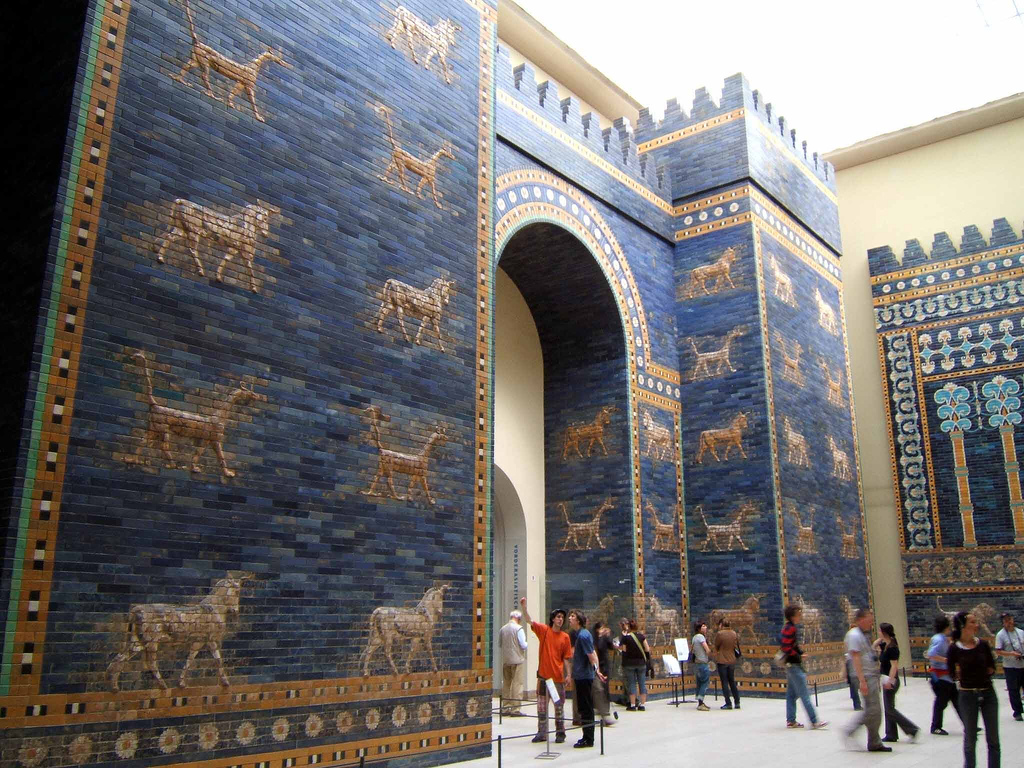
Sacred Objects. The cult statue of Marduk in Esagila, the god’s living presence. It was carried off more than once, including to Elam, and its return under Nebuchadnezzar I is one reason scholars connect the epic with his reign. The Tablet of Destinies, the mythic tablet that commands fate. Marduk’s emblems: the spade (*marru*) and the serpent-dragon *mušḫuššu*, shown on the Ishtar Gate. His weapons in the epic: bow, mace, net, the winds and the flood-weapon.
Sacred Places. Babylon (Bāb-ili, “gate of the god”), a UNESCO World Heritage Site since 2019. Esagila, Marduk’s temple, and Etemenanki, its ziggurat, “house of the foundation of heaven and earth”. The Akitu house outside the city walls, reached by the Processional Way through the Ishtar Gate. Ezida, Nabû’s temple at Borsippa. Eridu, Ea’s ancient city, where his temple stood over the Apsû.
Sacred Practices. The Akitu festival in the month Nisannu: on the fourth day the high priest recited Enuma Elish before Marduk; on the fifth the king was stripped of his insignia and struck by the priest, and his tears were a good sign; the gods’ statues gathered, destinies were fixed, and Marduk went in procession to the Akitu house. Daily meals for the gods, the mouth-washing ritual for statues, divination by extispicy and by the stars, and incantation rites.
Sacred Prohibitions. Hemerologies, lists of favourable and unfavourable days, forbade certain acts on certain days, and some texts restrict the king on particular days of the month. Oaths sworn by the gods bound absolutely.
The Shape This StoryWorld Shares
`cyclical`
The battle of order and chaos recurs annually; creation is performed, not remembered. Enuma Elish was not read as a record of something finished long ago. It was recited every New Year because the order it describes lapses without renewal: the king laid down his insignia and received them again, the destinies were fixed again, and Marduk was proclaimed king again. Chaos is held within the world, not erased from it: Tiamat’s body is the sky and the earth, bolted and guarded so her waters stay in place. The epic’s structure carries the cycle inside it as well: the young gods disturb Apsû, then Tiamat, so that disruption happens twice before order is won, and the poem closes by asking to be taught and told again.
The ending (the fifty names) is a door back to the beginning: next year the epic is recited again, because order lapses without renewal. Each turn of the cycle passes through disruption, the mobilising of chaos, the failure of the capable, the transfer of authority to a champion, combat, and world-building out of what was defeated. Resolution is not permanent victory but order sealed for one more turn of the year. The cycle also runs at a human scale. The king who is humbled and restored at the festival, the statue that is carried off and brought home, the temple that falls and is rebuilt: each repeats the same turn, and each restoration is told as Marduk’s order returning to its place.
Unnamed state → disruption → chaos mobilized → failures → champion’s bargain → combat and world-building from the defeated body → naming, and the wheel turns again.
The sevenfold cycle is taught as Babylon preserved it, in its own tablets and its own festival. Babylon’s heritage belongs first to the land where it was made, and to the cultures of Iraq today who hold it as their own. The tablets themselves are held in museums in Iraq, Britain, Germany and elsewhere, and new fragments still add lines to the text. The epic was the theology of a temple and a state, and it spoke for Babylon’s king and god; it should be read with that in mind, neither as a universal myth of all Mesopotamia nor as a curiosity, but as the sacred poem of a particular city and its people.