Trobriand & Melanesian Cultures — Ancestor Presence
Trobriand and Massim islands, ancestor presence and the Kula exchange
The Trobriand Islanders of Kiriwina and the other Massim island cultures of Milne Bay, Papua New Guinea, whose Kula exchange ties island to island; with the feast-giving and the earned leadership of the 'big man' that cultures of the Papua New Guinea Highlands and the Solomon Islands also know. Melanesia's are many, more than 800 languages are spoken in Papua New Guinea alone, and each holds its own traditions.
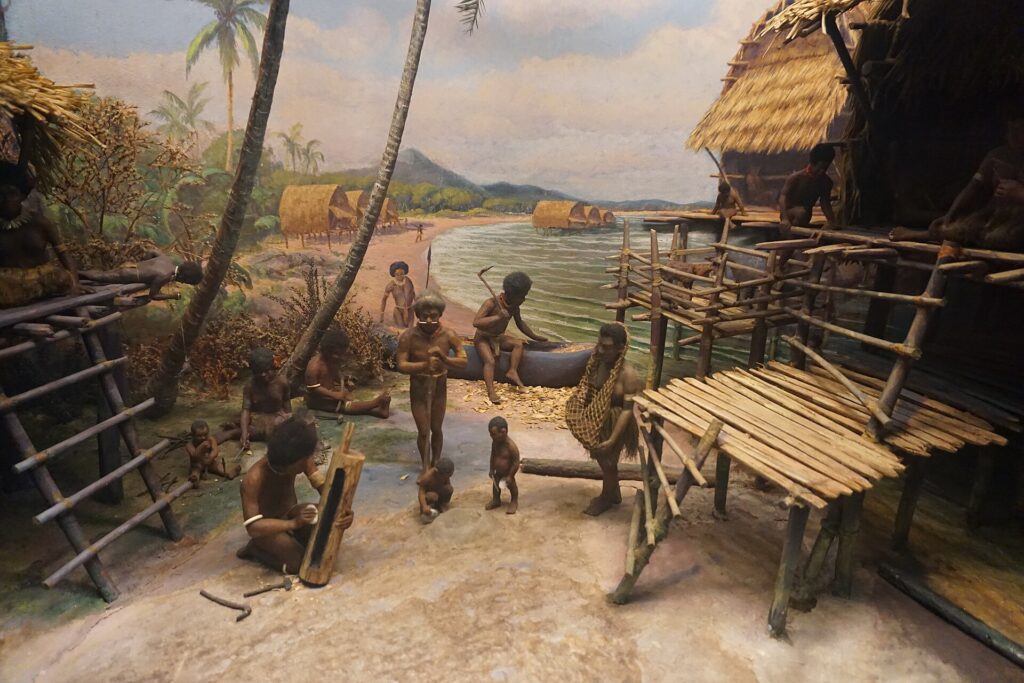
A note of respect
Melanesia’s hundreds of distinct cultures each hold their own traditions. The words of Trobriand spells are owned property, handed down within the dala, and the entry names them without giving them.
Trobriand & Melanesian Cultures
The culture
The Trobriand Islanders of Kiriwina and the other Massim island cultures of Milne Bay, Papua New Guinea, whose Kula exchange ties island to island; with the feast-giving and the earned leadership of the 'big man' that cultures of the Papua New Guinea Highlands and the Solomon Islands also know. Melanesia's are many, more than 800 languages are spoken in Papua New Guinea alone, and each holds its own traditions.
Where
Oceania — the Trobriand Islands and Milne Bay, Papua New Guinea
Time depth
People have lived in New Guinea for more than 50,000 years.
Living tradition
Yes. Hundreds of distinct living cultures. On the Trobriands the yam harvest, the harvest season of milamala, the women's mortuary distributions and the Kula itself continue today, alongside Christianity, schooling and cash, and the islanders adapt them as they have always done.
Language
Kilivila (also called Kiriwina), an Austronesian language of the Trobriand Islands; neighbouring Kula speak their own languages, among them Dobu, Muyuw (Woodlark) and the languages of the Amphlett Islands and Gawa. Story lives in spoken myth and tale, in magical spells (megwa) owned and handed down within the matrilineage, in songs and dances, in public oratory at distributions, and in the remembered names and histories of the Kula valuables themselves.
The world of its stories
Cosmological Structure
The world is a field of relationships more than a stack of heavens. The living occupy villages, gardens, reefs and sea lanes; the dead (baloma) live on Tuma, an island to the northwest; spirits of other kinds dwell in trees, rocks and the sea. People belong to one of four matrilineal clans (kumila): Malasi, Lukuba, Lukwasisiga and Lukulabuta, each divided into subclans (dala) that hold land, rank, magic and myth. Beyond the Trobriands, the Kula ring links islands in a great circle of named partners and travelling valuables.
Creation
Trobriand tradition, as recorded, tells of no single act of world-making. Instead each dala traces its origin to a particular spot, a hole in the ground, a grotto or a stone, where its first ancestors, a woman and sometimes her brother, came up from beneath the earth, already holding their magic, their rank and their right to the land around that spot. The best known account, at Obukula near the village of Laba'i, explains why the Malasi clan holds the highest rank. Gardening and order were later brought by the culture hero Tudava.
Time
Time turns with the garden year. Clearing, planting, weeding and the great yam harvest set the calendar, and the season of milamala, after the harvest, is when the spirits of the dead return to their villages. Lives also turn in a circle: the baloma age on Tuma, slough their skins to become young again, and at last become spirit children (waiwaia) who return to enter a woman of their own dala. The Kula adds a second clock, the slow years it takes a valuable to travel the ring.
The Sacred
Power is held in words and in relationships. Magic (megwa) is spoken, inherited and owned; a garden, a canoe, a Kula voyage or a courtship succeeds when the right spell is spoken by the right person. Land, rank and spells come from the first ancestors of the dala and are held in trust for them. Exchange is itself weighty: every gift calls for a return, and a person's name and renown (in Gawa the word is butu, fame) grow as valuables and food move through their hands.
Death / Afterlife
At death the person divides. A kosi, a lingering ghost, stays briefly near the village; the baloma travels to Tuma, where Topileta, the keeper of the entrance, receives it. Life on Tuma resembles life in the villages, though gentler. The living answer a death with long mourning and with the women's great distribution of banana-leaf bundles and fibre skirts (sagali), which, as Annette Weiner showed, restores the dala's identity and settles the debts of the dead person's life.
Why Web Architecture
Web / Network. The story’s true protagonist is the network: meaning lives in the connections, a gift traveling, an obligation ripening, an ancestral presence felt at many points at once. The full pattern is visible only from the whole network. In the Kula, a necklace moves one way and an armshell the other, and each exchange binds two named partners for life; no single partner ever sees the whole ring. In the village, every yam given at harvest and every bundle given at a death answers an older gift and calls for a new one. A Trobriand story is therefore a story of threads: who gave to whom, who owes, whose ancestor stands behind which claim.
Structural Logic
Stories move toward reciprocity made visible. A valuable or a gift enters the network and changes standing; an obligation ripens; an ancestral claim is felt along the lines of kin; a failure to answer a gift sends damage outward from strand to strand; and a great gathering, a distribution, a harvest display or a Kula meeting, brings every thread into the open at once. Resolution is not victory over an enemy but a network re-tied in a new pattern, with names and renown redistributed, and the gift moving on.
Structural Movement
Map the network → a gift moves → the ancestral thread → a thread breaks and the damage spreads → the great gathering makes it all visible → the web remade, and the gift moves on.
Key figures
Supreme Being / Creator
None is recorded. Trobriand belief has no high god or creator: authority comes instead from the first ancestors who emerged from the earth, from the culture hero Tudava, and from the inherited magic of each dala. Most Trobriand Islanders are now Christian, and many hold church and ancestral practice side by side.
Major Spirits
- Baloma: the spirits of the dead, who live on Tuma, return to their villages during milamala, and at last send spirit children back to the living.
- Kosi: the short-lived ghost that lingers near the village after a death, sometimes heard or glimpsed, harmless but unsettling.
- Waiwaia: spirit children, the rejuvenated dead, carried by a baloma to a woman of their own dala so that the matrilineage renews itself.
- Topileta: the keeper of the entrance to the land of the dead on Tuma, who receives the newly arrived baloma.
- Tokway: spirits that live in trees and rocks near gardens and villages, sometimes mischievous, sometimes the source of illness or of a stolen crop.
- Tauva'u: dangerous non-human beings, said to come from the south, held responsible for epidemics; they may appear in the shape of a reptile.
- Mulukwausi: women with the hidden power to fly through the air, feared above all by sailors at sea; Kula crews carry protective magic (kayga'u) against them.
Trickster / Culture Figure
Tudava is the great culture hero. He is conceived in a grotto by water dripping from the rock, grows up to kill the man-eating ogre Dokonikan who had driven the people from Kiriwina, and then travels the islands teaching gardening and the proper ways of life. Versions differ in detail from village to village, and many communities claim a share of his passage.
Ancestor Figures
The founders of each dala, who came up from the ground at their emergence spots, are the ancestral anchors of land and rank. The Tabalu subclan of the Malasi clan, whose chief lived at Omarakana, traces its high rank to such an origin. Every family's own baloma, honoured with food and gifts during milamala, keeps the ancestors present in ordinary life.
Heroes
- Tudava: slayer of Dokonikan and bringer of gardens.
- Mokatuboda of the Kudayuri: the man of Kitava whose canoe flew through the air, until his own kin killed him to gain its magic and found the art of flight lost.
- Kasabwaybwayreta: the old Kula sailor of Tewara who, abandoned by his companions, renews his youth and wins the famous necklace Gumakarakedakeda.
- The brother and sister of Kumilabwaga: tragic figures of the myth that tells how love magic began.
Who’s Who
Sacred elements
Sacred Objects
Kula valuables (vaygu'a): red shell-disc necklaces (soulava, also bagi) that travel the ring clockwise, and white armshells (mwali) that travel anticlockwise. Each famous piece has a name and a remembered line of holders. Polished stone axe blades (beku) are also valuables. Yams, above all the taytu stored in decorated yam houses (bwayma), are wealth and honour. Women's banana-leaf bundles and fibre skirts carry the dala's worth at mortuary distributions. Carved canoe prowboards (lagim and tabuyo) belong with Kula magic.
Sacred Places
Tuma, the island of the dead to the northwest. The emergence spots of the dala, including Obukula near Laba'i. The central plaza (baku) of each village, where dances, distributions and gatherings happen, and the yam houses that face it. The gardens, where garden magic is spoken. On the Kula route, Sarubwoyna beach near Dobu, where Trobriand crews make themselves beautiful with magic before meeting their partners.
Sacred Practices
Garden magic, led by the garden magician (towosi) at each stage of the year and recorded at length in Coral Gardens and Their Magic (1935). The harvest gifts of yams from a man to his sister's household (urigubu), and competitive displays of produce (kayasa). The Kula voyage, prepared with canoe-building rites and Kula magic (mwasila). The season of milamala, with dancing and food set out for the returning baloma. The women's sagali distributions after a death.
Sacred Prohibitions
Taboos (bomala) bind persons, subclans and seasons: certain foods are forbidden to particular subclans and to people of rank, and gardens and canoes are placed under restriction while magic is at work. Marriage within one's own clan is forbidden, and a breach (suvasova) is a grave matter. Brother and sister keep strict avoidance in all matters of courtship. The words of spells belong to their owners and are passed only to the rightful heirs.
How their stories are told
How Stories Are Told
Oral narrative, ceremonial oratory, dance and sing-sing performance, story carried through exchange itself, each valuable bearing its narrative of previous hands. Kilivila has three kinds of story: kukwanebu, tales told for pleasure; libogwo, 'old talk' of historical events and heroes; and liliu, the true and weighty myths that stand behind magic, rank and land.
Who Tells Them
Kukwanebu belong to particular owners, who have the right to tell them. Liliu are held by the dala whose rights they explain, and are often told by elders and by the owners of the related magic, since a myth and its spell belong together. Chiefs and senior men speak at distributions and before voyages; women lead the speech and display of the sagali. Kula sailors carry and retell the histories of the valuables.
When They Are Told
Kukwanebu are told in the wet season, after planting, when garden work is lighter; their telling is thought good for the growing crops. Liliu come forward when rights are claimed or questioned, when magic is taught, and at the great events of the year. The histories of valuables are recited when a piece changes hands, and Kula voyages and milamala bring their own songs and dances.
The Purpose of Story
Myth is a charter: the liliu set out who owns which land, why one subclan outranks another, and why a spell works. Stories also teach the moral weight of exchange, warn of the dangers of the sea and of hidden powers, and carry renown, so that a person's name travels with the valuable they passed on.
Signature Story Types
Emergence myths of the dala; the deeds of Tudava; the Kula myths of flying canoes, rejuvenated sailors and famous valuables; myths of the origin of love magic and of other spells; tales of the baloma's journey to Tuma; humorous and fanciful kukwanebu of animals and ogres; libogwo of wars, voyages and chiefs.
Wisdom quote
“Once in the Kula, always in the Kula.”: Trobriand saying
Tradition-level sentiment
Across many Melanesian traditions, the gift is never merely an object: it is history, standing, and relationship in motion. (Stated at the tradition level for this living, plural region.)
How their stories are built, step by step
The Web at Rest: Nodes and Threads
Meaning: The network exists before the story. In the Trobriands no one stands alone: a person is born into a mother's dala and a clan, owes harvest gifts to a sister's household, holds Kula partners across the sea, and carries the presence of the baloma who sent them as a spirit child.
Teaching: Nothing enters an empty stage. Every arrival lands on threads already strung.
Prompt: Map your nodes and threads, including the ancestors, before the first movement. Who is kin to whom, who owes whom, who holds which land, rank or spell, and which threads reach across water to other islands?
The Gift Enters: A Movement on the Web
Meaning: Something of value begins to travel. In the Kula an opening gift calls for a return that may come months or years later; in the village, yams, bundles and valuables move along the lines of marriage and kinship.
Teaching: A kula valuable arrives carrying its whole history of hands; arrival changes standing and creates obligation.
Prompt: What travels through your web, and what does its first arrival change? Whose name rises with it, who now owes a return, and who feels passed over?
The Ancestor's Thread (presence across the kin network)
Meaning: The ancestors participate. The baloma return at milamala, the founders of the dala stand behind every claim to land and rank, and each spell is spoken in the line of those who held it before.
Teaching: An ancestral presence is a node touching many living nodes at once, differently for each.
Prompt: Where is the presence felt, and what does it ask of the living? Which claim, spell or piece of land does it stand behind, and who among the living answers to it?
The Broken Thread: Obligation Unhonored
Meaning: Damage propagates strand by strand. A return gift is withheld, a harvest gift falls short, a valuable is passed to the wrong partner, a taboo is broken.
Teaching: A withheld counter-gift travels: standing falls, allied threads strain, old grievances wake.
Prompt: Which obligation fails, and how far does the trembling travel? Follow it node by node: who hears of it first, who takes sides, which old debt wakes because of it?
The Great Gathering: The Web Made Visible
Meaning: The whole network assembles, as it does at a sagali distribution, a harvest display or a Kula meeting on a foreign beach.
Teaching: Feast and exchange: obligations named publicly, standing rising and falling before all, the ancestors on the ground among the living.
Prompt: Stage the gathering. What is said aloud that was only whispered? Who gives, who receives, whose name is called, and whose silence is noticed?
The Web Remade (the pattern seen)
Meaning: Reciprocity restored; the gift moves on. The network does not return to where it began: it settles into a new arrangement of names, debts and renown.
Teaching: Threads re-tied in new configuration; the valuable departs carrying this story in its history; the pattern only the whole web could show.
Prompt: Once the whole network is visible, what does it show that no single person could see? What history does the valuable now carry as it leaves, and who will tell it on the next island?
What makes this tradition distinct
Genre affinities
Ensemble fiction, community sagas, trade and diplomacy narratives, stories where relationships, not individuals, carry the arc.
Craft note
Track every beat’s propagation: in web architecture, an event that touches one node must visibly pull adjacent threads.
What makes this tradition distinct from all others
Here exchange is the story. The Kula is one of the most fully described exchange systems in the world, and its valuables carry their own biographies of holders, so that an object's travels are a narrative in themselves. Trobriand myth is also unusually tied to rights: a liliu is a charter for land, rank or a spell, and telling it is a claim. The matrilineage renews itself through spirit children returning from Tuma, and women's wealth at mortuary distributions, as Weiner showed, holds the network together as surely as men's voyages.
What NOT to do in this StoryWorld
- Do not build the story around a lone hero who wins by force: standing comes from giving, and from obligations honoured before others
- Do not treat the Kula as trade for profit: the Trobriand Islanders themselves distinguish it from ordinary barter (gimwali)
- Do not call Trobriand leaders 'big men' without care: Trobriand chiefs hold inherited rank, while the big man who earns standing through feasts belongs to other Melanesian societies, such as those of the Highlands and the Solomon Islands
- Do not invent spells or present restricted magic as known: spells belong to their owners
- Do not leave the women out: their mortuary wealth and their dala are the ground the whole web stands on
- Do not treat Melanesia as one culture: this entry follows the Trobriand and Massim record
The stories
Each story with its source, where to read it and why it fits.
The StoryWorld in Full
StoryWorld · Oceania — Melanesia (Papua New Guinea, Solomon Islands, Vanuatu and neighbors)
MELANESIA — Ancestor Presence
Papua New Guinea and Melanesian island cultures — 800+ languages in PNG alone
Web architecture
The world as they see it
Core cosmology. The ancestors remain present in the life of the living — in garden, sea, and village. The person is a node in a weave of kin, partners, and presences.
Reciprocity. Every gift creates obligation; every obligation is a thread; the threads are the society. Standing is built by generosity honored across the network.
The visible weave. Great gatherings — feasts, ceremonial exchanges — make the whole network visible at once, obligations named publicly before all.
The powers and figures
The Ancestors
Not departed but present — active participants, honored and consulted, their influence traveling along kinship threads.
The Exchange Partners
Kula partners, feast partners, trade friends — relationships sustained across water and language for generations.
The Big Man
The Clan Totems
“Once in the Kula, always in the Kula.” — Trobriand saying
Sacred things and places
The Traveling Gift. Kula armshells and necklaces circling the islands in opposite directions, each carrying its history of hands.
The Garden. Cultivation as relationship — abundance as the visible health of the weave.
The Ceremonial Ground. Where the network gathers, obligations are honored, and the ancestors are present among the living.
Reciprocity. The governing principle — no power held without ongoing exchange.
How the stories are told
Form. Oral narrative, ceremonial oratory, dance and sing-sing performance — story carried through exchange itself, each valuable bearing its narrative of previous hands.
How their stories move
The story’s true protagonist is the network: meaning lives in the connections — a gift traveling, an obligation ripening, an ancestral presence felt at many points at once. The full pattern is visible only from the whole weave.
Map the weave → a gift moves → ancestral thread → a thread breaks and damage propagates → the great gathering makes all visible → the weave rewoven, the gift moves on.
Melanesia’s hundreds of distinct cultures each hold their own traditions. This resource engages shared narrative architecture at the public, structural level.
This culture
People · Papua New Guinea and Melanesian island cultures — 800+ languages in PNG alone
Place · Oceania — Melanesia (Papua New Guinea, Solomon Islands, Vanuatu and neighbors)
Depth · 50,000+ years of continuous habitation — among the oldest continuous human cultures on Earth
Living · Yes — hundreds of distinct living cultures
Web worlds
AKAN / ANANSI — Web Pattern
MIDDLE EASTERN — The Thousand and One Nights (Nested Storytelling)
HAUDENOSAUNEE — Sky Woman / Great Law
ANDEAN / INCA — Quipu (Khipu) Knotted-Cord Narrative
MĀORI — Whakapapa
UBUNTU / BANTU — Story Circle
YORUBA / IFÁ — Orisha Realms
The Architecture
Logic
The story’s true protagonist is the network: meaning lives in the connections — a gift traveling, an obligation ripening, an ancestral presence felt at many points at once. The full pattern is visible only from the whole weave.
Craft note
Track every beat’s propagation: in web architecture, an event that touches one node must visibly pull adjacent threads.
The Guide
GriotsWell StoryWorlds · Guide
Melanesia — Ancestor Presence
Web architecture · 6 steps
How it moves
- The Web at Rest — Nodes and Threads
- The Gift Enters — A Movement on the Web
- The Ancestor’s Thread — Presence Across the Weave
- The Broken Thread — Obligation Unhonored
- The Great Gathering — The Web Made Visible
- The Weave Rewoven — The Pattern Revealed
Map the weave → a gift moves → ancestral thread → a thread breaks and damage propagates → the great gathering makes all visible → the weave rewoven, the gift moves on.
Why it is told this way
The story’s true protagonist is the network: meaning lives in the connections — a gift traveling, an obligation ripening, an ancestral presence felt at many points at once. The full pattern is visible only from the whole weave.
Oral narrative, ceremonial oratory, dance and sing-sing performance — story carried through exchange itself, each valuable bearing its narrative of previous hands.
Where writers take it
Ensemble fiction, community sagas, trade and diplomacy narratives, stories where relationships — not individuals — carry the arc.
At a glance
People Papua New Guinea and Melanesian island cultures — 800+ languages in PNG alone
Region Oceania — Melanesia (Papua New Guinea, Solomon Islands, Vanuatu and neighbors)
Time depth 50,000+ years of continuous habitation — among the oldest continuous human cultures on Earth
Living tradition Yes — hundreds of distinct living cultures
How it is carried Oral narrative, ceremonial oratory, dance and sing-sing performance — story carried through exchange itself, each valuable bearing its narrative of previous hands.
“Once in the Kula, always in the Kula.”— Trobriand saying
Keep faith with it
Track every beat’s propagation: in web architecture, an event that touches one node must visibly pull adjacent threads.
Melanesia’s hundreds of distinct cultures each hold their own traditions. This resource engages shared narrative architecture at the public, structural level.