Finnish & Karelian — Kalevala
Finnish Kalevala, Väinämöinen
Finnish and Karelian
A note of respect
The Kalevala is the living inheritance of the Finnish and Karelian, carried by oral singers long before print. Lönnrot's epic stands on the voices of named singers such as Arhippa Perttunen and Ontrei Malinen in Viena Karelia, and on generations of women and men whose names were never written down. Many of those singers lived in Karelian lands now within Russia, and their descendants still keep the songs.
Stories here follow the public-domain W. F. Kirby translation (1907) and the John Martin Crawford translation (1888). Structure is engaged; the singers' tradition itself belongs to its people.
Finnish & Karelian
The culture
Finnish and Karelian. The richest songs were recorded among Karelians of Viena (White Sea Karelia) and Aunus (Olonets), and among Ingrians and Ingrian Finns around the Gulf of Finland.
Where
Northern Europe — Finland, Karelia
Time depth
Ancient oral rune-song tradition. Scholars hold that the Kalevala meter is very old, perhaps two thousand years or more, though any exact dating is debated. Mikael Agricola listed Tavastian and Karelian gods in the preface to his Psalter in 1551. Elias Lönnrot gathered songs on field journeys from 1828 to 1844 and published the Old Kalevala (1835, 32 poems) and the New Kalevala (1849, 50 poems). The Finnish Literature Society (founded 1831) holds the field recordings, published as Suomen Kansan Vanhat Runot (1908–1948).
Ancient oral rune-song tradition in the Kalevala meter, first written down in fragments from the sixteenth century; compiled by Elias Lönnrot as the Old Kalevala (1835) and the New Kalevala (1849) from living oral singers (laulajat)
Living tradition
Partially: the Kalevala is a living national and Karelian inheritance, read in schools, celebrated on Kalevala Day (28 February, the date of Lönnrot's 1835 preface) and reworked by artists. Rune-singing, kantele playing and women's laments (itkuvirret) continue through revival singers and teachers. The older ritual religion behind the songs gave way over centuries to Lutheran and Orthodox Christianity.
Partially: the Kalevala is a living national and Karelian inheritance, and rune-singing, kantele playing and lament revival traditions continue; the older ritual religion behind the songs gave way over centuries to Lutheran and Orthodox Christianity
Language
Finnish and Karelian (Baltic-Finnic languages of the Uralic family). Songs (runot) are sung in the Kalevala meter: unrhymed trochaic tetrameter bound by alliteration and parallelism, each line usually echoed by a second line that says the same thing in other words. Sung by a lead singer and a second singer, or alone; incantations (loitsut) spoken or chanted by the tietäjä; laments improvised by women.
The world of its stories
Cosmological Structure
A layered world of water, earth and sky. Above is the sky-dome, which in the songs the smith Ilmarinen forged, held up by a world-pillar and turning around the North Star. Below the living world lies Tuonela or Manala, the land of the dead, reached across a dark river. To the north, across the water, lies Pohjola, the cold North Farm. Forests, waters and homes each have their keepers (haltijat), and every being carries its own force (väki). The world-pillar and the turning sky appear in songs about the Sampo, which some scholars, following Uno Harva, read as the pillar itself; others disagree. Pohjola is both a real direction and a mythic otherworld, the place of cold, sickness and great wealth.
Creation
In Runo 1, Ilmatar, daughter of the air, drifts for seven hundred years on the primal sea. A bird, a teal in many versions, lays its eggs on her raised knee; when she moves, the eggs fall and break. From the lower shell comes the earth, from the upper shell the sky, from the yolk the sun, from the white the moon, and from the speckled parts the stars. In many folk versions the knee belongs to Väinämöinen himself; in others, to Ilmatar. Ilmatar then shapes the headlands, bays and sea-depths with her hands and feet. Creation here is gradual, watery and sung into completion rather than commanded: no one speaks the world into being in a single word.
Time
The world is not fixed at its first making. Things come into being one by one: iron, fire, barley, beer, the bear and the kantele each have an origin (synty) that can be sung. The epic moves through ages. At its close in Runo 50 a new age arrives with Marjatta's son, a king the old sage cannot rule, and Väinämöinen sails away, saying he will be needed again. Time also runs in the cycle of the year, marked in the old calendar by Kekri, the autumn feast at the turning of the agricultural year, and by the spring rites Agricola recorded. The right response to a new age is departure, leaving songs behind.
The Sacred
Power lies in knowledge spoken aloud. To know the origin-words of a thing and sing them rightly is to hold power over it: the tietäjä heals a wound by singing the birth of iron. The sacred is also in place and kin: the forest of Tapio and Mielikki, the waters of Ahti and Vellamo, the bear as relative, the sauna, the hearth, the grove and the graves of the family dead. Väki is the force that lives in places, beings and substances, in the forest, the water, iron, fire and the dead, and the tietäjä works by knowing and meeting it. Scholars such as Anna-Leena Siikala link the tietäjä's trance journeys to older shamanic practice.
Death / Afterlife
The dead go to Tuonela, ruled by Tuoni and Tuonetar, across a black river. It is hard to enter and harder to leave; Väinämöinen goes there in Runo 16 and only escapes by changing shape. The family dead remain close to the living. Karelians fed them at memorial meals, carved marks for them on karsikko trees, and still sing laments that guide the dead on their way and carry grief. In the songs, Tuonela's daughters guard the river and Tuoni's son waits with an iron net. Lemminkäinen dies there and is raked from the black water by his mother, who sews him back together: a mother's love reaching even into death.
Why Multi-Trial Architecture
The Kalevala has no single quest. Its heroes go back again and again to the same great challenges: the wooing of the Maiden of Pohjola, the Sampo, the journey to Tuonela, the contest of songs. Väinämöinen woos and loses, builds his boat and wounds himself, goes to Tuonela and must flee, then seeks the missing words in the belly of Antero Vipunen. Lemminkäinen faces Louhi's three tasks and dies at the last. Each attempt reveals a deeper layer of the world's nature and the hero's own limits. The trials do not create the hero; they uncover what was always present, since Väinämöinen is born old and already wise.
Structural Logic
The hero attempts the great challenges repeatedly. Each attempt reveals a deeper layer of the world's nature and his own limits. Success comes from knowing more, not from striking harder: the missing three words, the origin of iron, the right song. Trials do not create the hero; they uncover what was always present. The prize itself shatters, and its breaking seeds the world with plenty, so loss and gift are one event.
Structural Movement
Attempt → partial outcome → deeper attempt → revelation through repetition → withdrawal, leaving the gift behind.
Key figures
Supreme Being / Creator
No single creator stands behind everything. Ukko, the old man of the sky and thunder, is called ylijumala, the highest god, and is invoked in incantations when other help fails. Ilmatar, the air-daughter, is the mother of waters in whose lap the world is formed. Jumala, the old word for the sky-god, became the Christian word for God.
Major Deities
- Ukko: sky, thunder and rain; called on in the gravest incantations. Agricola names spring rites of Ukko's chest (Ukon vakat).
- Ilmatar: the air-daughter, mother of waters, from whose knee the world is born; mother of Väinämöinen in the Kalevala.
- Tapio: master of the forest and its game; hunters ask him for a good catch.
- Mielikki: mistress of the forest, Tapio's wife, giver of game and healer of the bear.
- Ahti: master of the waters and of fish.
- Vellamo: mistress of the waters, Ahti's wife.
- Tuoni and Tuonetar: lord and lady of Tuonela, the land of the dead.
- Kuu and Päivä: Moon and Sun, whom Louhi hides in a mountain in Runo 47 until Ilmarinen frees them.
- Hiisi: first a word for a sacred grove or burial place, later, under church pressure, a name for a hostile forest being; his elk and gelding are among Lemminkäinen's tasks.
Trickster / Culture Figure
There is no single trickster. Väinämöinen is the great culture figure: he plants the first barley, builds the first boat by singing, and makes the first kantele. Ilmarinen, the eternal smith, brings ironwork and forges the Sampo. Sampsa Pellervoinen sows the trees. Lemminkäinen plays the part closest to a trickster: reckless, boastful, seductive and always paying for it.
Ancestor Figures
Kaleva, the forefather whose name gives the land Kalevala, and the giant Kalevanpojat (sons of Kaleva) of local legend. Antero Vipunen, the dead giant sage lying in the earth with all the words of power inside him (Runo 17). The family dead (vainajat), honoured at the grave and at memorial meals. Otso the bear, spoken of in songs as a kinsman born in the sky.
Heroes
- Väinämöinen: the old, steadfast singer, born old, the deepest knower of words.
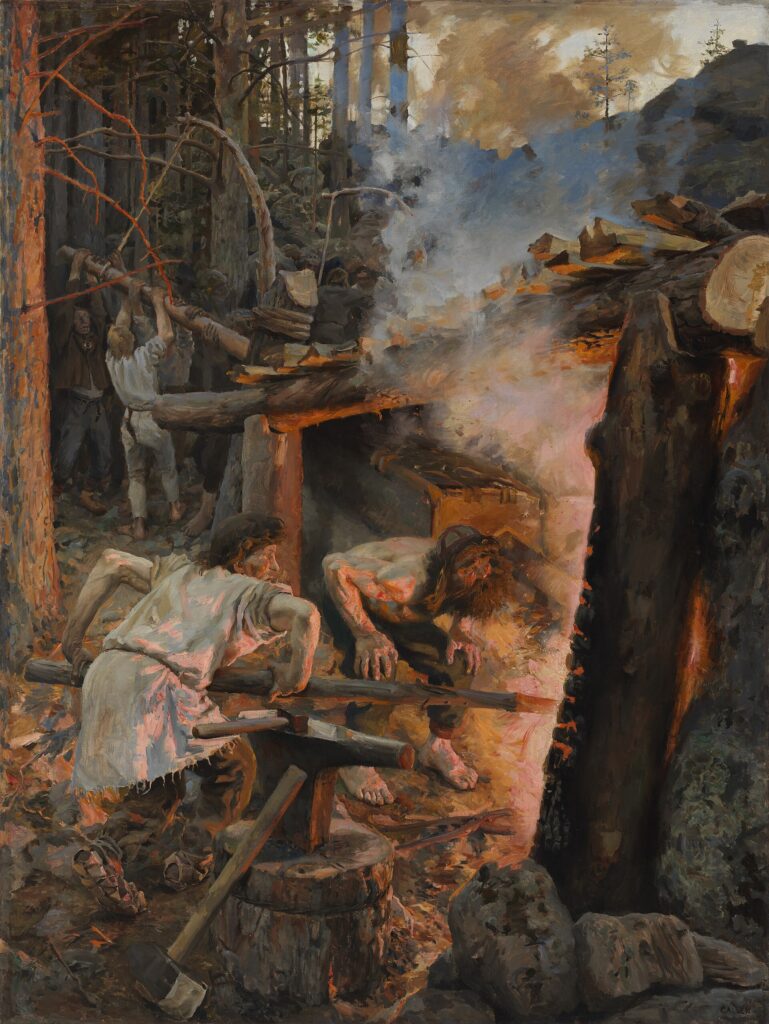
- Ilmarinen: the smith who forged the sky-dome and the Sampo, and who wins the Maiden of Pohjola.
- Lemminkäinen: the bold warrior and lover, also called Ahti Saarelainen, killed at the river of Tuonela and raised by his mother.
- Kullervo: the wronged slave-child of Kalervo whose story ends in revenge, grief and his own death (Runos 31–36).
- Joukahainen: the young Lapp singer who challenges Väinämöinen and loses.
- Louhi: mistress of Pohjola, the counterforce, a great figure in her own right.
Who’s Who
Sacred elements
Sacred Objects
The Sampo, the bright-lid mill of limitless plenty, forged by Ilmarinen from a swan's feather, the milk of a barren cow, a grain of barley and the wool of a summer ewe. Scholars have read it as a world-pillar, a mill or a talisman and do not agree. The kantele, first made from a pike's jawbone and later from birch. Bear skulls hung in a sacred pine (kallohonka). Charm bags and tools of the tietäjä. Iron and steel themselves carry force and protect against harm.
Sacred Places
The sacred grove (hiisi) and offering stones (uhrikivet) where food and first fruits were left. The karsikko, a tree carved with marks for the dead. The sauna, where children were born, the sick were healed and the dead were washed. The hearth. The family graves (kalmisto). Lakes, rapids and islands linked to the water keepers. In the songs: Kalevala, Pohjola and Tuonela. Holy places were often on hills, islands or old burial grounds, and many Finnish place names still carry the word hiisi.
Sacred Practices
Incantation (loitsu) by the tietäjä, the seer-healer who heals and protects by singing a thing's origin. The bear feast (karhunpeijaiset), a wedding for the slain bear that returns its spirit home. Wedding songs and laments. Ukko's chest rites recorded by Agricola. Women's laments at funerals and memorial days carry the dead across; the lamenter (itkijä) is trusted with a specialist's art.
Sacred Prohibitions
The bear is not called by its name; speakers use words such as mesikämmen (honey-paw) or kontio. The forest is entered with respect and quiet, as the home of Tapio and Mielikki. The dead must be properly mourned and fed or they may trouble the living. A healer's words lose their force if spoken carelessly or to the wrong person, and are kept within the line that holds them. At the bear feast the bear is addressed with honour and told it was not killed by people but fell by accident.
How their stories are told
How Stories Are Told
Sung in trochaic rune-song (the Kalevala meter), each idea stated and then restated in a parallel line. In Viena Karelia two singers often sat facing each other, hands joined, rocking; the lead sang a line and the second repeated it. Songs were episodes, not one epic: Lönnrot joined the episodes into the 50 runos of 1849, adding linking lines of his own. Melody is simple and repeated, so the words carry the weight, and the singer can draw from a shared stock of lines and formulas.
Who Tells Them
Men in Viena Karelia sang most of the epic songs; Arhippa Perttunen of Latvajärvi sang thousands of lines in 1834. Women carried lyric songs, wedding songs and laments; the Ingrian singer Larin Paraske was recorded at length in the 1880s and 1890s. The tietäjä held incantations. Today revival singers and kantele players teach the songs. Other singers named in Lönnrot's journeys include Ontrei Malinen and Vaassila Kieleväinen.
When They Are Told
During fishing and hunting trips, at the fire, while rowing, at work in the fields and forest, at weddings and at the bear feast. Incantations were sung when need arose: illness, wounds, a journey, a hunt. Laments were sung at death, at memorial meals and when a bride left her home. Kalevala Day, 28 February, now gathers readings and concerts. Long winter evenings gave time for the longest epic songs.
The Purpose of Story
Song is knowledge and power. Origin songs give the singer power over what they name; epic songs keep the memory of the first makers and their contests; wedding songs and laments carry people safely across life's thresholds. In the nineteenth century the Kalevala also gave Finns a written epic in their own language, which shaped the movement toward independence in 1917. Later artists, from Akseli Gallen-Kallela's paintings to Jean Sibelius's music, carried the songs to new audiences.
Signature Story Types
Origin songs (syntyloitsut) of iron, fire, beer and the bear. Creation songs. Singing contests. Wooing journeys to Pohjola and trials set for suitors. The forging and theft of the Sampo. Journeys to Tuonela. Kullervo's song of the wronged orphan. Wedding songs, bear songs and laments. Lyric songs gathered in Lönnrot's Kanteletar (1840) stand beside the epic, holding the voices of women singers above all.
How their stories are built, step by step
Named with Finnish terms from the epic's own movement. Each step title is the Finnish term followed by the English meaning.
Syntymä (Birth from the Primal Waters)
Cultural meaning
Emergence from the cosmic sea; the hero arrives already carrying his nature. The epic opens on seven hundred years of drifting water; Ilmatar carries Väinämöinen for thirty summers and winters, and he is born old, already a singer. Nothing in the trials to come will give him what he lacks; they will only show what he has.
In the step map, birth is not the start of growth but the start of disclosure: the reader meets a full nature, and the story slowly uncovers its depths.
In brief
The old singer does not become wise. He was born wise, and the world must find out.
Luominen (The Creation Act)
Cultural meaning
The first making, before any contest. In Runo 2, Väinämöinen comes ashore on bare land, has Sampsa Pellervoinen sow the trees, fells the great oak that hides the sun, and sows the first barley. Power is shown in making before it is ever tested in a fight.
The work is shared from the start: one sows, one fells, one clears, and the land answers.
In brief
Before the first contest, the singer makes a world worth contesting.
Kilpailu (The Contest)
Cultural meaning
The challenge that sets the trials in motion. Joukahainen's shallow knowledge meets the sage's depth in Runo 3; Väinämöinen sings the young man into the swamp, and to save himself Joukahainen promises his sister Aino. Aino will not marry the old man and goes into the water. Victory costs Aino to the water, and the loss drives the old sage north.
The young singer's knowledge is borrowed and shallow; the old sage's runs back to the first days of the world.
In brief
Winning a contest of songs can still lose the thing that mattered.
Sammon Taonta (The Forging)
Cultural meaning
The great thing made, by other hands, for another's keeping. Louhi promises her daughter to whoever forges the Sampo. Ilmarinen forges wrong things first: a crossbow, a boat, a heifer, a plough. He breaks them back into the fire before the Sampo comes out, and it is bargained to Pohjola and locked in a hill of stone.
The hero who wants the prize is not the hero who makes it, and that gap drives every trial that follows.
In brief
The greatest work is often made by another and kept by a rival.
Pohjolamatka (The Voyage North)
Cultural meaning
The crossing into Pohjola, the counterforce's land. In Runo 40 the heroes' boat sticks on the back of a great pike; Väinämöinen kills it and makes the first kantele from its jawbone. When he plays, every creature of land, air and water gathers to listen, and all are moved to tears. On the voyage the kantele is made, the crossing itself yields treasure.
The kantele is the true heart of the epic's gifts, and it is born from an obstacle met on the way.
In brief
The road to the prize gives a gift that the prize could not.
Sammon Ryöstö (The Theft and Trial)
Cultural meaning
The climactic attempt, and the shattering that seeds plenty. Väinämöinen sings Pohjola to sleep and the heroes carry off the Sampo. Louhi sends fog, the sea-monster Iku-Turso and storm; the kantele is lost to the sea. She pursues as a monstrous bird. In the struggle the Sampo shatters at sea; its fragments become the land's abundance.
Väinämöinen gathers what fragments he can and asks that they bring growth to the land; Louhi keeps only the lid, and her land stays poor.
In brief
What breaks in the struggle is not lost. It is scattered where it can feed everyone.
Lähtö (The Departure)
Cultural meaning
The sage sails away, leaving songs behind. In Runo 50 the maiden Marjatta bears a son; Väinämöinen judges against the child and is rebuked by him, and the child is made king. A new age arrives the old singer cannot rule; he departs in a copper boat, leaving the kantele and his songs for the people.
He leaves the kantele and his great songs for the people of Suomi, and promises to return when he is needed.
In brief
The master's last act is to leave, so that the songs can stay.
What makes this tradition distinct
What makes this tradition distinct from all others
The Kalevala is a world where knowledge is power and song is knowledge. Heroes win by knowing the origin of a thing and singing it, not by strength. The central treasure is forged by one hero, bargained to a rival, stolen back and broken, and the breaking is a blessing. The chief hero is born old, so his trials are revelations, not growth. The epic itself is a meeting of many oral singers and one compiler, so every episode exists in older, different sung versions. Few epics place an artist at their heart so fully: the chief hero is a singer and maker of instruments, and his final legacy is not a kingdom but music.
What NOT to do in this StoryWorld
- Do not make Väinämöinen a young hero who grows into wisdom: he is born old, and his trials reveal what he is
- Do not let strength settle the trials: the right words, the origin song, the deeper knowledge settle them
- Do not turn Louhi into a simple evil witch: she is a powerful mistress of her land who bargains, defends her household and fights for what is hers
- Do not treat the Sampo's breaking as failure: its fragments are the land's plenty
- Do not present Lönnrot's 1849 text as the only form: the songs were sung in many versions by many singers
- Do not invent incantations or present a tietäjä's words as content to be used
Genre affinities
Epic fantasy, generational sagas, artist-and-craft narratives, stories of aging mastery and succession.
Craft note
Let repetition carry meaning: the second and third attempts must reveal, not repeat. The prize breaking is the point, not the failure. Use parallelism the way the singers do: say a thing, then say it again in other words, so each echo deepens the line.
The stories
Each story with its source, where to read it and why it fits.
The StoryWorld in Full
StoryWorld · Northern Europe — Finland, Karelia
FINNISH KALEVALA — Väinämöinen
Finnish and Karelian — Finno-Ugric tradition
Multi Trial architecture
The world as they see it
Core cosmology. The world is assembled from broken eggs on the knee of Ilmatar, the air-daughter, drifting on the primal sea. Creation is gradual, watery, and sung into completion rather than commanded.
The operative power. Song. To know a thing’s origin-words and sing them rightly is to hold power over it. Magic is knowledge given voice — the deepest singer, not the strongest arm, prevails.
Time and fate. The world ages; a new era eventually arrives that even the primordial sage cannot govern, and the right response is departure, leaving songs behind.
The powers and figures
Väinämöinen
The primordial sage — born old from the sea, singer and maker. His trials (the Sampo, the wooing, the kantele) reveal rather than build him.
Louhi
Mistress of Pohjola, the North Farm — the epic’s great counterforce, setter of trials and driver of bargains.
Ilmarinen
Lemminkäinen
Sacred things and places
The Sampo. The bright-lid mill of limitless plenty — made, bargained away, stolen back, and shattered; its fragments become the land’s fruitfulness.
The Kantele. The string instrument first made from a pike’s jawbone; its music stills the whole living world.
Rune singing. The tradition’s operative magic — origin-knowledge sung aloud acts upon the world.
Pohjola. The North Farm across the water — the cold otherwhere where trials are set.
How the stories are told
Form. Trochaic rune-song (the Kalevala meter), sung antiphonally by paired singers; episodic cantos (runot) joined into an epic arc by Lönnrot’s compilation.
How their stories move
The hero attempts the great challenges repeatedly — each attempt reveals a deeper layer of the world’s nature and his own limits. Trials do not create the hero; they uncover what was always present. The prize itself shatters, and its breaking seeds the world with plenty.
The Kalevala is the living inheritance of the Finnish and Karelian, carried by oral singers long before print. Quotes here are from the public-domain Kirby translation (1907). Structure is engaged; the singers’ tradition itself belongs to its people.
This culture
People · Finnish and Karelian — Finno-Ugric tradition
Place · Northern Europe — Finland, Karelia
Depth · Ancient oral rune-song tradition; compiled by Elias Lönnrot in 1835/1849 from living oral singers (laulajat)
Living · Yes — Finnish and Karelian cultural inheritance; rune-singing revival traditions continue
Multi Trial worlds
HINDU EPIC — Mahabharata
NGUNI — Zulu / Xhosa
MAYA — Popol Vuh
SUMERIAN — Gilgamesh / Inanna
MANDÉ / SUNDIATA — Epic Cycle
CHINESE — Wuxia (武俠) / The Martial World
Key Figures
Louhi
Mistress of Pohjola, the North Farm — the epic’s great counterforce, setter of trials and driver of bargains.
Ilmarinen
The eternal smith who forged the sky’s dome and the Sampo — the great work made by other hands than the hero’s.
Sacred Elements
The Kantele
The string instrument first made from a pike’s jawbone; its music stills the whole living world.
Rune singing
The tradition’s operative magic — origin-knowledge sung aloud acts upon the world.
Narrative Tradition
Second quote
“Then the aged Väinämöinen / Spake aloud his songs of magic.” — Kalevala (Kirby translation, 1907, public domain)
The Guide
GriotsWell StoryWorlds · Guide
Finnish Kalevala — Väinämöinen
Multi Trial architecture · 7 steps
How it moves
- Syntymä — Birth from the Primal Waters
- Luominen — The Creation Act
- Kilpailu — The Contest
- Sammon Taonta — The Forging
- Pohjolamatka — The Journey North
- Sammon Ryöstö — The Theft and Trial
- Lähtö — The Departure
Attempt → partial outcome → deeper attempt → revelation through repetition → withdrawal, leaving the gift behind.
Why it is told this way
The hero attempts the great challenges repeatedly — each attempt reveals a deeper layer of the world’s nature and his own limits. Trials do not create the hero; they uncover what was always present. The prize itself shatters, and its breaking seeds the world with plenty.
Trochaic rune-song (the Kalevala meter), sung antiphonally by paired singers; episodic cantos (runot) joined into an epic arc by Lönnrot’s compilation.
Where writers take it
Epic fantasy, generational sagas, artist-and-craft narratives, stories of aging mastery and succession.
At a glance
People Finnish and Karelian — Finno-Ugric tradition
Region Northern Europe — Finland, Karelia
Time depth Ancient oral rune-song tradition; compiled by Elias Lönnrot in 1835/1849 from living oral singers (laulajat)
Living tradition Yes — Finnish and Karelian cultural inheritance; rune-singing revival traditions continue
How it is carried Trochaic rune-song (the Kalevala meter), sung antiphonally by paired singers; episodic cantos (runot) joined into an epic arc by Lönnrot’s compilation.
“Mastered by desire impulsive, / By a mighty inward urging, / I am ready now for singing.”— Kalevala, Runo I (W. F. Kirby translation, 1907, public domain)
Keep faith with it
Let repetition carry meaning: the second and third attempts must reveal, not repeat. The prize breaking is the point, not the failure.
The Kalevala is the living inheritance of the Finnish and Karelian, carried by oral singers long before print. Quotes here are from the public-domain Kirby translation (1907).