Javanese — Wayang Kulit
Javanese wayang kulit, the shadow puppet theatre and its pakeliran structure
Javanese: the island of Java, Indonesia, in a tradition synthesizing indigenous Javanese cosmology, Hindu-Buddhist epic (the Ramayana and Mahabharata, adapted into Javanese forms), and later Islamic and Sufi elements.
Javanese
The culture
Javanese: the island of Java, Indonesia, in a tradition synthesizing indigenous Javanese cosmology, Hindu-Buddhist epic (the Ramayana and Mahabharata, adapted into Javanese forms), and later Islamic and Sufi elements.
Where
Southeast Asia — Island Southeast Asia (Java, Indonesia)
Time depth
Wayang kulit has roots reaching back over a thousand years, developing through the Hindu-Buddhist Javanese kingdoms and continuing through the Islamic period to the present. Recognized by UNESCO as a Masterpiece of the Oral and Intangible Heritage of Humanity in 2003.
Living tradition
Yes. Wayang kulit is performed across Java and Bali today, with master puppeteers (dalang) performing all-night shows, and the tradition continuously evolving while preserving its ancient forms.
Language
Javanese (in its refined and ordinary registers), with the dalang narrating, voicing all characters, chanting mood-poems (suluk), and cueing the gamelan orchestra. An all-night wayang performance (pakeliran) is a total art of shadow, voice, music, and philosophy.
The world of its stories
Cosmological Structure
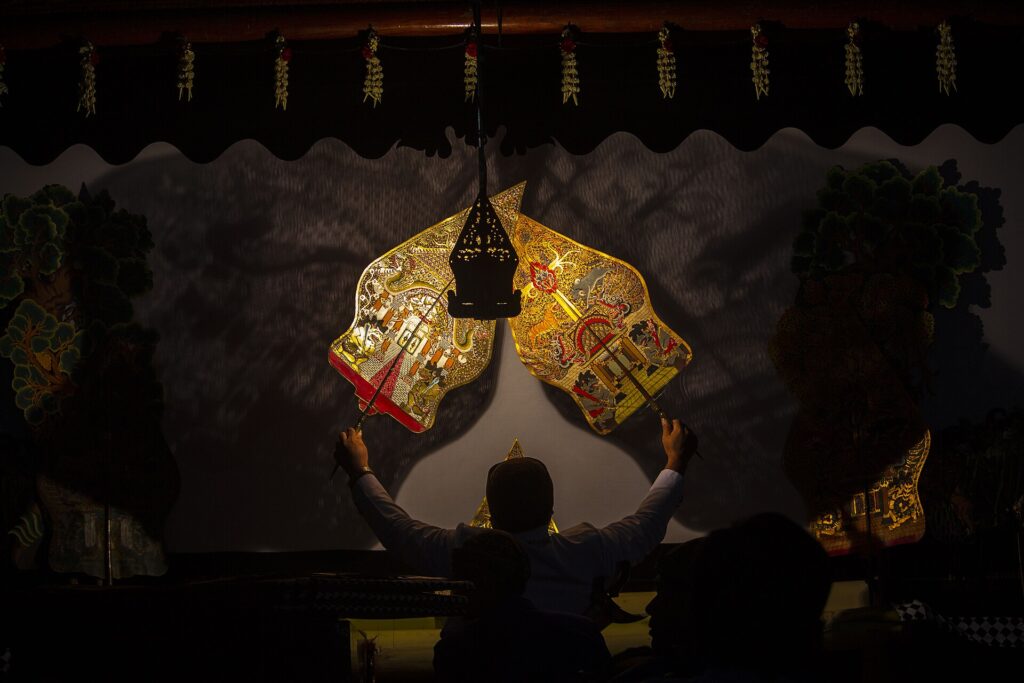
A cosmos of balance, the refined (alus) and the coarse (kasar), the right and the left, the noble and the demonic, held in necessary equilibrium. The world is a shadow-play (the wayang itself is the central metaphor): the visible forms are shadows cast by a hidden light (the blencong lamp), and behind them moves the puppeteer (the dalang), an image of the divine mover behind all appearances. The kayon or gunungan (the "tree/mountain of life") frames the cosmos and marks its transitions.
Creation
Javanese cosmology blends indigenous, Hindu-Buddhist, and Islamic strands. The wayang enacts the great cycles of the Hindu epics reframed in Javanese terms, and the dalang's opening plants the kayon as the axis of the world. The emphasis is less on a single creation than on the perpetual balanced order of the cosmos, enacted anew each performance.
Time
The all-night performance moves through named musical-dramatic phases (pathet) that mirror the passage from evening through midnight to dawn, a balanced arc from the world's establishment through its complication and battle to its resolution and the planting of peace. Time in wayang is this balanced nightly cycle, an image of cosmic order.
The Sacred
Balance itself, the equilibrium of refined and coarse, noble and demonic, that the wayang holds without destroying either pole. The dalang as the mover behind the shadows. The gunungan/kayon (tree of life). The gamelan music. The Punakawan: the beloved clown-servants (Semar and his sons) who are, in Javanese understanding, deeper and more sacred than they appear, guardians of the common people and of hidden wisdom.
Death / Afterlife
Wayang engages death within its epic dramas, but its deeper teaching is the shadow-nature of all appearance. That the visible world is a play of shadows behind which the true reality moves. The wayang is a meditation on illusion and reality, on the puppeteer behind the puppet, more than a doctrine of afterlife. The refined understanding sees through the shadow-play to the mover behind it.
Balance-Seeking Architecture
An Architecture of Story
The Balance-Seeking Architecture GuideWhy Balance Architecture
Wayang kulit is built on balance, the equilibrium of refined (alus) and coarse (kasar), noble and demonic, sacred and comic, held through the night's arc without destroying either pole. The pathet phases structure a balanced movement from establishment through complication, clown-interlude, and battle to resolution and the planting of peace, and crucially, the resolution restores balance rather than annihilating an enemy, for both poles are necessary to the cosmic order. The Punakawan (clowns) balance the epic nobility with earthy wisdom; the battles balance rather than simply resolve. The seven named phases of the pakeliran offer a complete balanced structure from evening to dawn.
Structural Logic
Movement through balanced phases from establishment to resolution, holding complementary poles (refined/coarse, noble/comic, order/disorder) in equilibrium rather than destroying one for the other. The resolution restores balance and plants peace, not the annihilation of an enemy.
Structural Movement
Pathet Nem (early evening, establishment of the world and its order) → Gara-gara (the clown interlude, the earthy, comic balancing of the noble) → Pathet Sanga (midnight: the complication deepens) → Perang Kembang (the flower battle, refined against coarse) → Pathet Manyura (before dawn, the movement toward resolution) → Tancep Kayon (the tree of life planted, balance restored, peace established) → Suluk (the closing song, the final resonance, the shadow-play acknowledged).
Key figures
Supreme Being / Creator
The Javanese cosmos is framed by a supreme unity (understood variously through Hindu, Islamic, and indigenous lenses), imaged by the dalang, the single mover behind all the shadow-figures. The divine is the light and the hand behind the play.
Major Figures
- The Pandhawa (Pandavas): the five noble brothers of the Mahabharata, refined (alus) heroes, in their Javanese forms.
- The Kurawa (Kauravas), their coarse (kasar) rivals.
- The Punakawan: Semar, Gareng, Petruk, Bagong, the clown-servants, uniquely Javanese, who accompany the heroes. Semar is secretly a god in humble form, the guardian spirit of Java; the Punakawan carry the tradition's deepest wisdom and humor, balancing the epic nobility with earthy common sense.
- The refined and the demonic (raksasa), the noble kings and knights balanced against the ogres and demons, both necessary to the cosmic order.
Trickster / Culture Figure
The Punakawan, especially Semar and the irrepressible Petruk, clown-servants whose humor, earthiness, and hidden wisdom balance and often surpass the noble heroes. Semar, the god-in-clown-form, is the beloved heart of Javanese wayang, embodying the union of high and low, sacred and comic.
Ancestor Figures
The lineage of dalang (master puppeteers) who transmit the tradition. The heroes of the epics, held as ancestral exemplars. Semar as the ancient guardian spirit of Java.
Who’s Who
Sacred elements
Sacred Objects
The wayang puppets themselves, intricate leather figures, each character with fixed iconography (the refined characters with downcast eyes and slim forms, the coarse with bulging eyes and robust forms). The kayon/gunungan (tree-mountain of life). The blencong (the oil lamp casting the shadows). The gamelan orchestra. The kelir (the screen).
Sacred Places
The performance space itself, with its screen, lamp, and gamelan, becomes a cosmos for the night. The dalang's position behind the screen, moving the shadows. The courts and villages of Java where wayang lives.
Sacred Practices
The all-night pakeliran performance, moving through the pathet phases from evening to dawn. The dalang's chanting of suluk (mood-poems). The planting and moving of the kayon at the cosmic transitions. The gara-gara (the clown interlude) and the perang (battle scenes). The union of shadow, voice, and gamelan music.
Sacred Prohibitions
The balance must be maintained, neither the refined nor the coarse, neither the noble nor the demonic, is simply destroyed; both are necessary to the cosmic order the wayang enacts. The dalang carries great responsibility as the mover of the cosmos for the night. The forms and iconography are traditional and not carelessly altered.
How their stories are told
How Stories Are Told
As all-night shadow-play (pakeliran), structured by the pathet, the musical-dramatic phases that carry the performance from the evening's establishment of the world and its conflict, through the midnight deepening and the clown interlude (gara-gara), to the great battle (perang) and the pre-dawn resolution, closing with the planting of the kayon and a final song. The dalang narrates, voices every character, chants the mood-poems, and moves the shadows, holding the whole balanced cosmos in a single performance.
Who Tells Them
The dalang, the master puppeteer, narrator, musician-cue, philosopher, and mover of the cosmos, a figure of immense skill and spiritual responsibility, who must know the epics, the music, the philosophy, and the art of the shadow.
When They Are Told
At ceremonies, celebrations, ritual occasions, and for their own sake, traditionally all night, from evening to dawn. Wayang marks life-transitions and communal occasions and enacts the cosmic order.
The Purpose of Story
To enact and maintain the balanced order of the cosmos, to hold the refined and the coarse, the noble and the demonic, the sacred and the comic, in the necessary equilibrium that is the Javanese vision of a whole world. Through the night the wayang keeps both poles in play and ends by restoring the balance and planting peace, with the "enemy" still part of the world. And, at its deepest, it teaches the shadow-nature of all appearance.
Signature Story Types
The Javanese Mahabharata and Ramayana cycles (the lakon, or wayang plays), the Punakawan clown scenes, the great battles (perang), and the philosophical suluk mood-poems.
How their stories are built, step by step
The phases of the all-night wayang performance (pakeliran), in Javanese, tracing the balanced arc from evening to dawn.
Pathet Nem (Early Evening / Establishment of the World)
Cultural meaning
The performance opens in Pathet Nem, the first musical mode, in the early evening. The dalang plants the kayon (tree of life) and establishes the world: the kingdom, the noble court, the order of things, the characters and their relations. This is the balanced world set in place, the refined and the coarse, the noble order and its tensions, all established as the equilibrium the night will move through.
In brief
The kayon is planted, and the world begins; here stand the kingdoms, and here the order of all things.
Cultural teaching
In Balance, open on a whole world with its order in place and its paired poles (noble and common, refined and coarse) where they belong. The wayang plants the tree of life and sets the cosmos. Establish your story's world as a balanced whole, with its opposing but complementary forces set in equilibrium from the start.
Gara-gara (The Clown Interlude / The Earthy Balancing)
Cultural meaning
Gara-gara is the beloved clown interlude, the Punakawan (Semar and his sons) appear, and the cosmic seriousness is balanced by earthy humor, common sense, and hidden wisdom. The world is turned upside down in comic disorder, and Semar, the god-in-clown-form, speaks truths the noble heroes cannot. This phase balances the epic nobility with the wisdom of the common and the comic, essential to the whole.
In brief
Semar laughs, and in his laughter is the wisdom the kings have forgotten; the clown carries what the crown cannot.
Cultural teaching
Balance the noble and serious with the earthy, comic, and humble, and give the humble the deeper wisdom. The Punakawan are the heart of wayang precisely because they balance the epic's grandeur with common truth and laughter. In your story, introduce the counterweight to the noble register: the earthy, comic, humble element that balances the grand, and let it carry its own hidden wisdom.
Pathet Sanga (Midnight / The Deepening)
Cultural meaning
At midnight the performance shifts to Pathet Sanga, the second mode, and the drama deepens. The complication intensifies, the stakes clarify, the refined heroes face their trials, and the tension between the poles (noble and demonic, order and disorder) sharpens. The tension deepens toward the battle that is still to come.
In brief
As the night deepens, so does the trial; at midnight the shadows are longest and the heart is tested.
Cultural teaching
Deepen the balanced tension at your story's midpoint, intensify the complication and sharpen the relation between the complementary poles, without yet resolving it. In balance architecture the middle deepens the equilibrium's stress rather than escalating toward a single victory. Let your story's tension between its poles reach its most intense before the balanced confrontation.
Perang Kembang (The Flower Battle / The Balanced Conflict)
Cultural meaning
Perang Kembang, the "flower battle," is the central combat, the refined hero (alus) faces the coarse ogres (raksasa) in a stylized, almost dance-like battle. Crucially, this is a balanced conflict: it is beautiful (a "flower" battle), stylized, and it is about the meeting of the poles, not the simple destruction of evil. The refined and the coarse meet; the balance is enacted through their encounter.
In brief
The knight and the ogre meet because they must; the flower battle is a dance as much as a fight.
Cultural teaching
Stage your story's central confrontation as a balanced meeting of complementary poles, not a battle of good against evil to be won by annihilation. The perang kembang is beautiful and stylized because it enacts the necessary meeting of the refined and the coarse. Let your central conflict be the encounter of your story's poles, an encounter that enacts and tests the balance rather than destroying one side.
Pathet Manyura (Before Dawn / The Movement Toward Resolution)
Cultural meaning
Pathet Manyura, the third mode, comes before dawn and moves toward resolution. The trials resolve, the tangled threads begin to order themselves, and the world moves back toward its balance. Peace has not come yet, but the night has turned toward it, and the order begins to reassert itself before morning.
In brief
Before dawn, the threads draw together; what was tangled in the night finds its order as the light approaches.
Cultural teaching
Turn your story toward the restoration of balance, the tangled complications ordering themselves, the equilibrium reasserting itself, the movement toward peace beginning. In balance architecture the resolution is a return to equilibrium rather than a triumph. Let your story begin to draw its threads back into balanced order as it moves toward its close.
Tancep Kayon (The Tree of Life Planted / Balance Restored)
Cultural meaning
Tancep Kayon, the planting of the kayon (tree of life) at the center of the screen, marks the resolution: balance restored, peace established, the cosmos returned to order. The kayon that opened the world now closes it, planted upright at the center. The resolution restores the whole order and plants peace at its center; the demonic pole is put back in its place.
In brief
The kayon is planted upright again; the world is whole, the balance restored, and peace stands at the center.
Cultural teaching
Resolve your story by restoring the balance and planting peace, with both poles still standing. The tancep kayon closes the cosmos as it opened it, the tree of life planted upright at the center. Let your story's resolution restore the balanced whole, with both poles still present and the equilibrium re-established, peace standing at the center.
Suluk (The Closing Song / The Shadow-Play Acknowledged)
Cultural meaning
The dalang chants the closing suluk (mood-poem), and the performance ends, often with an acknowledgment of the shadow-play's own nature: that all we have seen were shadows cast by the lamp, moved by the hidden hand, and that the true reality lies behind the screen. The closing song names what the night has been: a reflection on illusion and reality, and on the mover behind the shadows.
In brief
What you have seen were shadows on the screen; but who moved them, and who lit the lamp? Behind the shadow-play stands the one who is not seen.
Cultural teaching
Close with the suluk, the final song, and with the reminder that everything we watched was shadow, moved by a hand behind the screen. The suluk gives the balanced enactment its philosophical depth. Let your story close on a final song that points, as wayang does, to the hand behind the shadows.
What makes this tradition distinct
What makes this tradition distinct from all others
Wayang kulit builds its architecture from balance (the equilibrium of refined and coarse, noble and demonic, sacred and comic) held through the night's arc without destroying either pole, resolving in restored balance rather than the annihilation of an enemy. Its self-awareness as a shadow-play (the visible forms as shadows cast by a lamp, moved by the hidden dalang) makes it a long reflection on illusion and reality. The Punakawan (clown-servants), with Semar the god-in-clown-form, uniquely balance epic grandeur with earthy wisdom. And it is a total art of shadow, voice, and gamelan music, performed all night by a single master.
Cultural warnings — what NOT to do
- Do not resolve by annihilating the "demonic" pole, wayang balance keeps both poles, for both are necessary to the cosmic order.
- Do not omit or trivialize the Punakawan: the clowns, especially Semar, are the sacred heart of Javanese wayang, not comic relief.
- Do not flatten wayang into simple Hindu epic. It is a distinct Javanese synthesis of indigenous, Hindu-Buddhist, and Islamic elements.
- Do not treat the shadow-play metaphor as decoration, the meditation on shadow and reality, puppet and puppeteer, is the tradition's philosophical core.
The stories
Each story with its source, where to read it and why it fits.
The StoryWorld in Full
StoryWorld · Southeast Asia — Island Southeast Asia (Java, Indonesia)
JAVANESE — Wayang Kulit
Javanese — the island of Java, Indonesia, in a tradition synthesizing indigenous Javanese cosmology, Hindu-Buddhist epic (the Ramayana and Mahabharata, adapted into Javanese forms), and later Islamic and Sufi elements.
Balance architecture
The world as they see it
Cosmological Structure. A cosmos of balance — the refined (alus) and the coarse (kasar), the right and the left, the noble and the demonic, held in necessary equilibrium. The world is a shadow-play (the wayang itself is the central metaphor): the visible forms are shadows cast by a hidden light (the blencong lamp), and behind them moves the puppeteer (the dalang), an image of the divine mover behind all appearances. The kayon or gunungan (the "tree/mountain of life") frames the cosmos and marks its transitions.
Creation. Javanese cosmology blends indigenous, Hindu-Buddhist, and Islamic strands. The wayang enacts the great cycles of the Hindu epics reframed in Javanese terms, and the dalang's opening plants the kayon as the axis of the world. The emphasis is less on a single creation than on the perpetual balanced order of the cosmos, enacted anew each performance.
Time. The all-night performance moves through named musical-dramatic phases (pathet) that mirror the passage from evening through midnight to dawn — a balanced arc from the world's establishment through its complication and battle to its resolution and the planting of peace. Time in wayang is this balanced nightly cycle, an image of cosmic order.
The Sacred. Balance itself — the equilibrium of refined and coarse, noble and demonic, that the wayang holds without destroying either pole. The dalang as the mover behind the shadows. The gunungan/kayon (tree of life). The gamelan music. The Punakawan — the beloved clown-servants (Semar and his sons) who are, in Javanese understanding, deeper and more sacred than they appear, guardians of the common people and of hidden wisdom.
Death / Afterlife. Wayang engages death within its epic dramas, but its deeper teaching is the shadow-nature of all appearance — that the visible world is a play of shadows behind which the true reality moves. The wayang is a meditation on illusion and reality, on the puppeteer behind the puppet, more than a doctrine of afterlife. The refined understanding sees through the shadow-play to the mover behind it.
The powers and figures
Supreme Being / Creator
Major Figures
The Pandhawa (Pandavas) — the five noble brothers of the Mahabharata, refined (alus) heroes, in their Javanese forms.
The Kurawa (Kauravas) — their coarse (kasar) rivals.
The Punakawan — Semar, Gareng, Petruk, Bagong — the clown-servants, uniquely Javanese, who accompany the heroes. Semar is secretly a god in humble form, the guardian spirit of Java; the Punakawan carry the tradition's deepest wisdom and humor, balancing the epic nobility with earthy common sense.
The refined and the demonic (raksasa) — the noble kings and knights balanced against the ogres and demons, both necessary to the cosmic order.
Trickster / Culture Figure
Ancestor Figures
Sacred things and places
Sacred Objects. The wayang puppets themselves — intricate leather figures, each character with fixed iconography (the refined characters with downcast eyes and slim forms, the coarse with bulging eyes and robust forms). The kayon/gunungan (tree-mountain of life). The blencong (the oil lamp casting the shadows). The gamelan orchestra. The kelir (the screen).
Sacred Places. The performance space itself, with its screen, lamp, and gamelan, becomes a cosmos for the night. The dalang's position behind the screen, moving the shadows. The courts and villages of Java where wayang lives.
Sacred Practices. The all-night pakeliran performance, moving through the pathet phases from evening to dawn. The dalang's chanting of suluk (mood-poems). The planting and moving of the kayon at the cosmic transitions. The gara-gara (the clown interlude) and the perang (battle scenes). The union of shadow, voice, and gamelan music.
Sacred Prohibitions. The balance must be maintained — neither the refined nor the coarse, neither the noble nor the demonic, is simply destroyed; both are necessary to the cosmic order the wayang enacts. The dalang carries great responsibility as the mover of the cosmos for the night. The forms and iconography are traditional and not carelessly altered.
How the stories are told
How Stories Are Told. As all-night shadow-play (pakeliran), structured by the pathet — the musical-dramatic phases that carry the performance from the evening's establishment of the world and its conflict, through the midnight deepening and the clown interlude (gara-gara), to the great battle (perang) and the pre-dawn resolution, closing with the planting of the kayon and a final song. The dalang narrates, voices every character, chants the mood-poems, and moves the shadows, holding the whole balanced cosmos in a single performance.
Who Tells Them. The dalang — the master puppeteer, narrator, musician-cue, philosopher, and mover of the cosmos, a figure of immense skill and spiritual responsibility, who must know the epics, the music, the philosophy, and the art of the shadow.
When They Are Told. At ceremonies, celebrations, ritual occasions, and for their own sake — traditionally all night, from evening to dawn. Wayang marks life-transitions and communal occasions and enacts the cosmic order.
The Purpose of Story. To enact and maintain the balanced order of the cosmos — to hold the refined and the coarse, the noble and the demonic, the sacred and the comic, in the necessary equilibrium that is the Javanese vision of a whole world. The wayang does not destroy one pole to exalt the other; it balances them through the night's arc, resolving not in the annihilation of the "enemy" but in the restoration of balance and the planting of peace. And, at its deepest, it teaches the shadow-nature of all appearance.
Signature Story Types. The Javanese Mahabharata and Ramayana cycles (the lakon, or wayang plays), the Punakawan clown scenes, the great battles (perang), and the philosophical suluk mood-poems.
The stories
The Wayang Mahabharata (a Javanese lakon)
Source Javanese wayang tradition — the Mahabharata cycle reframed in Javanese cosmology, performed as all-night lakon
Public domain access Academic studies of wayang (e.g., the recorded and literary scholarship on Javanese shadow theatre); Internet Archive; the underlying epic is public domain
Why it fits The balanced arc of the pakeliran — establishment, clown interlude, deepening, flower battle, and resolution in restored balance rather than annihilation
Semar and the Punakawan
Source Javanese wayang tradition — the clown-servant Semar (god-in-clown-form) and his sons, unique to the Javanese synthesis
Public domain access Recorded and folkloric studies of Javanese wayang; academic archives via Internet Archive
Why it fits The balancing of noble and common, sacred and comic — the Punakawan holding the epic grandeur in equilibrium with earthy, hidden wisdom, the heart of wayang balance
The Gunungan / Kayon — the Tree of Life
Source Javanese wayang tradition — the kayon that opens and closes the cosmos of the performance and marks its transitions
Public domain access Studies of wayang iconography and cosmology; academic and museum documentation
Why it fits The frame of the balanced cosmos — planted at the beginning and the end, marking the establishment and restoration of the balanced order, the very emblem of the architecture
How their stories move
Wayang kulit is built on balance — the equilibrium of refined (alus) and coarse (kasar), noble and demonic, sacred and comic, held through the night's arc without destroying either pole. The pathet phases structure a balanced movement from establishment through complication, clown-interlude, and battle to resolution and the planting of peace — and crucially, the resolution restores balance rather than annihilating an enemy, for both poles are necessary to the cosmic order. The Punakawan (clowns) balance the epic nobility with earthy wisdom; the battles balance rather than simply resolve. The seven named phases of the pakeliran offer a complete balanced structure from evening to dawn.
Pathet Nem (early evening — establishment of the world and its order) → Gara-gara (the clown interlude — the earthy, comic balancing of the noble) → Pathet Sanga (midnight — the deepening, the complication intensified) → Perang Kembang (the flower battle — the balanced conflict, refined against coarse) → Pathet Manyura (before dawn — the movement toward resolution) → Tancep Kayon (the tree of life planted — balance restored, peace established) → Suluk (the closing song — the final resonance, the shadow-play acknowledged).
This culture
People · Javanese — the island of Java, Indonesia, in a tradition synthesizing indigenous Javanese cosmology, Hindu-Buddhist epic (the Ramayana and Mahabharata, adapted into Javanese forms), and later Islamic and Sufi elements.
Place · Southeast Asia — Island Southeast Asia (Java, Indonesia)
Depth · Wayang kulit has roots reaching back over a thousand years, developing through the Hindu-Buddhist Javanese kingdoms and continuing through the Islamic period to the present. Recognized by UNESCO as a Masterpiece of the Oral and Intangible Heritage of Humanity in 2003.
Living · Yes — wayang kulit is vibrantly alive in Java and Bali, with master puppeteers (dalang) performing all-night shows, and the tradition continuously evolving while preserving its ancient forms.
Balance worlds
DINÉ — Hózhó / Blessingway
ANCIENT EGYPTIAN — Ma'at Balance
INDIAN — Rasa (रस) / The Emotional Architecture of the Natyashastra
TAMIL SANGAM — Akam / Puram
Mythology Catalog
- Why it fits: The balancing of noble and common, sacred and comic — the Punakawan holding the epic grandeur in equilibrium with earthy, hidden wisdom, the heart of wayang balance
Story 3: The Gunungan / Kayon — the Tree of Life
- Why it fits: The frame of the balanced cosmos — planted at the beginning and the end, marking the establishment and restoration of the balanced order, the very emblem of the architecture
GriotsWell · Simplified Lore Library · Javanese Wayang Kulit · July 2026
The Guide
GriotsWell StoryWorlds · Guide
Javanese wayang kulit — the shadow puppet theatre and its pakeliran structure
Balance architecture · 7 steps
How it moves
- Pathet Nem — Early Evening / Establishment of the World
- Gara-gara — The Clown Interlude / The Earthy Balancing
- Pathet Sanga — Midnight / The Deepening
- Perang Kembang — The Flower Battle / The Balanced Conflict
- Pathet Manyura — Before Dawn / The Movement Toward Resolution
- Tancep Kayon — The Tree of Life Planted / Balance Restored
- Suluk — The Closing Song / The Shadow-Play Acknowledged
Pathet Nem (early evening — establishment of the world and its order) → Gara-gara (the clown interlude — the earthy, comic balancing of the noble) → Pathet Sanga (midnight — the deepening, the complication intensified) → Perang Kembang (the flower battle — the balanced conflict, refined against coarse) → Pathet Manyura (before dawn — the movement toward resolution) → Tancep Kayon (the tree of life planted — balance restored, peace established) → Suluk (the closing song — the final resonance, the shadow-play acknowledged). ---
Why it is told this way
Movement through balanced phases from establishment to resolution, holding complementary poles (refined/coarse, noble/comic, order/disorder) in equilibrium rather than destroying one for the other. The resolution restores balance and plants peace, not the annihilation of an enemy.
To enact and maintain the balanced order of the cosmos — to hold the refined and the coarse, the noble and the demonic, the sacred and the comic, in the necessary equilibrium that is the Javanese vision of a whole world. The wayang does not destroy one pole to exalt the other; it balances them through the night's arc, resolving not in the annihilation of the "enemy" but in the restoration of balance and the planting of peace. And, at its deepest, it teaches the shadow-nature of all appearance.
What this StoryWorld asks
- Does your story hold complementary poles (noble/coarse, serious/comic) in balance rather than destroying one?
- Is there an earthy, comic counterweight (Punakawan) carrying hidden wisdom that balances the noble?
- Does your resolution restore balance and plant peace rather than destroying an enemy — and might it acknowledge the shadow-nature of the whole?
At a glance
People Javanese — the island of Java, Indonesia, in a tradition synthesizing indigenous Javanese cosmology, Hindu-Buddhist epic (the Ramayana and Mahabharata, adapted into Javanese forms), and later Islamic and Sufi elements.
Region Southeast Asia — Island Southeast Asia (Java, Indonesia)
Time depth Wayang kulit has roots reaching back over a thousand years, developing through the Hindu-Buddhist Javanese kingdoms and continuing through the Islamic period to the present.
Living tradition Yes — wayang kulit is vibrantly alive in Java and Bali, with master puppeteers (dalang) performing all-night shows, and the tradition continuously evolving while preserving its ancient forms.
How it is carried Javanese (in its refined and ordinary registers), with the dalang narrating, voicing all characters, chanting mood-poems (suluk), and cueing the gamelan orchestra. An all-night wayang performance (pakeliran) is a total art of shadow, voice, music, and philosophy. ---
“The kayon is planted, and the world begins; here stand the kingdoms, and here the order of all things.”— dalang's opening, wayang tradition
Keep faith with it
- Do not resolve by annihilating the "demonic" pole — wayang balance keeps both poles, for both are necessary to the cosmic order. - Do not omit or trivialize the Punakawan — the clowns, especially Semar, are the sacred heart of Javanese wayang, not comic relief. - Do not flatten wayang into simple Hindu epic — it is a distinct Javanese synthesis of indigenous, Hindu-Buddhist, and Islamic elements.