Sanskrit Epic — Mahābhārata
Sanskrit epic tradition: the Mahabharata and the Bhagavad Gita
Sanskrit literary and religious tradition: attributed to the sage Vyasa, compiled from older oral tradition roughly 400 BCE–400 CE, pan-Indian in reach and influence.
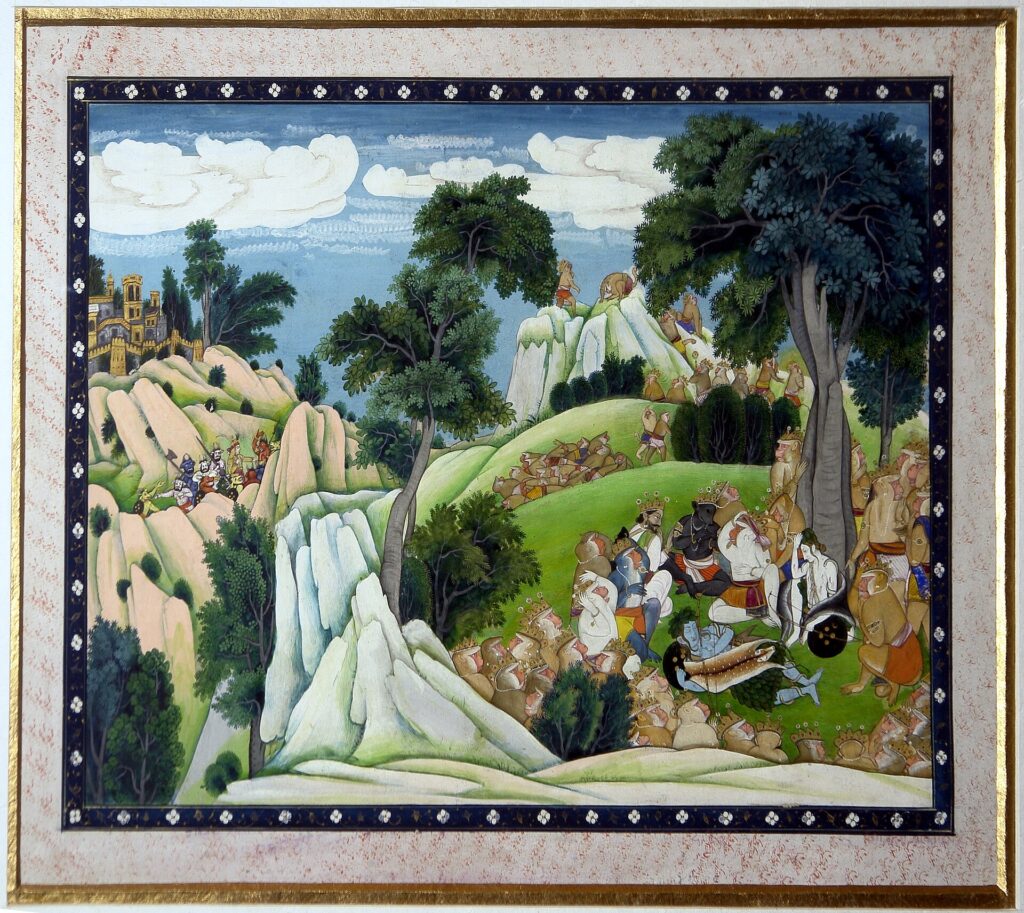
Sanskrit Epic
The culture
Sanskrit literary and religious tradition: attributed to the sage Vyasa, compiled from older oral tradition roughly 400 BCE–400 CE, pan-Indian in reach and influence.
Where
South Asia: the Sanskrit / Vedic / Epic tradition of the Indian subcontinent
Time depth
The Mahabharata took shape over roughly eight centuries, drawing on far older oral and Vedic tradition. At some 100,000 verses, it is the longest epic poem in the world, several times the length of the Iliad and Odyssey combined.
Living tradition
Yes: the Mahabharata and the Bhagavad Gita are central living scriptures of Hinduism, continuously read, performed, taught, and enacted (in theatre, television, and ritual) across the Indian subcontinent and far beyond it.
Language
Sanskrit. Composed in shloka verse, recited and chanted; transmitted orally for centuries before and alongside written form. Performed in countless regional and dramatic traditions.
The world of its stories
Cosmological Structure
A cosmos ordered by dharma: cosmic and moral law, the right ordering of duty, righteousness, and the way things should be. Above and within the human drama move the gods (devas), avatars (especially Krishna, an incarnation of Vishnu), and the vast machinery of karma (action and its consequence) and rebirth (samsara). The four aims of life: dharma (duty), artha (prosperity), kama (desire), and moksha (liberation), frame human existence. The ultimate goal is moksha: release from the cycle of rebirth.
Creation
The Mahabharata assumes the Vedic and Puranic cosmos, cycles of creation and dissolution across vast ages (yugas). The epic itself unfolds at the cusp of the Kali Yuga, the darkest age, when dharma has declined to a quarter of its fullness. The great war is the crisis of a declining age.
Time
Cyclical across cosmic ages (yugas) and karmic across lifetimes, action in one life shapes the next; the wheel of samsara turns until liberation. Within the epic, time is the unfolding of consequence: choices made early return as fate, and the war is the harvest of long-sown karma.
The Sacred
Dharma above all: the right ordering of duty and righteousness, endlessly tested and rarely simple. Krishna, the divine incarnate, counselor and revealer. The Bhagavad Gita: the sacred dialogue at the war's threshold. Karma and its working-out. The aims of life, culminating in moksha.
Death / Afterlife
Death is a passage in the cycle of rebirth (samsara), governed by karma. The soul (atman) is eternal and indestructible: a central teaching of the Gita ("weapons cannot cleave it, fire cannot burn it"). Liberation (moksha) is release from the cycle altogether, the soul's union with the ultimate reality (Brahman). The epic ends with the Pandavas' ascent and the question of who reaches heaven.
Why Multi-Trial Architecture
The Mahabharata proceeds through a sequence of discrete, escalating trials: the dice game and its catastrophe, the thirteen years of exile, the year lived in disguise, the failed peace, the eighteen days of war, each of the great warriors' falls, each a distinct test of dharma, each revealing more of the moral cosmos and transforming those who pass through it. The Pandavas are made, and dharma is defended, through these trials, and they end in the revelation of liberation (moksha) as well as victory. The tests are of righteousness itself, and their accumulation drives toward a spiritual, not merely martial, resolution.
Structural Logic
A sequence of escalating trials, each testing dharma and transforming those who endure it, accumulating toward the defense of righteousness and, ultimately, the transcendence of the whole struggle in liberation. The trials are moral and spiritual, and they end in the soul's release.
Structural Movement
Dharma (the cosmic duty established) → Vana (the exile, the first great trial) → Ajnatavasa (the disguise, the trial of concealment) → Yuddha (the war, the culminating trial) → Bhagavad Gita (the teaching at the center, the revelation within the trial) → Kurukshetra (the field of truth, the war as the working-out of dharma) → Svargarohana (the ascent, the passage beyond the trials) → Moksha (the release, liberation, the transcendence of the whole struggle).
Key figures
Supreme Being / Creator
Within the epic's theology, Krishna (an avatar of Vishnu, the preserver) is the supreme divine presence, who reveals his cosmic form in the Gita. Brahman is the ultimate impersonal reality behind all.
Major Figures
- The five Pandava brothers: Yudhishthira (embodiment of dharma, the eldest), Bhima (strength), Arjuna (the great archer), and the twins Nakula and Sahadeva.
- Draupadi: the Pandavas' shared wife, whose humiliation in the Kaurava court is a central wound driving the war.
- The Kauravas: the hundred sons of Dhritarashtra, led by Duryodhana, the Pandavas' cousins and rivals.
- Krishna: the divine charioteer and counselor, avatar of Vishnu.
- Bhishma, Drona, Karna: the great, tragic warriors whose divided loyalties give the epic its moral depth.
Trickster / Culture Figure
Krishna himself carries a trickster dimension: the divine who bends the rules of war for the greater dharma, whose "deceptions" serve cosmic righteousness. The epic is full of moral complexity where even the righteous must act ambiguously.
Ancestor Figures
Vyasa, the sage-author who is also a character and progenitor within the epic. The lineage of the Kuru dynasty. The ancestors whose karma and choices shape the present generation's fate.
Who’s Who
Sacred elements
Sacred Objects
Divine weapons (astras) granted by the gods. Krishna's discus (Sudarshana Chakra) and conch. The Gandiva, Arjuna's celestial bow. The dice of the fateful game that exiles the Pandavas.
Sacred Places
Kurukshetra: the field of the great war, called dharmakshetra, "the field of dharma." Hastinapura and Indraprastha, the rival capitals. The forest of the Pandavas' exile. The Himalayas of the final ascent.
Sacred Practices
The recitation and study of the Mahabharata and the Gita. The performance of dharma in the face of impossible moral complexity. Yoga and devotion (bhakti) as taught in the Gita: the paths of action (karma yoga), knowledge (jnana yoga), and devotion (bhakti yoga) toward liberation.
Sacred Prohibitions
Adharma (the violation of dharma) brings catastrophe; the epic is the vast working-out of dharma's decline and defense. Do not mistake dharma for simple rule-following; the epic insists it is subtle, contextual, and agonizing. The abandonment of one's svadharma (one's own duty) is the error Arjuna is tempted toward and Krishna corrects.
How their stories are told
How Stories Are Told
As vast epic: a frame narrative (Vyasa's tale recited to a king) containing the central Kuru dynasty story, which itself contains hundreds of embedded tales, teachings, and digressions. The Mahabharata proceeds through a sequence of great trials and set-pieces: the dice game, the exile, the year in disguise, the war's eighteen days, each a discrete testing, accumulating toward the working-out of dharma and the final liberation. It famously claims: "What is here may be found elsewhere; what is not here is nowhere."
Who Tells Them
Vyasa (author and character); the bards (sutas) who recited it; the countless regional and dramatic traditions that perform it. The Gita is spoken by Krishna to Arjuna and preserved within the epic.
When They Are Told
In recitation, temple, festival, drama, and daily devotion. The Gita is read as standalone scripture. The epic is performed at every scale from village theatre to national television.
The Purpose of Story
To explore dharma in all its difficulty, to test righteousness through a sequence of trials so morally complex that even the gods and the greatest heroes are caught in tragic binds, and through this to teach the paths toward liberation. The epic does not offer easy answers; it stages the agony of right action in a declining age, and points beyond it toward moksha. Here story is the deepest moral and spiritual instruction there is.
Signature Story Types
The great epic of dynastic war and dharma (the central Mahabharata), the philosophical dialogue (the Bhagavad Gita), embedded moral tales and parables, the tragic-hero narratives of the divided warriors.
How their stories are built, step by step
Sanskrit terms following the Mahabharata's arc from duty to liberation.
Dharma (The Cosmic Duty Established)
Cultural meaning
The epic establishes dharma. The cosmic and moral order, the web of duties and righteousness within which all the characters are bound. The Pandavas and Kauravas, cousins and rivals, are set within a world where every person has their svadharma (own duty), and where the great question is what righteousness requires when duties conflict. This foundational order is what the trials will test.
Wisdom quote
"Dharma, when protected, protects; when destroyed, destroys. Therefore dharma must not be destroyed.": Mahabharata (Ganguli translation basis, public domain)
Cultural teaching
In this multi-trial architecture, begin by establishing the moral order (the dharma, the web of duties and righteousness) that the trials will test. The Mahabharata's stakes are moral from the first: what righteousness requires matters more than what the hero wants. Establish the duties, loyalties, and rival claims that make right action difficult, so the coming trials genuinely test dharma.
Vana (The Exile / The First Great Trial)
Cultural meaning
Through the fateful dice game, the Pandavas lose everything and are exiled to the forest for thirteen years. Vana, the exile, is the first great trial: the righteous stripped of their kingdom, tested by loss, hardship, and the temptation to abandon dharma for revenge or despair. They endure, and the endurance begins to forge them. The trial reveals their quality under deprivation.
In brief
The forest tests the king more truly than the throne; in loss, dharma is either kept or abandoned.
Cultural teaching
Begin the accumulation of trials with a great loss that strips the protagonists and tests whether they will keep dharma under deprivation. In the Mahabharata, exile is the first crucible: the righteous lose everything and must choose, again and again, to remain righteous. Let your first trial be one of loss and endurance that reveals whether your characters hold to their principles when everything is taken.
Ajnatavasa (The Disguise / The Trial of Concealment)
Cultural meaning
The final year of exile must be lived in disguise, undiscovered. Ajnatavasa. The mighty Pandavas must conceal their identities entirely, the warrior Arjuna living as a dance teacher, the strong Bhima as a cook. This is the trial of concealment: greatness that must hide itself, power that must be restrained, identity that must be suppressed. It tests humility, patience, and the endurance of indignity.
In brief
The hardest test is to hide one's strength and wait, holding dharma in silence.
Cultural teaching
Include a trial of concealment and restraint, where the protagonists' power or true selves must be hidden, their greatness suppressed, their patience tested by indignity. This trial tests humility and endurance. Let your characters face a passage where they must conceal who they are, restrain their power, and endure being underestimated, holding to their purpose in silence.
Yuddha (The War / The Culminating Trial)
Cultural meaning
Peace fails, and the great war at Kurukshetra begins. Yuddha, the culminating trial toward which all before has built. Eighteen days of catastrophic war between cousins, in which every warrior faces impossible choices, dharma itself seems to fracture, and the cost is annihilating. This is the trial that gathers everything, where the defense of righteousness demands the most terrible price.
In brief
This war is not desired, yet dharma demands it; there is no path through that does not wound.
Cultural teaching
The culminating trial should gather everything and demand the most terrible cost, and in this tradition, it should be morally agonizing, not a clean triumph. The Mahabharata's war is a catastrophe even for the righteous; kin kill kin, and dharma is defended only at annihilating cost. Let your culminating trial be one where victory and righteousness are terribly entangled, and no path through is without deep wound.
Bhagavad Gita (The Teaching at the Center / The Revelation Within the Trial)
Cultural meaning
At the very threshold of the war, Arjuna despairs, seeing his kin arrayed against him, he throws down his bow, unwilling to fight. Krishna, his charioteer, reveals the eternal teaching: the soul is deathless, duty must be performed without attachment to its fruits, and the divine underlies all. The Bhagavad Gita is the revelation in the middle of the trial, where the meaning of the whole struggle is disclosed. The trial contains, at its center, its own transcendent teaching.
Wisdom quote
"You have a right to your action, but never to its fruits. Let not the fruits of action be your motive, nor let your attachment be to inaction.": Bhagavad Gita 2.47
Cultural teaching
Place a moment of revelation at the very center of your culminating trial, where its true meaning is disclosed, transforming how everything is understood. The Mahabharata puts its greatest teaching, the Gita, inside the trial, on the field before battle. Let your protagonist reach a moment of crisis and doubt at the trial's heart, and let a revelation there transform the meaning of the whole struggle.
Kurukshetra (The Field of Truth / The Working-Out of Dharma)
Cultural meaning
Kurukshetra, the field of the war, is called dharmakshetra, the field of dharma. Here the war plays out as the working-out of righteousness: the great warriors fall, each death a moral reckoning, the cost of the declining age paid in full. This step completes the trial: a long, tragic working-out of consequence in which dharma is defended at a price that leaves the victors hollow.
Wisdom quote
"On the field of dharma, on the field of the Kurus, gathered together, eager for battle.". Bhagavad Gita 1.1, the epic's most famous opening line
Cultural teaching
Let the culminating trial work itself out fully as a moral reckoning, not a triumphant sweep. In the Mahabharata every fall is weighted, every victory shadowed, and the righteous win only through terrible cost and even moral compromise. Show the working-out of your story's central conflict as a reckoning where consequences come due and victory is inseparable from loss, the field where truth is paid for.
Svargarohana (The Ascent / The Passage Beyond the Trials)
Cultural meaning
After the war and their reign, the Pandavas renounce the throne and set out on their last walk. Svargarohana, the ascent to heaven: they walk into the Himalayas toward death and beyond it. One by one they fall on the path, and Yudhishthira, the embodiment of dharma, faces final tests of righteousness even at heaven's threshold. This is the passage beyond the trials, the movement from the earthly struggle toward transcendence.
In brief
Having gained and lost a kingdom, having won and mourned, they turned at last toward the mountain and the beyond.
Cultural teaching
After the culminating trial, include a passage beyond it. A turning from the earthly struggle toward transcendence, where even the resolution of the conflict is left behind. The Mahabharata does not end at victory; the Pandavas renounce their hard-won kingdom and ascend. Let your story move beyond the resolution of its central conflict toward something higher, a final passage where the earthly stakes are released.
Moksha (The Release / Liberation)
Cultural meaning
The final aim, moksha, liberation, release from the cycle of rebirth, the soul's union with the ultimate. The trials, the dharma defended and the terrible cost end in liberation. The whole vast struggle is revealed to have been, ultimately, a passage toward release. This is the deepest resolution the tradition knows: freedom from the world's cycle.
Wisdom quote
"The soul is neither born nor does it die; unborn, eternal, it is not slain when the body is slain.". Bhagavad Gita 2.20, the teaching that points toward moksha
Cultural teaching
End with liberation, beyond any worldly triumph. The revelation that the whole accumulated struggle was, ultimately, a passage toward release and transcendence. In this tradition the truest resolution is moksha, freedom from the cycle itself. Let your story's ending point past victory toward release, so the struggle turns out to have been about getting free of it.
What makes this tradition distinct
What makes this tradition distinct from all others
The Mahabharata is the longest epic in the world. Its trials test dharma (righteousness) in situations so tangled that gods and the greatest heroes are caught in tragic binds, and it ends in liberation (moksha). Its placement of the supreme teaching (the Bhagavad Gita) within the culminating trial, at the very threshold of battle, is a structural masterstroke. It refuses easy moral answers, insisting dharma is subtle, contextual, and agonizing. And it ends beyond victory, with renunciation and the ascent toward release.
Cultural warnings — what NOT to do
- Do not simplify dharma into good-versus-evil: the Mahabharata's power is its moral complexity, where the righteous compromise and the "enemy" has honor and reason.
- Do not treat the Gita as a pep talk. It is scripture about action, the soul and liberation; handle it with depth and respect.
- Do not end at the war's victory: the epic's genius is that it continues past triumph to renunciation and moksha.
- Do not detach the epic from its living religious status, the Mahabharata and Gita are sacred scripture to hundreds of millions today.
The stories
Each story with its source, where to read it and why it fits.
The StoryWorld in Full
StoryWorld · South Asia — the Sanskrit / Vedic / Epic tradition of the Indian subcontinent
HINDU EPIC — Mahabharata
Sanskrit literary and religious tradition — attributed to the sage Vyasa, compiled from older oral tradition roughly 400 BCE–400 CE, pan-Indian in reach and influence.
Multi Trial architecture
The world as they see it
Cosmological Structure. A cosmos ordered by dharma — cosmic and moral law, the right ordering of duty, righteousness, and the way things should be. Above and within the human drama move the gods (devas), avatars (especially Krishna, an incarnation of Vishnu), and the vast machinery of karma (action and its consequence) and rebirth (samsara). The four aims of life — dharma (duty), artha (prosperity), kama (desire), and moksha (liberation) — frame human existence. The ultimate goal is moksha: release from the cycle of rebirth.
Creation. The Mahabharata assumes the Vedic and Puranic cosmos — cycles of creation and dissolution across vast ages (yugas). The epic itself unfolds at the cusp of the Kali Yuga, the darkest age, when dharma has declined to a quarter of its fullness. The great war is the crisis of a declining age.
Time. Cyclical across cosmic ages (yugas) and karmic across lifetimes — action in one life shapes the next; the wheel of samsara turns until liberation. Within the epic, time is the unfolding of consequence: choices made early return as fate, and the war is the harvest of long-sown karma.
The Sacred. Dharma above all — the right ordering of duty and righteousness, endlessly tested and rarely simple. Krishna, the divine incarnate, counselor and revealer. The Bhagavad Gita — the sacred dialogue at the war's threshold. Karma and its working-out. The aims of life, culminating in moksha.
Death / Afterlife. Death is not an ending but a transition in the cycle of rebirth (samsara), governed by karma. The soul (atman) is eternal and indestructible — a central teaching of the Gita ("weapons cannot cleave it, fire cannot burn it"). Liberation (moksha) is release from the cycle altogether, the soul's union with the ultimate reality (Brahman). The epic ends with the Pandavas' ascent and the question of who reaches the higher realms.
The powers and figures
Supreme Being / Creator
Within the epic's theology, Krishna — an avatar of Vishnu, the preserver — is the supreme divine presence, who reveals his cosmic form in the Gita. Brahman is the ultimate impersonal reality behind all.
Major Figures
The five Pandava brothers — Yudhishthira (embodiment of dharma, the eldest), Bhima (strength), Arjuna (the great archer), and the twins Nakula and Sahadeva.
Draupadi — the Pandavas' shared wife, whose humiliation in the Kaurava court is a central wound driving the war.
The Kauravas — the hundred sons of Dhritarashtra, led by Duryodhana, the Pandavas' cousins and rivals.
Krishna — the divine charioteer and counselor, avatar of Vishnu.
Bhishma, Drona, Karna — the great, tragic warriors whose divided loyalties give the epic its moral depth.
Trickster / Culture Figure
Krishna himself carries a trickster dimension — the divine who bends the rules of war for the greater dharma, whose "deceptions" serve cosmic righteousness. The epic is full of moral complexity where even the righteous must act ambiguously.
Ancestor Figures
Sacred things and places
Sacred Objects. Divine weapons (astras) granted by the gods. Krishna's discus (Sudarshana Chakra) and conch. The Gandiva, Arjuna's celestial bow. The dice of the fateful game that exiles the Pandavas.
Sacred Places. Kurukshetra — the field of the great war, called dharmakshetra, "the field of dharma." Hastinapura and Indraprastha, the rival capitals. The forest of the Pandavas' exile. The Himalayas of the final ascent.
Sacred Practices. The recitation and study of the Mahabharata and the Gita. The performance of dharma in the face of impossible moral complexity. Yoga and devotion (bhakti) as taught in the Gita — the paths of action (karma yoga), knowledge (jnana yoga), and devotion (bhakti yoga) toward liberation.
Sacred Prohibitions. Adharma — the violation of dharma — brings catastrophe; the epic is the vast working-out of dharma's decline and defense. Do not mistake dharma for simple rule-following; the epic insists it is subtle, contextual, and agonizing. The abandonment of one's svadharma (one's own duty) is the error Arjuna is tempted toward and Krishna corrects.
How the stories are told
How Stories Are Told. As vast epic — a frame narrative (Vyasa's tale recited to a king) containing the central Kuru dynasty story, which itself contains hundreds of embedded tales, teachings, and digressions. The Mahabharata proceeds through a sequence of great trials and set-pieces — the dice game, the exile, the year in disguise, the war's eighteen days, each a discrete testing — accumulating toward the working-out of dharma and the final liberation. It famously claims: "What is here may be found elsewhere; what is not here is nowhere."
Who Tells Them. Vyasa (author and character); the bards (sutas) who recited it; the countless regional and dramatic traditions that perform it. The Gita is spoken by Krishna to Arjuna and preserved within the epic.
When They Are Told. In recitation, temple, festival, drama, and daily devotion. The Gita is read as standalone scripture. The epic is performed at every scale from village theatre to national television.
The Purpose of Story. To explore dharma in all its difficulty — to test righteousness through a sequence of trials so morally complex that even the gods and the greatest heroes are caught in tragic binds, and through this to teach the paths toward liberation. The epic does not offer easy answers; it stages the agony of right action in a declining age, and points beyond it toward moksha. Story here is the profoundest moral and spiritual instruction.
Signature Story Types. The great epic of dynastic war and dharma (the central Mahabharata), the philosophical dialogue (the Bhagavad Gita), embedded moral tales and parables, the tragic-hero narratives of the divided warriors.
The stories
The Bhagavad Gita — Arjuna's Despair and Krishna's Teaching
Source The Bhagavad Gita, contained within the Bhishma Parva of the Mahabharata — Arjuna's crisis at the threshold of war and Krishna's revelation
Public domain access Kisari Mohan Ganguli's complete translation of the Mahabharata (public domain); Edwin Arnold's "The Song Celestial" (public domain Gita); sacred-texts.com/hin
Why it fits The revelation at the center of the culminating trial — the teaching that transforms the meaning of the whole struggle, turning it toward the transcendent
The Game of Dice and the Exile
Source The Sabha Parva of the Mahabharata — the fateful dice game, Draupadi's humiliation, and the Pandavas' exile
Why it fits The first great trial — the catastrophic loss that strips the righteous and sends them into the crucible of exile, beginning the accumulation
The Ascent to Heaven (Svargarohana)
Source The Svargarohana Parva and Mahaprasthanika Parva of the Mahabharata — the Pandavas' renunciation and final journey toward the higher realms
Why it fits The passage beyond the trials toward liberation — the epic's refusal to end at victory, moving instead toward transcendence and moksha
How their stories move
A sequence of escalating trials, each testing dharma and transforming those who endure it, accumulating toward the defense of righteousness and, ultimately, the transcendence of the whole struggle in liberation. The trials are moral and spiritual; their culmination is not the war's end but the soul's release.
This culture
People · Sanskrit literary and religious tradition — attributed to the sage Vyasa, compiled from older oral tradition roughly 400 BCE–400 CE, pan-Indian in reach and influence.
Place · South Asia — the Sanskrit / Vedic / Epic tradition of the Indian subcontinent
Depth · The Mahabharata took shape over roughly eight centuries, drawing on far older oral and Vedic tradition. At some 100,000 verses, it is the longest epic poem in the world — several times the length of the Iliad and Odyssey combined.
Living · Yes — the Mahabharata and the Bhagavad Gita are central living scriptures of Hinduism, continuously read, performed, taught, and enacted (in theatre, television, and ritual) across the Indian subcontinent and the global Hindu diaspora.
Multi Trial worlds
FINNISH KALEVALA — Väinämöinen
NGUNI — Zulu / Xhosa
MAYA — Popol Vuh
SUMERIAN — Gilgamesh / Inanna
MANDÉ / SUNDIATA — Epic Cycle
CHINESE — Wuxia (武俠) / The Martial World
Cultural warnings — what NOT to do
- Do not treat the Gita as a mere pep talk — it is profound scripture about action, the soul, and liberation; handle it with depth and respect.
Mythology Catalog
Story 1: The Bhagavad Gita — Arjuna's Despair and Krishna's Teaching
- Why it fits: The revelation at the center of the culminating trial — the teaching that transforms the meaning of the whole struggle, turning it toward the transcendent
Story 2: The Game of Dice and the Exile
- Why it fits: The passage beyond the trials toward liberation — the epic's refusal to end at victory, moving instead toward transcendence and moksha
GriotsWell · Simplified Lore Library · Hindu Epic (Mahabharata) · July 2026
The Guide
GriotsWell StoryWorlds · Guide
Sanskrit epic tradition — the Mahabharata and the Bhagavad Gita
Multi Trial architecture · 8 steps
How it moves
- Dharma — The Cosmic Duty Established
- Vana — The Exile / The First Great Trial
- Ajnatavasa — The Disguise / The Trial of Concealment
- Yuddha — The War / The Culminating Trial
- Bhagavad Gita — The Teaching at the Center / The Revelation Within the Trial
- Kurukshetra — The Field of Truth / The Working-Out of Dharma
- Svargarohana — The Ascent / The Passage Beyond the Trials
- Moksha — The Release / Liberation
Dharma (the cosmic duty established) → Vana (the exile, the first great trial) → Ajnatavasa (the disguise, the trial of concealment) → Yuddha (the war, the culminating trial) → Bhagavad Gita (the teaching at the center — the revelation within the trial) → Kurukshetra (the field of truth — the war as the working-out of dharma) → Svargarohana (the ascent — the passage beyond the trials) → Moksha (the release — liberation, the transcendence of the whole struggle). ---
Why it is told this way
A sequence of escalating trials, each testing dharma and transforming those who endure it, accumulating toward the defense of righteousness and, ultimately, the transcendence of the whole struggle in liberation. The trials are moral and spiritual; their culmination is not the war's end but the soul's release.
To explore dharma in all its difficulty — to test righteousness through a sequence of trials so morally complex that even the gods and the greatest heroes are caught in tragic binds, and through this to teach the paths toward liberation. The epic does not offer easy answers; it stages the agony of right action in a declining age, and points beyond it toward moksha. Story here is the profoundest moral and spiritual instruction.
What this StoryWorld asks
- Are your trials tests of righteousness (dharma) in genuine moral complexity, not just tests of strength?
- Is there a revelation at the center of the culminating trial that transforms its meaning?
- Is the culminating conflict morally agonizing, where even the righteous are wounded and compromised?
- Does your story end beyond worldly victory, pointing toward transcendence or liberation?
At a glance
People Sanskrit literary and religious tradition — attributed to the sage Vyasa, compiled from older oral tradition roughly 400 BCE–400 CE, pan-Indian in reach and influence.
Region South Asia — the Sanskrit / Vedic / Epic tradition of the Indian subcontinent
Time depth The Mahabharata took shape over roughly eight centuries, drawing on far older oral and Vedic tradition. At some 100,000 verses, it is the longest epic poem in the world — several times the length of the Iliad and Odyssey combined.
Living tradition Yes — the Mahabharata and the Bhagavad Gita are central living scriptures of Hinduism, continuously read, performed, taught, and enacted (in theatre, television, and ritual) across the Indian subcontinent and the global Hindu diaspora.
How it is carried Sanskrit. Composed in shloka verse, recited and chanted; transmitted orally for centuries before and alongside written form.
“Dharma, when protected, protects; when destroyed, destroys. Therefore dharma must not be destroyed.”— Mahabharata (Ganguli translation basis, public domain)